On January 26 1994 when I purchased this P53 Enfield rifle musket I had no idea that it 'might have had' a CS history.
I have since learned a few things from Bill Adams an expert on Confederate P.53 Enfield rifle muskets.
P53 rifle musket –24 bore barrel marked .58 cal.
Lock plate dated 1861.
Control number 1121 on the butt plate tang.
Bill advises that some Enfields made for the US, in 24 bore, in the early part of the war, were actually bought by the Rebels, and that might explain the bore size.

Control number 1121 which will be referred to below.
Brit regulations specified that all arms were to have a number not to exceed four digits engraved "and in no instance stamped or punched" on the butt plate, the ramrod, the bayonet socket, the bayonet scabbard stud, and the waist belt.


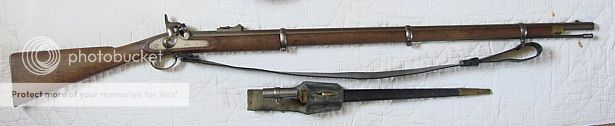
24 bore is .58 calibre, typical of many Enfields made for the American market. The Confederates did not stipulate that .577 was the regulation calibre until 1862. The federals stuck with .58. Ramrods, butt plates, bayonets, and bayonet frogs were all numbered together as a "stand" of arms. That followed British regulation. The bayonets and ramrods were not readily interchangeable and therefore all of the components were numbered together.
The Control number on the butt plate tang was the first clue…#1121.
It was only after communicating with Joe Bilby and later with Bill Adams that the situation became more clear.
Bill Adams’ comments.
The stock was scraped - the supplier's letter code is missing as well as the JS Anchor stamp (if it ever had
one).

Those P53's were all supplied by C. W. James and originally had a letter J in front of the butt plate tang and had a letter G stamped on the lock side of the butt stock.
Yes, there are numbered Enfields without the JS Anchor stamp; a number did not have JS Anchor stamps because they were state purchases. Most of the stamps were light and scraped away when refinished.
With crate #56 having been marked for Gov. Brown of Georgia and #58 having been marked G for Georgia, chances seem good that crate #57 that contained 1121 was also destined for Georgia.
The reason that I think that 1121 was a G purchase is because the stock has been scraped down enough for the G to have been removed along with the contractor's name that was originally on the belly of the stock and the supplier's code or the CH1 stamp that would have been in front of the butt plate tang. Even if there was no G present on the stock, the other markings would have been there and were scraped away.
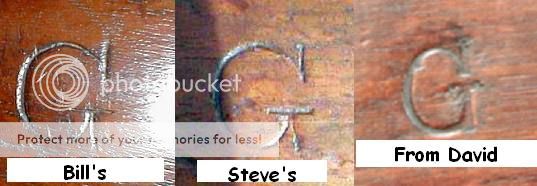
Yes, G is for Georgia. There are many variants of the G stamp that have been applied to Enfields in recent times. The large size G stamp often was light to begin with and cleaning, scraping, and sanding over the years removes the traces of the letter.
Examples of the 'G' for Georgia.
A sketch of the Fingal that brought the P.53 Enfields to Savannagh Georgia.

I may have posted this stuff before----sorry for that----I just learned more since then.
David
I have since learned a few things from Bill Adams an expert on Confederate P.53 Enfield rifle muskets.
P53 rifle musket –24 bore barrel marked .58 cal.
Lock plate dated 1861.
Control number 1121 on the butt plate tang.
Bill advises that some Enfields made for the US, in 24 bore, in the early part of the war, were actually bought by the Rebels, and that might explain the bore size.

Control number 1121 which will be referred to below.
Brit regulations specified that all arms were to have a number not to exceed four digits engraved "and in no instance stamped or punched" on the butt plate, the ramrod, the bayonet socket, the bayonet scabbard stud, and the waist belt.


24 bore is .58 calibre, typical of many Enfields made for the American market. The Confederates did not stipulate that .577 was the regulation calibre until 1862. The federals stuck with .58. Ramrods, butt plates, bayonets, and bayonet frogs were all numbered together as a "stand" of arms. That followed British regulation. The bayonets and ramrods were not readily interchangeable and therefore all of the components were numbered together.
The Control number on the butt plate tang was the first clue…#1121.
It was only after communicating with Joe Bilby and later with Bill Adams that the situation became more clear.
Bill Adams’ comments.
The stock was scraped - the supplier's letter code is missing as well as the JS Anchor stamp (if it ever had
one).

Those P53's were all supplied by C. W. James and originally had a letter J in front of the butt plate tang and had a letter G stamped on the lock side of the butt stock.
Yes, there are numbered Enfields without the JS Anchor stamp; a number did not have JS Anchor stamps because they were state purchases. Most of the stamps were light and scraped away when refinished.
With crate #56 having been marked for Gov. Brown of Georgia and #58 having been marked G for Georgia, chances seem good that crate #57 that contained 1121 was also destined for Georgia.
The reason that I think that 1121 was a G purchase is because the stock has been scraped down enough for the G to have been removed along with the contractor's name that was originally on the belly of the stock and the supplier's code or the CH1 stamp that would have been in front of the butt plate tang. Even if there was no G present on the stock, the other markings would have been there and were scraped away.
Yes, G is for Georgia. There are many variants of the G stamp that have been applied to Enfields in recent times. The large size G stamp often was light to begin with and cleaning, scraping, and sanding over the years removes the traces of the letter.
Examples of the 'G' for Georgia.

A sketch of the Fingal that brought the P.53 Enfields to Savannagh Georgia.

I may have posted this stuff before----sorry for that----I just learned more since then.
David
Last edited: