Sometimes we are surprised about the pieces that we trip over.

drm3m

CGN frequent flyer
Rating - 100%
13   0   0
Location
Montreal Quebec
On January 26 1994 when I purchased this P53 Enfield rifle musket I had no idea that it 'might have had' a CS history.

I have since learned a few things from Bill Adams an expert on Confederate P.53 Enfield rifle muskets.

P53 rifle musket –24 bore barrel marked .58 cal.

Lock plate dated 1861.

Control number 1121 on the butt plate tang.

Bill advises that some Enfields made for the US, in 24 bore, in the early part of the war, were actually bought by the Rebels, and that might explain the bore size.


Control number 1121 which will be referred to below.

Brit regulations specified that all arms were to have a number not to exceed four digits engraved "and in no instance stamped or punched" on the butt plate, the ramrod, the bayonet socket, the bayonet scabbard stud, and the waist belt.


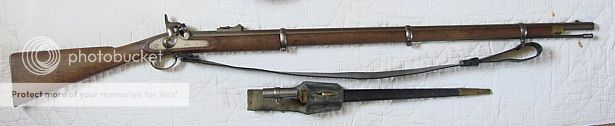


24 bore is .58 calibre, typical of many Enfields made for the American market. The Confederates did not stipulate that .577 was the regulation calibre until 1862. The federals stuck with .58. Ramrods, butt plates, bayonets, and bayonet frogs were all numbered together as a "stand" of arms. That followed British regulation. The bayonets and ramrods were not readily interchangeable and therefore all of the components were numbered together.

The Control number on the butt plate tang was the first clue…#1121.

It was only after communicating with Joe Bilby and later with Bill Adams that the situation became more clear.

Bill Adams’ comments.
The stock was scraped - the supplier's letter code is missing as well as the JS Anchor stamp (if it ever had
one).


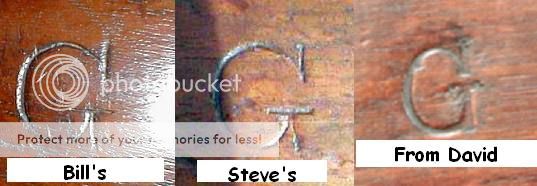
Those P53's were all supplied by C. W. James and originally had a letter J in front of the butt plate tang and had a letter G stamped on the lock side of the butt stock.

Yes, there are numbered Enfields without the JS Anchor stamp; a number did not have JS Anchor stamps because they were state purchases. Most of the stamps were light and scraped away when refinished.

With crate #56 having been marked for Gov. Brown of Georgia and #58 having been marked G for Georgia, chances seem good that crate #57 that contained 1121 was also destined for Georgia.

The reason that I think that 1121 was a G purchase is because the stock has been scraped down enough for the G to have been removed along with the contractor's name that was originally on the belly of the stock and the supplier's code or the CH1 stamp that would have been in front of the butt plate tang. Even if there was no G present on the stock, the other markings would have been there and were scraped away.

Yes, G is for Georgia. There are many variants of the G stamp that have been applied to Enfields in recent times. The large size G stamp often was light to begin with and cleaning, scraping, and sanding over the years removes the traces of the letter.

Examples of the 'G' for Georgia.


A sketch of the Fingal that brought the P.53 Enfields to Savannagh Georgia.


I may have posted this stuff before----sorry for that----I just learned more since then.

David
 
Last edited:
Great find and looks to be in very good shape. Did you mean that the Confederates wanted the .577 caliber? I read somewhere that a .575 minie ball was used for the .58's which is what I cast for the .577. They would have been easier to load for the .58 cal muskets as I find them a bit hard to start. Are you going to shoot it? Nice piece of history. Congrats.
 
lyman54.

I think what Bill Adams meant was "The Confederates did not stipulate that .577 was the regulation calibre until 1862."
The .577 cal. was marked 25 on the barrel instead of 24 for .58 cal.

I doubt that I will ever shoot this P.53 Enfield...but it is in the condition to do so.
I guess that I am more interested in its history.....as mysterious as it is.

David

The photos below show original .58 cal and .577 cal. cartridges.
The cartridge on the left is .577 cal. with the bullet at the bottom---the rest is .58 cal.----I think.

 
Last edited:
Oh, God!

Well done, Sir.

Thats why I love they old ones, sometimes we can make them talk a little!

Now you have my wheels turning.

I have a 1864 Tower, well used, but still shootable.

It has had about 1 inch nipped off the end of the barrel.

All I can find is the faint mark of the stock maker on the underside of they butt.

Also, no Anchor stamp that I can see.

I will have to pull the lock again and check the maker.

The .577 cal. was marked 25 on the barrel instead of 24 for .58 cal.

Mine is stamped 25.
 
Last edited:
If you can get one of those "black light" bulbs (I found one in a "Dollar" store), then you might be able to find some markings on the sanded stock wood. Stamp Collectors use these lights to find watermarks on stamps. ***CAUTION**** DO NOT LOOK AT THE LIGHT - PUT THE BULB INTO A SHADED HOLDER. IT CAN DAMAGE EYESIGHT ****
 
buffdog,

That is a good suggestion.

I think that this photo shows that some marking was on the stock.

Possibly part of a 'J' or 'S'-----certainly no anchor.


This is what it should look like.

JS stands for John Southgate, Major Edward Anderson (Caleb Huse's "boss") recorded in his dairy that Southgate had been retained as an inspector.


David
 
Last edited:
I consider myself very fortunate to have connected with Bill Adams regarding my P-53 Enfield.
The subject of Confederate P.53 Enfields is very complicated.

A comment from Craig L. Barry.

The person I consider the most knowledgable about the US Civil War Enfield is a professional researcher and arms collector named William O. Adams. Bill assisted with wrote the foreward to The Civil War Musket, and contributed quite a bit to An Introduction to Civil War Small Arms by Coates & Thomas. Many of the CS Richmonds shown in CS Armory: A History of the Confederate States Armory, Richmond VA by Paul Davies are from Adams collection, and so on. Adams chided me once for writing that he had 200 P-53s, a fact he dismissed as an understatement. Most of us have never even seen 200 Enfields at one time much less owned and had them in hand to compare. He told me he actually has owned over a thousand. Anyway, the point is Adams has some in his collection that are marked with rack numbers, and many that are not. While a thousand is a drop in the bucket compared to the total number imported here during the early-to-mid 1860s, it is still a statistically significant sample for purposes of making some general statements about rack markings.
-----------------------------------------------------------------------------

Bill seems to have a lot of respect for Steve Knott's book on Confederate Enfields.

Bill's comment.

You should order a copy of Steve Knott's book and study the photos of markings. The fakers are using the photos as a guide for their creations, but not enough collectors buy reference material to protect themselves.

All of the information in the various postings is in Steve Knott's book, but Steve did not have an agenda other than sharing information. He is not a dealer or an investor for profit and doesn't have a need to polish his ego or reputation.


Collectors nowadays need to approach collecting forensically, just as art collectors must be wary of counterfeits. Tool marks, letter fonts, and other things need to be measured and magnified.

-----------------------------------------------------------------------------

Some other comments by Bill in various emails.

As I mentioned in a previous email, crate 57 with Enfields #1121-1140 is missing from the manifest of arms ready to be shipped from London. Note that Tim's description contains "probabilities" and suppositions. 1121 may have been on the Fingal as 7520 Enfields were aboard the Fingal when it arrived in Savannah. The Georgia arms aboard the Fingal did not go to Georgia; they were sent to the Army of Tennessee. I may have records that list crate #57, but I don't have time to look for them at present.

I found my listings of the crates that were missing from the London manifests. All of the crates are there except for #57, which seems very strange. #58 had P53's #1141-1160; #59 had 1161-1180, etc. Crates 1-7 and 58-62 came from arms merchant Wm. Grazebrook on May 1st 1861 and were marked with the G cypher. With crate #56 having been marked for Gov. Brown of Georgia and #58 having been marked G for Georgia, chances seem good that crate #57 that contained 1121 was also destined for Georgia.

#1121.


The transaction is quite complicated, but there was an overlap of Georgia state funds and CS government funds in one of Maj. Anderson's large purchases. Anderson was the CS ordnance officer that was Caleb Huse's immediate supervisor, but he was also working for Gov. Brown of Georgia. Fortunately, Anderson kept a diary and he also recorded the first 2,000 of the Georgia purchases. Crate #57 having somehow been left off of the Georgia charts. Interestingly, there are two #58 crates, one listed as short rifles and the other listed as long Enfields, so there is a distinct possibility that the crate that should have been #57 was listed incorrectly. Crates #51-56 and #62-129 are on Anderson's main Georgia listing and crates 1-7 and 58-62 are on a supplemental list (these latter lists have not been published). Any other information causes me to invoke the Stonewall Jackson caution: a farmer asked Jackson which road he would be taking to cross a mountain; Jackson leaned over and asked the farmer if he could keep a secret; the farmer replied that he could; Jackson said, "So can I."
------------------------------------------------------------------------------------------

This has been an interesting ride with a very knowledgeable teacher.....Thanks to Bill!

One of the many photos that Bill sent me.


David
 
Last edited:
Some more comments from Bill Adams along with some of his photos.

Since the book came out with photos of various CS markings, the fakers have duplicated the markings and generated quite a few fakes. Any SC, Georgia or Louisiana Enfields must be viewed with suspicion.

You will save a lot of time by getting one of Steve's books that will give an overview of the whole process. Going on the internet and gathering opinions and theories will not necessarily produce valid information and the pieces pictured on the internet are not necessarily legitimate examples.

The reason that I think that 1121 was a G purchase is because the stock has been scraped down enough for the G to have been removed along with the contractor's name that was originally on the belly of the stock and the supplier's code or the CH1 stamp that would have been in front of the butt plate tang. Even if there was no G present on the stock, the other markings would have been there and were scraped away. There would also have been two other stamps in the wood indicating a commission broker and/or inspector or other information. None of the stamps are present on your stock.

CH1 stock marking not seen on the stock of my P-53.


Both SC and Georgia also had stamped numbers on the butt plates of some Enfields in certain number ranges. Some arms were state marked, but did not have state numbers; some arms were state marked with government numbers; many arms that went to states and the central government were not numbered. The lock dates must agree with certain numbers and stock markings. This isn't anything that can be easily condensed into a few pages or a ten minute study. States other than GA and SC used numbers.

Collectors do not study proof marks and are not aware that the British proof laws (and those of other countries) changed over the years and so did the proof marks; hence a crowned R proof on a Belgian made revolver indicates a piece made long after the 1860's. The British proof laws changed in 1868 and many of the "Civil War" Enfields in collections with locks dated 1861-1863 have 1868 or later proof marks on the barrels. The Barnett artillery carbines without bayonet lugs that seem to be unusually common and have Barnett Gunmakers London stamped in the stock have shortened and reworked surplus P53 barrels and post-1868 proof marks. That doesn't keep anyone from buying them as "Confederate."

-----------------------------------------------------------------------------

Some of Bill's photos.

Confederate revolvers.


Some rifles and other stuff.


Some stock markings.


Part of a collection that belongs to one of Bill's friends.


Bill in not just a Confederate arms collector----he is also a shooter along with Joe Bilby.

David
 
buffdog,

That is a good suggestion.

I think that this photo shows that some marking was on the stock.

Possibly part of a 'J' or 'S'-----certainly no anchor.


David

Odd, as I see an Anchor, with the bottom towards the brass plate in that pic. Looks to be an "S" stamped above it to the right.

You do not see that?

I comment because I looked at the picture and saw it, before reading the comment that there was not one there. Huh?

Cheers
Trev
 
Trevj.

I took many photos trying to capture any markings on the stock----I could never see the 'Anchor'.
Perhaps the faint remains of a 'J' and an 'S'.
Note in the photos below the position of the 'Anchor' relative to the trigger guard brass plate.

Someone also suggested gently using a lead pencil with light weight white paper ---the thought being that whatever indented markings on the wood ---would show up white?????

There was a time that I scoured the Internet looking for the JS/Anchor stamp on P-53 Enfied stocks.
Most of the photos below came from dealers web sites.


David
 
Last edited:
Odd, as I see an Anchor, with the bottom towards the brass plate in that pic.

I see the same as trevj, yes, the bottom of the anchor seems to be facing the butt plate.

Also a partial letter above it???

Most times, I cant see the trees because of the forest in front of them.
 
Last edited:
cigar_man,

Trev said-----Odd, as I see an Anchor, with the bottom towards the brass plate in that pic. Looks to be an "S" stamped above it to the right.

You said-----I see the same as Trevj, yes, the bottom of the anchor seems to be facing the butt plate.

All of the photos that I have found show the bottom of the 'Anchor' facing as shown in the dealer photo below.
It is facing toward the rear of the gun toward the underside of the butt plate.

The butt plate tang.


The bottom of the 'Anchor' is not facing the brass trigger guard plate.


This is the underside of my gun. (I just took these last two photos)


This is a photo of where the JS/Anchor should be with the bottom part of the 'Anchor' facing the butt plate not the trigger guard plate.


The subject of Confederate arms is a bit of a ‘wild’ target in the U.S.
Lots of faking…..you really have to know what you are doing as the prices for CS stuff is hefty.
The interesting part of this P-53 Enfield ----if in fact it has a CS history--- is that it was found in Canada.

Thanks for your interest in this subject.

David
 
Last edited:
Stockmarkingnew_zps16fe46e0.jpg


Large circle - anchor
small circle - part of a letter

Very hard to see on my laptop, when I'm on my Imac, I can see the anchor as plain as day.

Very interesting to say the least.


My 1864 only has a partial makers name on the bottom just before the butt plate.
 
Last edited:
Trevj.

I took many photos trying to capture any markings on the stock----I could never see the 'Anchor'.
Perhaps the faint remains of a 'J' and an 'S'.
Note in the photos below the position of the 'Anchor' relative to the trigger guard brass plate.

Yeah, wrong way around to what it should be, if the marks I am seeing are markings at all, just...??? This presumes that the picture I quoted earlier was the trigger guard to the left side of the picture. It seemed to me that the anchor was bottom towards the brass, and that the letter seemed in the right place comparatively, for it to have been an S.

Just the right collection of handling marks and safe 'kisses'. eh? (I see that cigar_man has done what I was considering, which was to mark out the marks on the photo, and reposted it)

Dunno if finding such in Canada should be considered odd or not, as there would have been a lot of this sort of gun sold by mail order, at a time before there was a whole lot of hard factual and researched knowledge about some of the minutiae.

Cheers
Trev
 
I am always surprised about some of the U.S. Civil War guns that I have found in my immediate vacinity....
how they got here----I have no idea......mail order perhaps?
----------------------------------------------------------
Some other comments from Bill Adams.

Bill these observations were made a long time ago.
I only had this gun apart just after I purchased it in 1994.

Inside the lock of this P-53 Enfield -E.C & W.C,-- back of hammer E 8, 8 also on lock plate behind hammer.
Under barrel, J. R.Cooper also E.C (over) J.H. and another J.H.
-74 on breech plug and breech --- under barrel inside barrel groove in stock just behind spoon spring-XX
------------------------------------------------------------------------------------

Bill’s response;

Regarding the stamp on the bottom of the barrel, J. R, Cooper was Joseph Rock Cooper, a gun and pistol manufacturer. At some point, Charles Henry Cooper also became involved in the operation and the company became known as Cooper and Goodman. I don't recall the full name for Goodman. Cooper & Goodman were also barrel makers. There are P53 Enfields marked Cooper & Goodman in the belly of the stocks. The firm was a large operation in the late 1850's and continued in operation for decades producing a variety of firearms.

Many of the Enfield suppliers purchased barrels and locks from the "trade" makers. Many of the individual components have the names or initials of the suppliers found on the ramrods, rear sights, bands, etc. The typical grade 2 hand made/fitted "Enfield" was an assemblage of parts.

I cannot find a firm or partnership name for the E.C & W.C mark inside the lock. There was an Edward Cooper, but there were several parts makers with the initials E. C. and W. C. that included an Edw. Corbett and a William Corbett.

Initials under a barrel could designate the viewer, the filer, the rifler, or the general assemblyman who fitted everything together. That would depend on the practices of the individual shop or company. The #74 would normally be the number in a particular series of barrels. The barrel and breech plug were numbered to each other because the plugs were fitted to each barrel and not interchangeable.
-------------------------------------------------------------------------

Interesting stuff!

David

P.S.

cigar-man;

Can you send me an image that shows the 'Anchor' from your Imac----I am really very curious!
 
Last edited:
My bayonets-scabbards and frogs for CW P-53 Enfields.--- comments From Bill.


The bayonet pictured on the Enfield in one of your emails (from the posting?) is a P58 interchangeable bayonet from Enfield and would not have been used on a Civil War Enfield. It is likely a Snider bayonet. The sling on the P53 is a later pattern sling. The correct sling would have an adjusting buckle and would not be fastened with a thong. Correct P53 slings are quite rare.

The photo below is my bayonet.


The scabbards appear to be correct. They appear to be the 1860 style scabbards. The only way to tell for sure is to look inside the frogs - the later scabbards have three or four rivets in a triangle or diamond just above the mounting stud. The frogs normally have unit marks or dates on the backs. The upper scabbard without a bayonet has Canadian unit markings on the stud. The bayonet has an Enfield inspector's stamp and was made for either an RSAM Enfield or a Snider. Here's the back of a frog and a view showing the style of fuller found on most of the P53 bayonets that were imported by either side.

Bill's photo.


Why not keep both frogs? They don't eat anything and both were correct. RSAM Enfield was the Royal Small Arms Manufactory at Enfield, sometimes called the Royal Small Arms Factory. It was against English law for current issue Enfield production arms and accessories to be sold. No current issue/model Enfield products were used in the American Civil War. The few arms marked Enfield that were used in America were obsolete arms such as the Brunswick rifle, which was not in the current regulation calibre and also had surpassed its twelve year service life. RSAM Enfield and the London Armoury Company were the only two manufacturers of Grade 1 fully interchangeable machine made percussion "Enfields." BSAT (Birmingham Small Arms Trade) allegedly began producing Grade 1 arms, but it seems that only some components were fully machine made and/or interchangeable.

David
 
Last edited:
cigar-man;

Can you send me an image that shows the 'Anchor' from your Imac----I am really very curious!

The image above that I posted with the red circles is the image.

I will try and crop the area and post it for you.

I mentioned this situation above using different monitors to look at digital pictures.

A friend that works in forensics at a local Regional Police Force by me here in Ontario said their go to p/c for this is a iMac,,Huh!

On my ASUS laptop, I can barely make the anchor out.
 
Back
Top Bottom