Old brass questions

1899

CGN Ultra frequent flyer
Rating - 100%
39   0   0
Location
West
What are your views about old brass +25-30 years old, that has never been used? Would you want/need to anneal them before use?

One reason I ask is because I had some of my old handloads that used to be fine back in the day but seem to be splitting necks now (heavily compressed loads), and I even found some old factory Federal Premium Safari in .338 WM and the neck split on the one I fired. That ammo was close to 30 years old too.
 
You can never go wrong on annealing.
Brass can get hard with age, no doubt. I have seen cracked necks on old factory loads.
They tell us it is the tension on the necks that harden the brass, so a case sitting empty for a long time may not have hardened, but by the same token, it may have hardened some, so annealing wold make it like new brass and couldn't hurt anything.
Bruce
 
You can never go wrong on annealing.
Brass can get hard with age, no doubt. I have seen cracked necks on old factory loads.
They tell us it is the tension on the necks that harden the brass, so a case sitting empty for a long time may not have hardened, but by the same token, it may have hardened some, so annealing wold make it like new brass and couldn't hurt anything.
Bruce

Thanks. What about the head area of the brass? I know it doesn't get worked as much, but there is still some brass flow and clearly we can't anneal that low. Would you be concerned about case head separation?
 
Thanks. What about the head area of the brass? I know it doesn't get worked as much, but there is still some brass flow and clearly we can't anneal that low. Would you be concerned about case head separation?

No, I wouldn't be concerned at all.
I have both Norma and CIL Dominion fired brass in 270 and 30-06, that have been in my drawer as fired brass from my rifles, for up to fifty years. A very few years ago I loaded and fired some and they showed no sign of any abnormalities.
Since you brought the subject up and out of pure curiosity, I think I will load up some fifty year old fired empties in 30-06, without any special preparation, and see how they behave!
 
Let me get a pic of some old CIL cases I received recently

It was heavily tarnished, ran it through the cleaner twice so I could see what was happening

IMG_20141011_163015_zps5e9a3b31.jpg


IMG_20141011_162935_zpsfdd6ec74.jpg
 
Last edited:
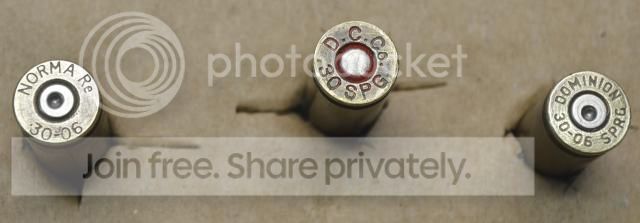
Here is a picture of three cases I will load and shoot.
Note the Norma case has the letters, "Re" on it. This was on the old Norma cases and we took it to mean they were reloadable.
The Dominion on the right is a head stamp of about the early, or mid 1960s.
The Dominion in the centre, marked D.C.Co. is the oldest CIL head stamp and I think it dates to pre WW2, and this one has a story behind it. Shortly after WW2 Fred Barnes renewed his custom bullet making and made 30 calibre bullets with regular copper tubing as jackets. This made a very solid bullet that really hung together and penetrated on game. I had a brother that bought a batch of the Barnes bullets in 200 grain and had a friend load them for him. The friend said he used 4350 powder and loaded them pretty hot, so he painted the primers red, to indicate this. Red can be seen around the primer in the centre cartridge.
I ended up with some of these loadings and some years ago I wondered what the load in them had been, so I pulled the bullet from this one and weighed the powder. Thus, the case in the centre was a loaded but not fired cartridge, with the bullet and powder now removed. So the case had been loaded from about 1948 until maybe in the 1990s, when I pulled the bullet.
A bullet still fits the neck like a newly sized case and the empty goes into the chamber on my rifle. So I will just put about 58 grains of 4350 in the case, put a 180 grain bullet in it and fire it, then I will show pictures of the fired cases when they are done.
Bruce
 
I fired them and all was pretty normal.
The Norma on the right (second picture) that has a shiny ring which was there before I shot it. It showed up after I sized it, prior to loading.
The old one with the red primer I didn't do any sizing to. The bullet seemed to seat at normal pressure. In the picture it looks like a ring on it, also, but it is barely visible when looking at the case, and not the picture.
One thing I notice is that the primer in red, which was seated in the case about 1948, must have been much harder than the new Federal primers I put in the other two, as all three had the same load and it didn't flatten near as much.


So, judging by this, I wouldn't have much fear of your "old" cases, which by comparison, are pretty young!
,
 
Thanks Bruce, that was a very good read.

Yomomma - that looks like some sort of corrosive material got onto the brass. I've never seen anything like it.
 
Was you brass stored in the same room as chemicals during those years? Ammonia or other types of household cleaners perhaps? Chemicals can have an adverse effect upon both the brass and loaded ammunition.

The brass may appear to be clean but micro cracks may have formed.

Time alone will not do much to deteriorate ammo if it is stored well - I fired twenty five .303 British today. Headstamps were all "1944 DI Z" - no cracks or other problems. I have already cleaned them for reloading...
 
I had some old Czech 9.3x74r that was split in the original packaging. There was about a third of the cases with a vertical split from the neck. I annealed all the brass that survived the first firing and they've all been good to go on the second firing. Not exactly a long term study, but i hope it helps.
 
That case is from a lot of once fired brass I received. There were a few others like it.

My only guess would be that they were the 3-4 rounds the previous owner always took hunting and that through going from hot to cold repeatedly that some moisture got inside.

Theory only...

Never seen anything like that, especialy from a 30-30. Took all the other tarnished brass with same head stamp and tossed them to be safe
 
Back
Top Bottom
































































