What do you guys think happened here? (30-06 reload)

H335 should be safe to 47gr, and I think Tightgroup would have written a different ending.
Barrel obstruction? Obstruction will be hard to prove.
Did he buy the powder new, sealed?

Had he used IMR instead of H, it still doesn't explain anything. I believe he'd have been under min, but not drastically.

Where did the bullet go, any idea?

He did buy the powder new, was sealed. He was shooting at target that was 50 yards away, not sure where the bullet went.
 
When I reload, there is only one can of powder on my bench and it go back in the safe after empty the mesure and trickler, before I even think to take another powder.

One I was loading with H1000 and accidently dump the mesure in the IMR4350 can. A mistakes li that, if you dont see it may lead to a DARWIN AWARD.

I will used it as fire starter at my camp

Anyone can do mistakes at realoding. But be extremly attentive and when you are lucky enough to find one out before pull the trigger, then its time to start all over.
 
Holy Moly. I seriously think he should be thanking his lucky stars. By the looks of that, one more kernel of powder might have taken his hand and eyes out. Serious case stretch there. I bet that round pumped 100k of pressure. How the rifle held together is beyond me. BUY A LOTTERY TICKET. SERIOUSLY.
OH Yeah, make sure he pulls all the bullets , and weighs not only the powder , but the bullets too. Inquire about what kind of components he has available to him. Did he use a fast powder by mistake with a magnum primer, or whatever. This is my biggest reloading pet peeve that the powder makers can label so many dangerous powders with similar names. FFS, there are only 250 or so kinds of powder. How hard can it be to give each one a unique name that is less confusing to mistake. Kind of like when Ottawa named their team Roughriders after Sask. already had it. FFS, there is only 6 or 7 teams, yet they still couldn't find a name??? Idiocy abounds. Also , tell your friend to make sure he removes any distractions to the reloading process such as wives, kids, phones etc. Too easy to lose where you are in the assembly line and double charge something.
 
I think there is definitely more to this than I'm about to suggest, but it is CRUCIAL to calibrate any scale before using it. To hear that the scale was not checked against any known weight is a huge boo-boo, IMHO.

Digital scales can be extremely sensitive to changes in temp and even a breeze going through a room. If the scale hasn't been properly calibrated in the first place, then changing environmental conditions can only amplify any already present errors.

Again, I think there's more to the story than an outta whack scale, but this should really be checked as a possible link in the chain leading up to this near disaster.
 
Was that first shot also the first round that was loaded after changing over from reloading Titegroup. Perhaps the hopper tube had say 20gn of Titegroup, add 25gn of H4895 and voila, mega pressure. If this is the case the rest of the reload will be H4895.

It is amazing how much powder can sit on the bottom of the hopper/tube.

18.5gn of Titegroup makes a huge fireball in my S&W 500. Expect 45gn TG in 30-06 would blow up.
Possibly since he is new to loading, he didn't empty the hopper drop tube after whatever he was loading before the 30'06.
335 & Titegroup don't look like H4895, he needs to pull the bullets and figure out what he did wrong.
 
I have a Lyman electrpnic scale that has to be zero'd EVERY time. If I don't it reads about 12% low.

I use it to weigh bullets now, and use an RCBS 505 for powder- maybe time to invest in a beam scale?
 
Sorry- said zeroed, meant calibrated. Coffee is kicking in now. Another good tip with electronic scales is to switch them on an hour or so before you start loading. They tend to be more consistent once they've acclimatised to their surroundings.
 
Was that first shot also the first round that was loaded after changing over from reloading Titegroup. Perhaps the hopper tube had say 20gn of Titegroup, add 25gn of H4895 and voila, mega pressure. If this is the case the rest of the reload will be H4895.

It is amazing how much powder can sit on the bottom of the hopper/tube.

18.5gn of Titegroup makes a huge fireball in my S&W 500. Expect 45gn TG in 30-06 would blow up.

This seems the most likely scenario if the first round loaded was the one shot that was fired. I wouldn't be surprised if every one of the other 99 showed 45 grs of H4895. A barrel obstruction would have behaved differently - you'd typically see a blown or at least a "ringed" barrel as well. At the end of the day, there might never be proof of what happened.

Good comments about the rifle too. They're overbuilt, but it would be a good idea to check it out and not assume it wasn't affected by this single high pressure incident.
 
Was it a decent electronic scale or a cheap one? Did he zero it with the powder pan on it or was he doing math with his charges?
 
This past weekend we were at the range and a friend of mine was shooting some 30-06 reloads. His first shot the bolt was jammed in the rifle and he had smoke coming out all over the place.
He actually used a block of wood to beat the bolt back out. After that he didn't use anymore of his reloads, but did shoot some factory stuff.
So his load was supposed to be 45 grains of H4895 with a 168 grain Sierra match king.
Shooting out of a Model 70.
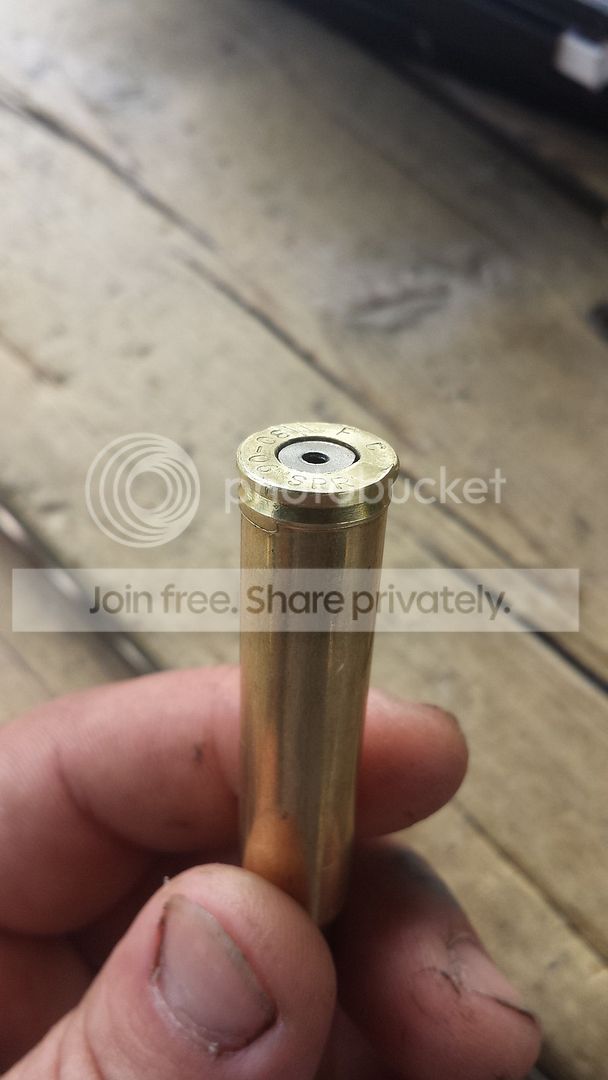
20150808_160933.jpg


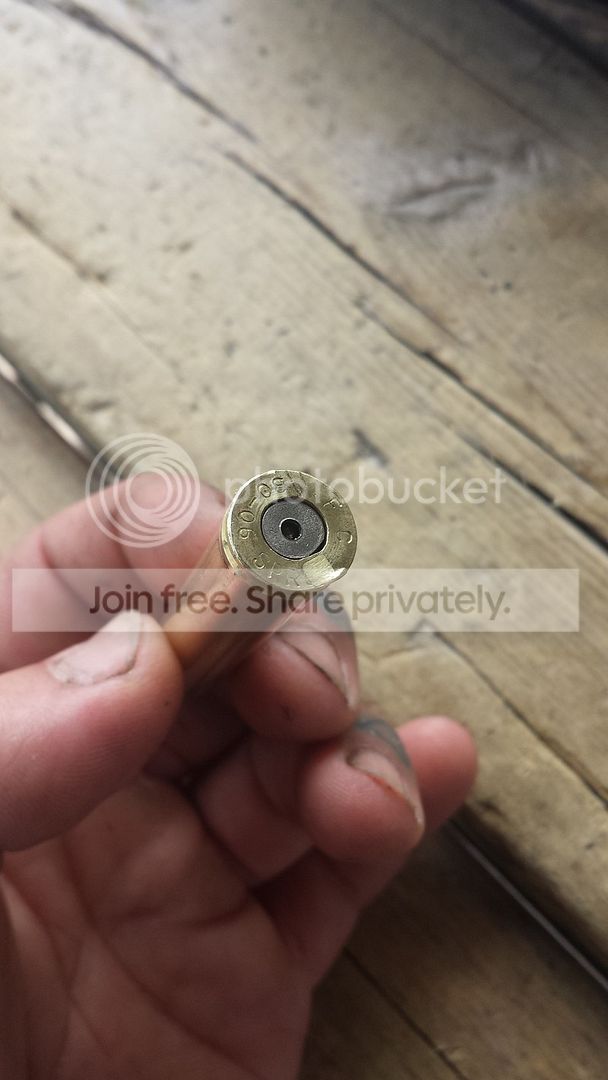
20150808_160944.jpg

The primer pocket had stretched out so much the the primer was actually loose and moving around.
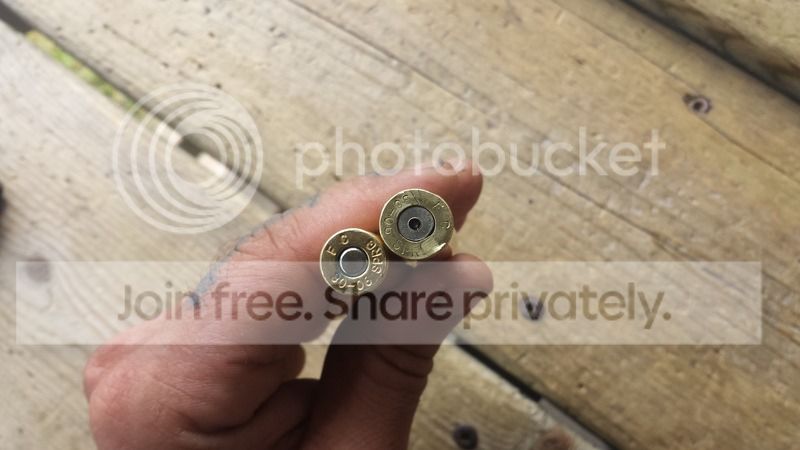
20150808_161003.jpg

Here's a comparison photo.

Your load was SUPPOSED to have 45gr/H4895, which tells me you don't know what the charge was.

You have a pierced primer, flattened primer, bolt face tattoo on the case.

Pull any and all remaining loads apart and start again.

Remember that you only want the powder you are using on the bench.
 
Case might be too long for the chamber. Measure that case and some others to check. Once fired in a loose military rifle is a case growing concern.
 
Possibly since he is new to loading, he didn't empty the hopper drop tube after whatever he was loading before the 30'06.
335 & Titegroup don't look like H4895, he needs to pull the bullets and figure out what he did wrong.

Good guess! - makes total sense.
I would suggest buddy stop loading and start reading - the above shouldn't happen, and if it was the above, rookie mistake/extreme carelessness - he is so lucky he didn't have a catastrophe.
 
Case might be too long for the chamber. Measure that case and some others to check. Once fired in a loose military rifle is a case growing concern.

If the case was stretched from firing it in an oversized chamber, he would not have gotten the bolt closed.Even if he did, a stretched case would not cause this issue. On the other hand if the case had been fired many times, and never been trimmed, forcing the bolt closed could put a lot of extra pressure on the bullet, which would cause higher than normal pressures. However, even that wouldn't likely case this much of an overpressure situation.
 
Was that first shot also the first round that was loaded after changing over from reloading Titegroup. Perhaps the hopper tube had say 20gn of Titegroup, add 25gn of H4895 and voila, mega pressure. If this is the case the rest of the reload will be H4895.

It is amazing how much powder can sit on the bottom of the hopper/tube.

18.5gn of Titegroup makes a huge fireball in my S&W 500. Expect 45gn TG in 30-06 would blow up.

I agree that this is the most likely explanation. I always make sure both the hopper and the rotor are completely empty when I tidy things away after loading. With the price of powder I can't afford to throw any away!
 
For those of you throwing out pressure guesses in the 90-100,000 psi range, I have to say I don't think so!!!!
First off this is FC brass, and although it is quite badly deformed from pressure I have seen FC brass do this, when a W-W case with the same load had a slightly flattened primer and a touch of ejector mark with only a slight resistance on the bolt lift. I would say given my experience with FC brass this case probably saw not more than 70-75,000 PSI, at 90-100,000 PSI you DO NOT get the bolt open, I don't care who's brass it is. Secondly, with as much brass flow as is evident, he did not set his lugs, or he would not have got the bolt open either, he would have had to remove the barrel. Even a .002-.003" lug set and you do not open the bolt.
Don't get me wrong, I'm not saying there is not a problem here which needs to be addressed..........I'm just saying let's not go over board with the "OH MY GOD, YOU'RE SO LUCKY TO HAVE SURVIVED THIS" and "IT HAD TO HAVE BEEN GENERATING 90-100,000 PSI"
I have seen many cases that looked like this, mine and other peoples, and I also have to say that probably more than 1/2 the cases I have seen do this have been FC brass.
I was trying to make some 25-06 from FC 270 cases and found in my test loads (which are all individually weighed and funneled into the cases, and no I didn't forget to trim to 25-06 length) that I had 3 of the same load that were warm but still good and then #4 smoked the primer, no good reason, no mistakes.........So when I had finished sizing, cleaning and prepping this batch of cases I started weighing them, in 40 (well 39 actually) cases I had weight variations exceeding 30 grains, and the case with the blown primer was one of the extra heavies, of course. Solved the problem, threw the lot in the scrap brass bucket and bought 200 W-W off a CGNr

Just as an aside, the 39 FC 270 Win cases were once fired range pick up brass that were from 2 factory boxes from the same lot.........the boxes were there on the ground as well.
 
Last edited:
I think this link was posted here some time back, but its a good read and c-fbmi is correct about some cases being soft. Our American Military Lake City .223/5.56 ammunition has the hardest brass in the base of the case than "ANY" commercially made .223 case. Meaning it is very high quality brass and great for reloading.

Simple Trick for Monitoring Pressure of Your Rifle Reloads
http://www.hodgdonreloading.com/reloading-education/tips-and-tricks/simple-trick-monitoring-pressure-your-rifle-reloads

Below, enlarged primer pocket, brass flow into the ejector and brass flow in the unsupported area of the base of the case. Which is WAY over the amount explained in the above link.

brass%20flow_zps0pbcy3kb.jpg


In the exaggerated example below the base expansion is what is measured and explained at the Hodgdon's link above.

base%20expanshion_zpss3c0gjcm.png
 
Could be 55gr instead of 45gr of powder...there is plenty of room for it.

I filled a Lapua case to the base of the neck with H4895 for fun and it came in at 57 grains. Sure that's not a Federal, but there is plenty of room in any case for an over charge of H4895.

A few possibilities are loading 55 instead of 45 grains, powder bridging in the funnel or powder measure. Easy to do and an inexperienced reloader might not catch it. Mixing up H4895 and H335 isn't going to cause a problem, the charges are too similar and surely anyone can tell the difference between a stick powder and a ball powder? 45 grains of tight group and there probably wouldn't be a gun left. A bit of Tight Group being left in the measure would do it. A gob of cleaning media stuck in the case reduce the internal capacity enough to put pressures over the top. I've caught plenty of those by comparing the height of the powder in the whole block with a flashlight. Sometimes it can be caked in so hard it needs to be scraped out. Pistol powder can be dumped out of a measure into the wrong can too.

First order of business is to pull down all the remaining rounds. I'll bet that if they aren't all over weight then theres a light one in there.
 
45 grains of H4895 isn't terribly hot. Close to max(47.5) though, so it's possible the guy overloaded the case. Serious operator failure.
 
Back
Top Bottom































































