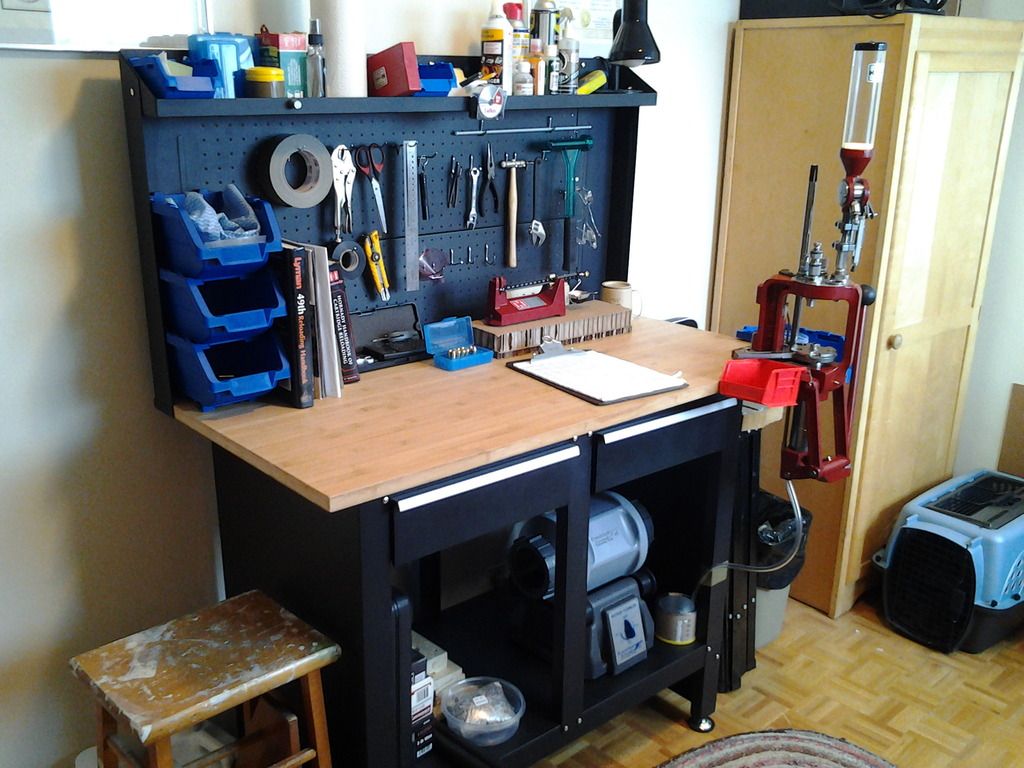
I think Im set....

jon1985

CGN Regular
Rating - 100%
25   0   0
So I have spent the last little while researching reloading equipment and supplies and I think Im ready to start buying. I will be reloading mainly 9mm, some 357mag, and eventually .223.

I have settled on a Hornady LnL AP press. Ive watched several Youtube videos and they seems good. Very simple to change calibers, the option to add a bullet and case feeder later if I decide I need to and great warranty.

As for dies, they are the only thing I havent decided on yet. Hornady, LEE, RCBS, Dillon...to many choices and everyone has good and bad reviews. I may have to go into a store and handle them to see if I can see/feel a difference.

Scale, bullet puller, primer flip tray, I will probably pick up from who ever I buy the rest of the equipment from, saves some shipping.

Calipers, I will make a trip to CT.

As for components, this is where Im at so far
CCI small pistol primers
Hodgdon Titegroup powder
campro 9mm 147g

I am already borrowing 3 reloading manuals from my BIL and Hodgdon has a great reference online that covers all their powders for each caliber so I think Im set there.

now to start buying.....
 
Save yourself the heartache and buy a real set of calipers and not a set from Canadian tire.

mine work perfectly fine for reloading but i wouldn't use them as a hobby machinist though.

Jon, i would wait until the calipers go on sale, usually $15.
 
Many people say not to start on a progressive for your first press. I would says it's more dependant on the person, some people will be fine starting out on one as long as you take it slow and pay close attention.
Also some people say not start out loading 9mm with heavy bullets and very fast powder as pressure can spike quickly. Again just pay close attention.

Once you get rolling the AP will be great.
As for the dies, it doesn't really matter. The lee ones work just fine for me
 
Ive heard its better to start on a single stage or turret press, but I dont have the space to have 2 presses, as nice as it would be, and its unrealistic to reload 9mm on a single stage press. I would get frustrated and give up long before any investment was paid off.

I have watched a full series of videos put out by Hornady about setting up and using the AP press. I understand the numbers that go into reloading, powder load, OAL, bullet weight, velocity and what not. I plan to start with 10-20 round batches starting just above the minimum load and increasing the slightly better then half way. Ill see how they work regarding cycling my pistol, aswell as meeting power factor. If they dont make power factor or cycle the action, I will add a little more powder.

I have heard CZ shadows can be picky with OAL so I have talked to a few other shadow shooters at my range and have the ranges of lengths they use, aswell as the factory ammo I am using now that works fine to base my starting loads off of.

I don't plan to crank out 500 rounds the first night it shows up.

All that said, Im excited to get started.
 
Jon, we've basically have the same exact setup for the same calibers, an I did exactly like you, starter straight with the LnL progressive. No regrets, either. :)

20160307_151020_zpspjagkv4b.jpg


I went with Hornady for the dies, simply because they were nearest at hand on the shelves when I was buying. Picking one brand over another is a bit like picking one brand of pickup truck over another: all of the main brands (Lee, Hornady, RCBS, etc..) will do the job perfectly fine, else they'd have either gone out of business long since or else gotten an uniform bad rep known all over.


You didn't mention some more equipment you might need, in particular for case preparation:

Tumbler? I recommend wet stainless steel pin method: it's relatively quieter, makes no dust, the media lasts forever and the results are excellent.

Case prep: for the narrow necked rifle cartridges, you'll need to trim, chamfer and deburr the cases. There's all sorts of tools for that going from manual hand-held tools to powered multi-tool stations, it's all about how much you're willing to spend for convenience.


Various small tools and accessories:

A go/no go chamber gauge for .223? Might be practical to check your finished product for dimensions.

Case lubrication pad? Some people swear by wax and fingers, I like to roll my cases on a pad in the morning. ;)

Small powder funnel to fill individual cases, and a larger kitchen-type funnel to empty the powder back from the thrower into the powder container after use.

Magnifying glass (depending on your eyes, I find it practical to examine the case crimping and primer seating once in a while).

Canned air (to clean the press after the inevitable time where you'll forget to seat a primer in the case before filling it with powder and see precious grains trickling everywhere).

Freezer Ziplock bags for the dirty brass, and Tupperware-type containers (salad-bowl size to soup-bowl size) to store sorted/cleaned brass.

Beer bottle holder for those long and pleasant reloading sessions. ;)
 
Any suggestion on brand?

I have a Mastercraft one from Canadian Tire, and I take it to our gauge inspection department at work, it passes fine. However, if you want something that's professional, Mitutoyo or Starrett are the way to go. But you'll be spending $100's instead of $15
 
Jon, we've basically have the same exact setup for the same calibers, an I did exactly like you, starter straight with the LnL progressive. No regrets, either. :)

20160307_151020_zpspjagkv4b.jpg


I went with Hornady for the dies, simply because they were nearest at hand on the shelves when I was buying. Picking one brand over another is a bit like picking one brand of pickup truck over another: all of the main brands (Lee, Hornady, RCBS, etc..) will do the job perfectly fine, else they'd have either gone out of business long since or else gotten an uniform bad rep known all over.


You didn't mention some more equipment you might need, in particular for case preparation:

Tumbler? I recommend wet stainless steel pin method: it's relatively quieter, makes no dust, the media lasts forever and the results are excellent.

Case prep: for the narrow necked rifle cartridges, you'll need to trim, chamfer and deburr the cases. There's all sorts of tools for that going from manual hand-held tools to powered multi-tool stations, it's all about how much you're willing to spend for convenience.


Various small tools and accessories:

A go/no go chamber gauge for .223? Might be practical to check your finished product for dimensions.

Case lubrication pad? Some people swear by wax and fingers, I like to roll my cases on a pad in the morning. ;)

Small powder funnel to fill individual cases, and a larger kitchen-type funnel to empty the powder back from the thrower into the powder container after use.

Magnifying glass (depending on your eyes, I find it practical to examine the case crimping and primer seating once in a while).

Canned air (to clean the press after the inevitable time where you'll forget to seat a primer in the case before filling it with powder and see precious grains trickling everywhere).

Freezer Ziplock bags for the dirty brass, and Tupperware-type containers (salad-bowl size to soup-bowl size) to store sorted/cleaned brass.

Beer bottle holder for those long and pleasant reloading sessions. ;)


I should have been a bit more specific. I have a friend who already uses a stainless tumbler who is going to clean my brass for me. As for the tools to prep rifle brass, I will slowly build those up between now and when I start reloading rifle.

To be 100% honest I wasn't planning to start reloading anything until the fall so I had the winter to build up a cache of ammo, I didnt realize I was going to shoot 300 rounds every time Im out and Im out atleast once a week hopefully twice.
 
I really woundn't wait. ;)

The reason is that for every caliber there there's several options of bullet types and weight you can use, and for each of those there's several brands and model of powder you could use, and for each of those there's a range of charge weight from min charge to max charge, and that's just if you keep the Cartridge Overall Length the same as what the powder manufacturer's did when testing their load data. Not to mention using different brass and/or primers.

Winter reloading is fine, no mistake about it... when you've perfected your preferential load and you're stocking up for the next shooting season. Until you do, though, you'll likely want to experiment and try to find out which case/primer/bullet/powder/charge/COL gives real good results for your particular firearm, and that means making LOTS of small batches (say, 25 rounds), shooting them, seeing the results and using the feedback from that to try more small, incremental changes.

I thought I'd be set with just making one batch of each case/primer/bullet/powder/charge/COL combo... until I realized that from one day to the next I might get different results for the same batch of ammo, depending on weather, tiredness, small changes in the shooting position, etc...

In the end, it just gave me more excuse to shoot more... must test new recipe... must confirm old recipe... and the standby, "Today WE PLINK!" :d


(Caveat: It's a pet project of mine to see how accurate I can make the 9x19mm Luger when I shoot it out of a 19-3/4" barrel. And I shoot the .357Mag out of a lever action rifle, too: I have no handguns. So I treat those pistol calibers the same as other treat their long range hunting calibers. If that's not true for you, just ignore everything I said above, lol! Just grab a recipe and load batches. :) )
 
I will be reloading the vast majority of 9mm for my Shadow (pistol) but I also have a JR carbine in 9mm that I may adjust a load for. When I get into reloading 357mag it will be for lever action rifle aswell.
 
I have or have had dies from Lee, Hornady, RCBS, Lyman, Redding, Bair, and C-H.
The thing I don't like with Lee and Hornady is the decapper is one piece. This only really effects me when I want to do Berdan rifle cases.
Overall I'd say I like RCBS the best, but again that's just me.
 
Some suggesttions.

For pistol and 223, buy carbide dies.

For pistol calibers, buy the Lee carbide sets that include the Factory Crimp die. Or buy the Factory Crimp separately. This die also sizes the exterior of the loaded round and smooths out any bumps that would otherwise jam the gun.

I like Lee dies because the decapper rod is almost unbreakable.

I have a dial caliper and an electronic. I much prefer the dial. faster and easier to use.
 
Don't forget about a base to ogive comparator for rifle calibers. If you are not measuring cartridge length that way it won't make any difference what kind of caliper you use. And for what it is worth my CT calipers are just as good as my Starret for reloading purposes. Calibration on gauge blocks proves it every time. But I agree with the other poster that for real machine work I would not use the CT.
 
Back
Top Bottom