












































You are using an out of date browser. It may not display this or other websites correctly.
You should upgrade or use an alternative browser.
You should upgrade or use an alternative browser.
Reloading .40 s&w
- Thread starter RTF2
- Start date


Any pistol can cause "Glock bulge" and any minor bulging is OK and can be fixed with any tool like the Lee bulge buster.
Below is a extreme example and a case bulge you do not want to reload.

The problem with extreme bulging is the case has been stretched beyond its elastic limits and the case will crack when resized or run through a bulge buster.
Below a resized case like above that cracked at the extreme bulge area of the bulge.

I use range pickup brass in my hand guns and rifles, I inspect each case carefully and only use them with reduced practice loads and I have never had a single problem. And when I say range pickup brass I do not mean any case and I have high standards when picking up brass at the range.
Below is a extreme example and a case bulge you do not want to reload.
The problem with extreme bulging is the case has been stretched beyond its elastic limits and the case will crack when resized or run through a bulge buster.
Below a resized case like above that cracked at the extreme bulge area of the bulge.
I use range pickup brass in my hand guns and rifles, I inspect each case carefully and only use them with reduced practice loads and I have never had a single problem. And when I say range pickup brass I do not mean any case and I have high standards when picking up brass at the range.
Lower than book powder charges can also lead to squib loads. If you don't notice the squib, the next shot could be very bad.
What you say is true with some powders "BUT" there are powders that can be reduced lower than that published in reloading manuals. And you will find them when looking for minor and major loads used in competition.
As a example the Speer manual lists a 5.8 grain load of 231 as minimum with their 165 TMJ plated bullet, but I have used loads as low as 3.6 grains of 231 in my Glock .40
I've been doing some research, I'm thinking (once reloading equipment is payed off) I can reload .40 S&W for about .20 a round, which puts me at about 10$ a box. What I'm thinking of doing is buying a Lee Classic turret press, and the following materials:
Brass, once fired. I've been saving my brass since the start.
Titegroup 1lb of powder
CAMPRO 1000/bx - 10mm/.40 FCP TC 165 gr. .400 diameter
CCI small pistol primers, 500 box.
What's the difference (besides weight) of using a 165gr vs 180gr bullet? I've shot both and the 180 seems a little hotter. I'm assuming that if I use the 165gr I will have to use less powder? Will the pressure in the chamber be less? Or will the bullet have to be seated lower to maintain a certain pressure?
And One more question, when you are adjusting the die that bells out the case before you put the bullet on to be seated, how do you know how deep to seat the bullet or how much you should flare the case?
Thanks!
Brass, once fired. I've been saving my brass since the start.
Titegroup 1lb of powder
CAMPRO 1000/bx - 10mm/.40 FCP TC 165 gr. .400 diameter
CCI small pistol primers, 500 box.
What's the difference (besides weight) of using a 165gr vs 180gr bullet? I've shot both and the 180 seems a little hotter. I'm assuming that if I use the 165gr I will have to use less powder? Will the pressure in the chamber be less? Or will the bullet have to be seated lower to maintain a certain pressure?
And One more question, when you are adjusting the die that bells out the case before you put the bullet on to be seated, how do you know how deep to seat the bullet or how much you should flare the case?
Thanks!

Lower than book powder charges can also lead to squib loads. If you don't notice the squib, the next shot could be very bad.
I've always found that a load without enough power to get the bullet to exit the barrel, won't have enough power to cycle the slide, either.
So if you have to rack the slide for the next shot, check the barrel first for obstructions. Of course this only applies to semis, not revolvers.
I've been doing some research, I'm thinking (once reloading equipment is payed off) I can reload .40 S&W for about .20 a round, which puts me at about 10$ a box. What I'm thinking of doing is buying a Lee Classic turret press, and the following materials:
Brass, once fired. I've been saving my brass since the start.
Titegroup 1lb of powder
CAMPRO 1000/bx - 10mm/.40 FCP TC 165 gr. .400 diameter
CCI small pistol primers, 500 box.
What's the difference (besides weight) of using a 165gr vs 180gr bullet? I've shot both and the 180 seems a little hotter. I'm assuming that if I use the 165gr I will have to use less powder? Will the pressure in the chamber be less? Or will the bullet have to be seated lower to maintain a certain pressure?
And One more question, when you are adjusting the die that bells out the case before you put the bullet on to be seated, how do you know how deep to seat the bullet or how much you should flare the case?
Thanks!
So far so good. I use the Lee press as well for 5 different calibres so far and it has served me well. A progressive press can produce more ammo faster but I've done 20K+ rounds in less than a year and a half without too much hassle.
Lighter bullets generally allow the use of more powder and hence have higher velocities. I'm going to the range in about an hour to test some .40 S&W 135gr Nosler JHC's using 6.7gr of HP-38.
There are recommended COAL specs for every bullet but many reloaders tweak for their particular gun. One of the handy aspects of doing your own.
I adjust the expanding die so to flare the case just enough to allow the bullet to start into the case because it saves overworking the brass so it lasts longer. And again seating depth is a published spec.
Sounds like you're well on your way, as you gain confidence and experience by practising good habits, it will become even more fun. And also make it easier to indentify and correct mistakes before they can cause problems.
hillbros_96
Regular
- Location
- Nowhere BC
I've been doing some research, I'm thinking (once reloading equipment is payed off) I can reload .40 S&W for about .20 a round, which puts me at about 10$ a box. What I'm thinking of doing is buying a Lee Classic turret press, and the following materials:
Brass, once fired. I've been saving my brass since the start.
Titegroup 1lb of powder
CAMPRO 1000/bx - 10mm/.40 FCP TC 165 gr. .400 diameter
CCI small pistol primers, 500 box.
What's the difference (besides weight) of using a 165gr vs 180gr bullet? I've shot both and the 180 seems a little hotter. I'm assuming that if I use the 165gr I will have to use less powder? Will the pressure in the chamber be less? Or will the bullet have to be seated lower to maintain a certain pressure?
And One more question, when you are adjusting the die that bells out the case before you put the bullet on to be seated, how do you know how deep to seat the bullet or how much you should flare the case?
Thanks!
I am currently testing 180 grains under 4.7 gr of long shot, the advantage of the heavier bullet is the recoil is not as snappy as you can get the velocities down, with this load, I should be close to 9mm speeds. Also don't forget if you are shooting factory ammo, the heavier weight bullet will be a much heavier load which will skew your thoughts on the heavier bullets
So far so good. I use the Lee press as well for 5 different calibres so far and it has served me well. A progressive press can produce more ammo faster but I've done 20K+ rounds in less than a year and a half without too much hassle.
Lighter bullets generally allow the use of more powder and hence have higher velocities. I'm going to the range in about an hour to test some .40 S&W 135gr Nosler JHC's using 6.7gr of HP-38.
There are recommended COAL specs for every bullet but many reloaders tweak for their particular gun. One of the handy aspects of doing your own.
I adjust the expanding die so to flare the case just enough to allow the bullet to start into the case because it saves overworking the brass so it lasts longer. And again seating depth is a published spec.
Sounds like you're well on your way, as you gain confidence and experience by practising good habits, it will become even more fun. And also make it easier to indentify and correct mistakes before they can cause problems.
So basically you just flare it enough to get the bullet to sit there without falling off? Will the amount of flare affect the seating depth of the bullet?
And also, is the seating depth going to depend on the bullet weight and charge used? Or is seating depth a flat standard no matter the bullet or charge?
So basically you just flare it enough to get the bullet to sit there without falling off? Will the amount of flare affect the seating depth of the bullet?
And also, is the seating depth going to depend on the bullet weight and charge used? Or is seating depth a flat standard no matter the bullet or charge?
SAAMI specs for COL for .40 S&W. COL=Cartridge overall length.
Min 1.085"
Max 1.135"
The load data for your Bullet will give you a COL.
Seating depth will be determined by the COL.
SAAMI specs for COL for .40 S&W. COL=Cartridge overall length.
Min 1.085"
Max 1.135"
The load data for your Bullet will give you a COL.
Seating depth will be determined by the COL.
So when I go to reload a cartridge say for example with titegroup, and I'm using berry TC bullets, where do I get the data on how to load a "low recoil" round? Do I get the data from the bullet manufacturers or the powder manufacturers? I know the data can vary from which powder you use or which weight bullet you use. But what about the case you're using? Are they all the same or does it vary from manufacturer to manufacturer?
So basically you just flare it enough to get the bullet to sit there without falling off? Will the amount of flare affect the seating depth of the bullet?
And also, is the seating depth going to depend on the bullet weight and charge used? Or is seating depth a flat standard no matter the bullet or charge?
Yes
No
Sometimes
Usually pretty standard but exceptions exist for much lighter or heavier bullets than usual.
So when I go to reload a cartridge say for example with titegroup, and I'm using berry TC bullets, where do I get the data on how to load a "low recoil" round? Do I get the data from the bullet manufacturers or the powder manufacturers? I know the data can vary from which powder you use or which weight bullet you use. But what about the case you're using? Are they all the same or does it vary from manufacturer to manufacturer?
Pick a starting charge weight, published minimum or less.
Either, although powder manufacturers are much more willing to share. Bullet makers seem to want money in exchange for info
Case capacity can vary from brand to brand but the differences don't start to make much difference until getting close to the maximums. Still, I sort all mine by headstamp just because.
Pick a starting charge weight, published minimum or less.
Either, although powder manufacturers are much more willing to share. Bullet makers seem to want money in exchange for info
Case capacity can vary from brand to brand but the differences don't start to make much difference until getting close to the maximums. Still, I sort all mine by headstamp just because.
I plan on using all S&B casings for my first reloads, berry TC 180 or 165 gr bullets, and titegroup powder. I've been on the website mentioned above, and I can put in a bullet weight, a powder brand, and powder name, but when it gives me min & max charges it says "hornady" casing. I don't know if that makes a difference where I'm going to be using the S&B casings? Where would you get your data if you were me?
By the way, I'm ordering the Lee classic turret precision press tonight, along with .40/10mm .400 plated TC bullets, CCI small pistol primers, and 1lb of titegroup. I was going to wait to do this, but I'm much too interested to do it & every 1000 round case of ammo I order is money down the drain! I can't wait to start and customize my own loads and play around a little. Hopefully I don't blow anything up...
Thanks to everyone very much, I really appreciate all of the help I've gotten here!
So also I need the die separately, are .40 S&W "carbide" what I need? I've never heard it called carbide before.
Last edited:
I plan on using all S&B casings for my first reloads, berry TC 180 or 165 gr bullets, and titegroup powder. I've been on the website mentioned above, and I can put in a bullet weight, a powder brand, and powder name, but when it gives me min & max charges it says "hornady" casing. I don't know if that makes a difference where I'm going to be using the S&B casings? Where would you get your data if you were me?
By the way, I'm ordering the Lee classic turret precision press tonight, along with .40/10mm .400 plated TC bullets, CCI small pistol primers, and 1lb of titegroup. I was going to wait to do this, but I'm much too interested to do it & every 1000 round case of ammo I order is money down the drain! I can't wait to start and customize my own loads and play around a little. Hopefully I don't blow anything up...
Thanks to everyone very much, I really appreciate all of the help I've gotten here!
That's because that was the actual brand of casing used when Hodgdon was testing that combination. S&B is good brass so don't worry, start low and work up as per good practise and have fun. And I use Hodgdon's info all the time because I use a lot of their powder.
Pretty hard to blow up a semi-auto pistol because of the way they're designed. Usually there will be other pressure signs long before the point of damage to the gun, I shot 73 rounds of some pretty hot loaded .40 (6.7gr HP-38) with 135gr Nosler's this morning and other than some minor primer cratering, everything was fine. Fun load at this level but I'd be hesitant to go any hotter even though the max is 7.0gr of HP-38.
Carbide dies do not require case lube for sizing.
For pistol they are the best choice.
You should consider downloading or buying some reloading books.
Lymans 49th edition is great.
Hodgdons 2016 manual has more loads listed than the website brigs up.
I'm sure there's more but that's off the top of my head.
For pistol they are the best choice.
You should consider downloading or buying some reloading books.
Lymans 49th edition is great.
Hodgdons 2016 manual has more loads listed than the website brigs up.
I'm sure there's more but that's off the top of my head.
So also I need the die separately, are .40 S&W "carbide" what I need? I've never heard it called carbide before.
Yes, you need dies to go with the press. Assuming a Lee 4 piece die set with carbide (a particularly hard material) sizing and crimp dies, around $65 +/-
Yes, you need dies to go with the press. Assuming a Lee 4 piece die set with carbide (a particularly hard material) sizing and crimp dies, around $65 +/-
Longshot 5.5gr behind Campro plated RN 180gr works really well in my 40S&W pistols(mp40/g22/p30l/p226). Up to 25 meters(max at my range), it's accurate than me(only started to shoot 25 meters this month, 3 times). one of today's best targets.
93 with 1X
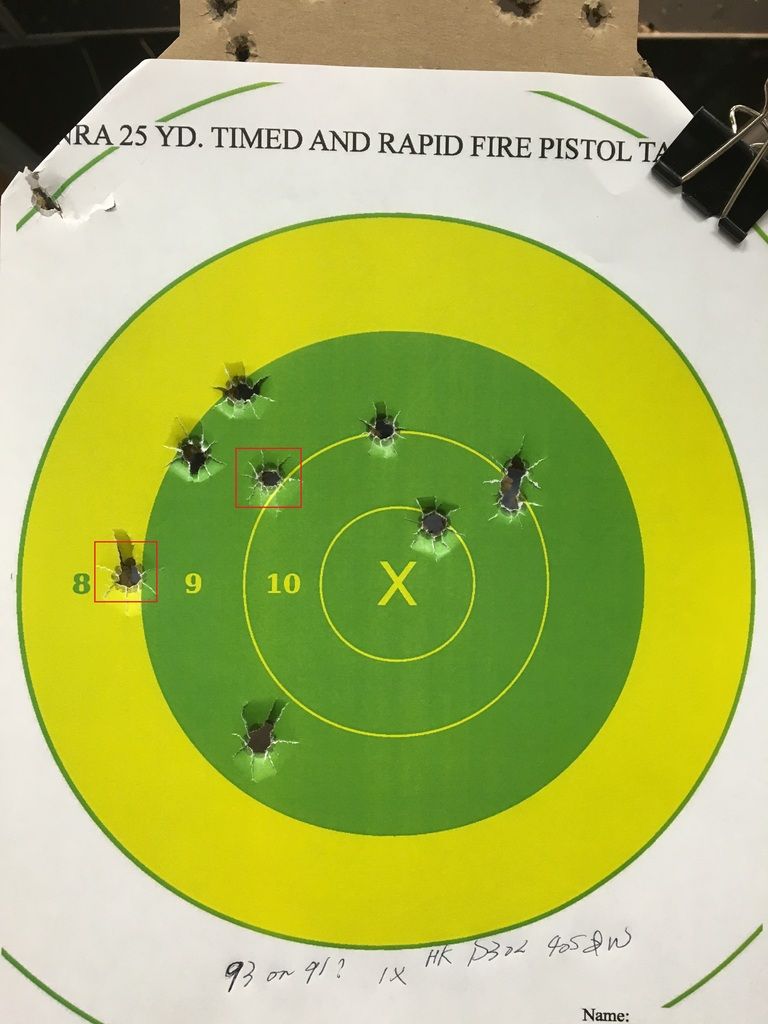
93 with 1X

231 works well in the 40 S&W
165gr 5.0 gr
180 gr 4.8 gr
Last edited:
This is what you need. and did you order the kit, or just the press? If not the kit, you will need powder measure and primer feeder as well I think. If you are not using LEE's powder measure, you will have to buy another powder die that works with whatever powder measure you use. for example, dillon power measure needs dillon powder die.
http://leeprecision.com/4-die-set-40-s-w-carb.html
http://leeprecision.com/4-die-set-40-s-w-carb.html
So also I need the die separately, are .40 S&W "carbide" what I need? I've never heard it called carbide before.
Yes, you need dies to go with the press. Assuming a Lee 4 piece die set with carbide (a particularly hard material) sizing and crimp dies, around $65 +/-
Last edited:





















