What Cause's A Buck's Antler to do this ??

Kondor

CGN Regular
Rating - 100%
109   0   0
Location
Barrie Area 705
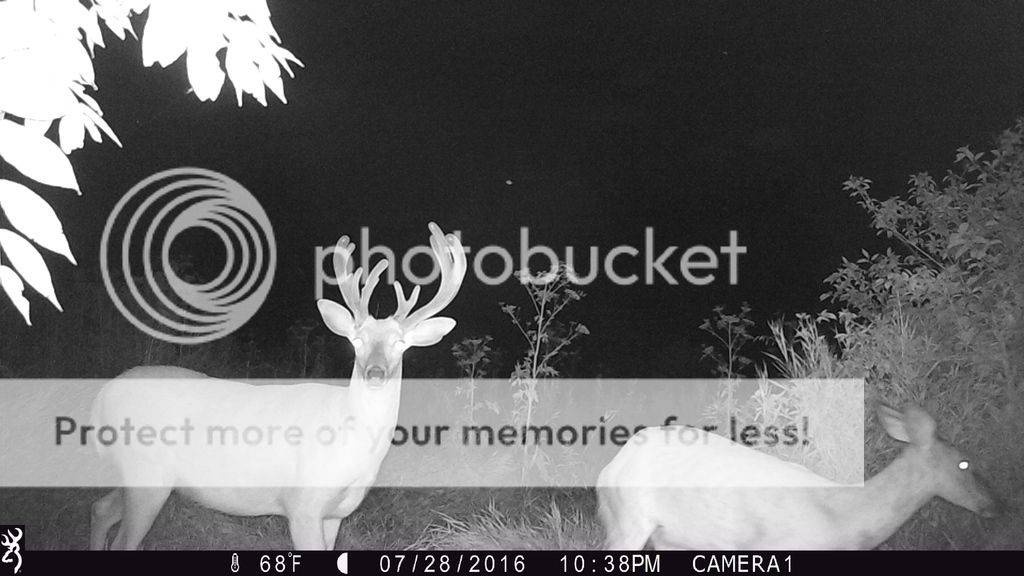
So i have checked my camera's for the first time in this spot, a few does.. a few fawns THEN this buck walks on in!! I have several angle's of his head and i have counted 11 points!! But i am curious as to why this happens ? I have seen when deer get a very LARGE set of antler's they start to do this maybe on one side but i have not seen both sides deformed before! I have nicknamed him "Claw" and he is my goal this year! :D

 
Often caused by injury to the pedicle surface early in antler developement... and sometimes it is a genetic predisposition.
 
"There are several unique antler facts that will surprise and interest most deer hunters. One of the most unique is the impact that an injury to the back leg of a buck has to subsequent antler development on the opposite site. For example, the next time you see a deer with a normal rack on the right and a twisted stunted rack on the left, check its back right leg for injury. For some reason, after a buck has a serious injury to a hind limb, it will cause the opposite antler to be abnormal and stunted. The cause for this is unknown, but it is more common than most deer hunters realize. This stunting effect will persist even after the hind leg heals.

A second unique male antler anomaly is a “cactus” buck. These bucks suffer from very low testosterone production due to hypogonadism or cryptochidism (i.e., their testicles are the size of a green pea or never descend from the body cavity). Because they never experience a fall surge of testosterone, the antlers are never shed. Each year new velvet and antler material is grown over and around the existing antler. Over time this gives the antlers the look of a gnarly “cactus.” These bucks are not common, but a couple are reported killed in Virginia each year.

Because the testosterone plays such an important part of the antler cycle, castration in deer can have a profound effect on antlers. If a male fawn is castrated early, he will never grow pedicels or antlers. If a deer is in hard antler and is castrated, he will lose his antlers normally and grow a new set, which will never shed their velvet. If a deer is in velvet and is castrated, he will never shed his velvet or lose his antlers.
What about non-typical antlers. Well, the jury is still out, but there is probably a genetic component. As noted above, injury can cause abnormal antlers, but many of the anomalies commonly seen on deer antlers (e.g., drop tines, kicker points, abnormal tines, palmated antlers) are not caused by injury. Age is also a factor. Many typical antlered bucks begin to pick up abnormal antler characteristics such as kickers and beauty points about the burr as they get older. When they get really old, in their teens, their antlers typically look like small twisted bonsai trees."

 
"There are several unique antler facts that will surprise and interest most deer hunters. One of the most unique is the impact that an injury to the back leg of a buck has to subsequent antler development on the opposite site. For example, the next time you see a deer with a normal rack on the right and a twisted stunted rack on the left, check its back right leg for injury. For some reason, after a buck has a serious injury to a hind limb, it will cause the opposite antler to be abnormal and stunted. The cause for this is unknown, but it is more common than most deer hunters realize. This stunting effect will persist even after the hind leg heals.

A second unique male antler anomaly is a “cactus” buck. These bucks suffer from very low testosterone production due to hypogonadism or cryptochidism (i.e., their testicles are the size of a green pea or never descend from the body cavity). Because they never experience a fall surge of testosterone, the antlers are never shed. Each year new velvet and antler material is grown over and around the existing antler. Over time this gives the antlers the look of a gnarly “cactus.” These bucks are not common, but a couple are reported killed in Virginia each year.

Because the testosterone plays such an important part of the antler cycle, castration in deer can have a profound effect on antlers. If a male fawn is castrated early, he will never grow pedicels or antlers. If a deer is in hard antler and is castrated, he will lose his antlers normally and grow a new set, which will never shed their velvet. If a deer is in velvet and is castrated, he will never shed his velvet or lose his antlers.
What about non-typical antlers. Well, the jury is still out, but there is probably a genetic component. As noted above, injury can cause abnormal antlers, but many of the anomalies commonly seen on deer antlers (e.g., drop tines, kicker points, abnormal tines, palmated antlers) are not caused by injury. Age is also a factor. Many typical antlered bucks begin to pick up abnormal antler characteristics such as kickers and beauty points about the burr as they get older. When they get really old, in their teens, their antlers typically look like small twisted bonsai trees."



Interesting...who would have thought of castrating a bunch of deer in the name of science.
 
This guy? I would spit on this picture but I don't want to clean my phone
uc5u1hav.jpg
.
 
There are several unique antler facts that will surprise and interest most deer hunters. One of the most unique is the impact that an injury to the back leg of a buck has to subsequent antler development on the opposite site. For example, the next time you see a deer with a normal rack on the right and a twisted stunted rack on the left, check its back right leg for injury. For some reason, after a buck has a serious injury to a hind limb, it will cause the opposite antler to be abnormal and stunted. The cause for this is unknown, but it is more common than most deer hunters realize. This stunting effect will persist even after the hind leg heals.

Nailed it ... ^
This is discussed in the excellent biology textbook ..... 'Mule and Black-tailed Deer of North America' .... Olof C. Wallmo ISBN 0-8032-4515-X
This is a quite common condition .....
Took an oddball Mule deer many years ago.
Had a large typical 5 pt. antler on one side, and a short thick twisted spike with 5 large eyebrow spikes on the other.
Opposite side rear leg had been shattered at one time ..... old injury, healed, and quite de-formed.
 
Back
Top Bottom