Range brass

I have built up an ammo supply but have yet to get into reloading. I have some factory loaded brass in 8x57, 7.62x39 and 7.62x54r which I will put aside for a rainy day to either sell or reload in the future if it becomes reasonable to do so. With these calibres I can't really justify buying all the equip and powder with its high cost when steel options are avail cheaper. Down the road it may be the only option so keeping things open.
I'd pick up brass in popular calibres at the range, I have several boxes with sorted brass (some just a few rounds) over a while it will add up and give me grocery money in a few yrs when there's enough to unload.
 
For me, I'll pick up range brass if it's pistol brass for a cartridge I load for or if it's a rare or expensive cartridge like 44 mag, 50AE, 10mm auto. No handloader is going to leave a bunch of that brass behind so chances are good that it's once fired and pistol brass is pretty easy to inspect.
For rifle cartridges I usually leave it on the ground unless there is a bunch of nice shiny ones together, chances are that if it's 308win or 223 for instance someone who doesn't reload was out playing and just left it where it fell.
No matter what it is every piece of brass needs to be inspected before every loading. I don't get overly anal about it but after tumbling and sizing I give them all a good visual to make sure there are no cracks, deep gouges, or nasty dents.
I'm not a benchrest shooter trying to get the most accuracy out of each load so I don't worry about it too much as long as they are safe.
I do sort all rifle brass by headstamp and for rifles like my 338Lapua I only use brass that I bought or know where it came from.
It all depends what you're loading and what you want out of your loads. If you just want to save some money then it's less important where the brass came from and how crazy you go with prep but if you want the most accurate and consistent loads possible you'll want to buy new brass and spend the time at the bench prepping it.
 
Regarding the 303, the chamber of mine is quite large and about 1 out of every 5 there is noticeable misshapenness and "out of roundness" near the base after firing. These cases actually have the start of separation near the base. These are Federal, Winchester and Remington factory loads. I haven't reloaded any tougher cartridges for this rifle but the point here is that after firing, if one in every 5 has a visible defect what would the probability be of the other 4 developing issues shortly there after with reuse? This is not the same concern using modern day rifles I know but a person never knows the chamber the cartridges came from and if significant stresses have been produced leading to premature cartridge failure. That's where the tougher brass steps into the equation. Less probability.I saved a ton of federal brass that was once fired from 3 savage bolt actions we owned in the same caliber. My first reloads using this brass was better than factory, but because the accuracy was not repeatable enough for my liking, I got into brass prep a little deeper. If that's all you are looking for when you are reloading then consider the posts here.

Regards
Ronr

The the reason for this is the diameter of the Enfield chamber is much larger than the diameter of the case. The case is laying in the bottom of the chamber when fired and expands more on one side because it is not centered in the chamber. If you use a rubber O-ring when fire forming the case it will center the rear of the case in the chamber and hold the case against the bolt face.

Any examples of some of this tougher brass for the .303?

Prvi Partizan is the best currently made .303 British brass you can get. It has a thicker rim, a larger base diameter and thicker case walls in the base.

Below both cases were fired in the same No.4 Enfield rifle, you can see the HXP case is bulged more on one side. A rubber o-ring was not used to fire form this case and it was not centered in the rear of the chamber when fired. The Prvi Partizan case was fire formed using a rubber o-ring and its larger diameter and thicker base is much better formed to the chamber.

privihxp-1_zpsshjfudwg.jpg
 
.303 brass even with a full length sizing die? That is one of the calibres i look out for the most lol

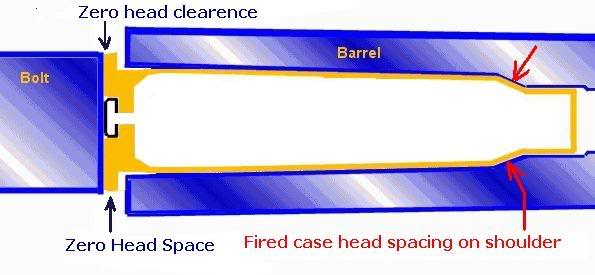
I'd use them. Before any resizing, I try to chamber them first. If they chamber ok, I just neck size the cases using a Lee collet die. If they are hard to chamber or impossible, I use a full length sizing die set up for partial full length sizing and try the case again. Adjust the full length sizing die down incrementally until the case chambers easily. Remember, after the first firing in your rifle, just neck size your cases to extend case life. For a factory round or full length sized round, the case "headspaces" on the rim but after reloading and neck sizing, the case "headspaces" on the shoulder. If you don't know how many times the case has been fired, especially .303 cases, use a straightened paper clip with the end 1/16" bend at 90 deg to "feel" the inside of the case just ahead of the case web for a groove. Discard any case that has a groove ahead of the web since it will probably separate at the next firing.
 
In 1914 the chambers of the Enfield rifle had to be reamed larger in diameter and longer to the shoulder of the chamber, and this was for two reasons.

1. There was a ammunition scandal over who was awarded ammunition contracts and some of this poorly made ammunition had chambering problems.
2. This was aggravated by the dirty muddy conditions of trench warfare.

NOTE, none of the other combatants had to make their chambers larger and this shows how poorly made much of the .303 British ammunition was made. And in attempting to cover up this poorly made ammunition the British put publicity on the Ross rifle and blaming its design. Read the story of "The Enfield Inch" and the problems Pratt and Whitney had making the manufacturing equipment and setting up the Lithgow Enfield plant in Australia.

Also the American SAAMI did not come into being until 1926 long after the Enfield rifle was developed. Meaning the reloading dies were designed for smaller civilian chambers and not the fatter and longer military chambers.

I use a Redding .303 British case forming and trim die to bump my case shoulders back on my neck sized cases. This case forming die will not reduce the case neck or body diameter of the case and only push/bump the case shoulder back.
 
Good quality 303 brass (Herters made by Metallverken in Sweden) can be had from Higginsons for $21/50.
Other good stuff is IVI once fired that can be found at some of the reloading supply stores.
 
Most guys that reload don't discard their brass (stands to reason, right?) so the safe bet is that the stuff at the range will be once fired.

Or the brass they left at the range was reloaded so many times the primer pockets are oversized or the cases are ready to separate.

The problem is even if its good brass once fired brass you only get a few cases and you end up with a bunch of mixed brass.

Meaning you have a bunch of brass that is not uniform and better off buying new brass from the same lot.

Don't get me wrong I have several five gallon buckets full of once fired range pickup .223/5.56 brass that I use as blasting ammo in my AR15 rifles.

And I only keep the cases with crimped primers and then knowing it is once fired.

"BUT" I only use new brass in my .223 bolt action after sorting and prepping it for uniformity.
 
Last edited:
Or the brass they left at the range was reloaded so many times the primer pockets are oversized or the cases are ready to separate.

The problem is even if its good brass once fired brass you only get a few cases and you end up with a bunch of mixed brass.

Meaning you have a bunch of brass that is not uniform and better off buying new brass from the same lot.

Don't get me wrong I have several five gallon buckets full of once fired range pickup .223/5.56 brass that I use as blasting ammo in my AR15 rifles.

And I only keep the cases with crimped primers and then knowing it is once fired.

"BUT" I only use new brass in my .223 bolt action after sorting and prepping it for uniformity.


This is what i was concerned with the most.
 
This is what i was concerned with the most.

I can pretty well guarantee that if you use mixed brass reloads in your No1 or No4, you'll never know know the difference. Now if you're shooting an F-class or PRS type rifle in competition, well, that's an entirely different matter. Also, if your range pick-up won't hold a primer properly, you'll know it has been fired many times. 303 brass, if neck sized after the first firing, should be good for about 5 reloads or more.
 
If you use a rubber O-ring when fire forming the case it will center the rear of the case in the chamber and hold the case against the bolt face...Prvi Partizan is the best currently made .303 British brass you can get. It has a thicker rim, a larger base diameter and thicker case walls in the base.

:) Yup O ring technique in progress already. X2 regarding the PPU brass in my experience.

Good quality 303 brass (Herters made by Metallverken in Sweden) can be had from Higginsons for $21/50.
Other good stuff is IVI once fired that can be found at some of the reloading supply stores.

I remember that from a previous post. Will be purchasing to keep headstamps different because...I found another mildly used 303Br for my son. :dancingbanana: He loves the mil surp stuff. Thanks for the reminder Hitzy.

Regards
Ronr
 
Hey guys, so I dont reload yet, but i plan to get a beginners setup going this winter. Whenever I'm at the range I make a point of collecting any brass i find. My question is, how can you determine if some of this brass is once fired, or discarded by a reloader who has figured its no good for another round of use?

Do I need to do a quick visual inspection of each case for certain obvious things? Or does it come down to case wall thicknesses or some other measurements that im not equipped to measure?

Don't waste your time with range brass. Buy new brass if you are loading for accuracy. If you are loading for economy, then range brass might work for you. Unfortunately as you have realized already, you are starting out with a dog's breakfast. Not a good start.
 
Interesting and informative video, thanks for sharing that. Can anyone shed any light on why full length sizing contributes to case head separation? Is it just because the brass is being worked, which weakens it?

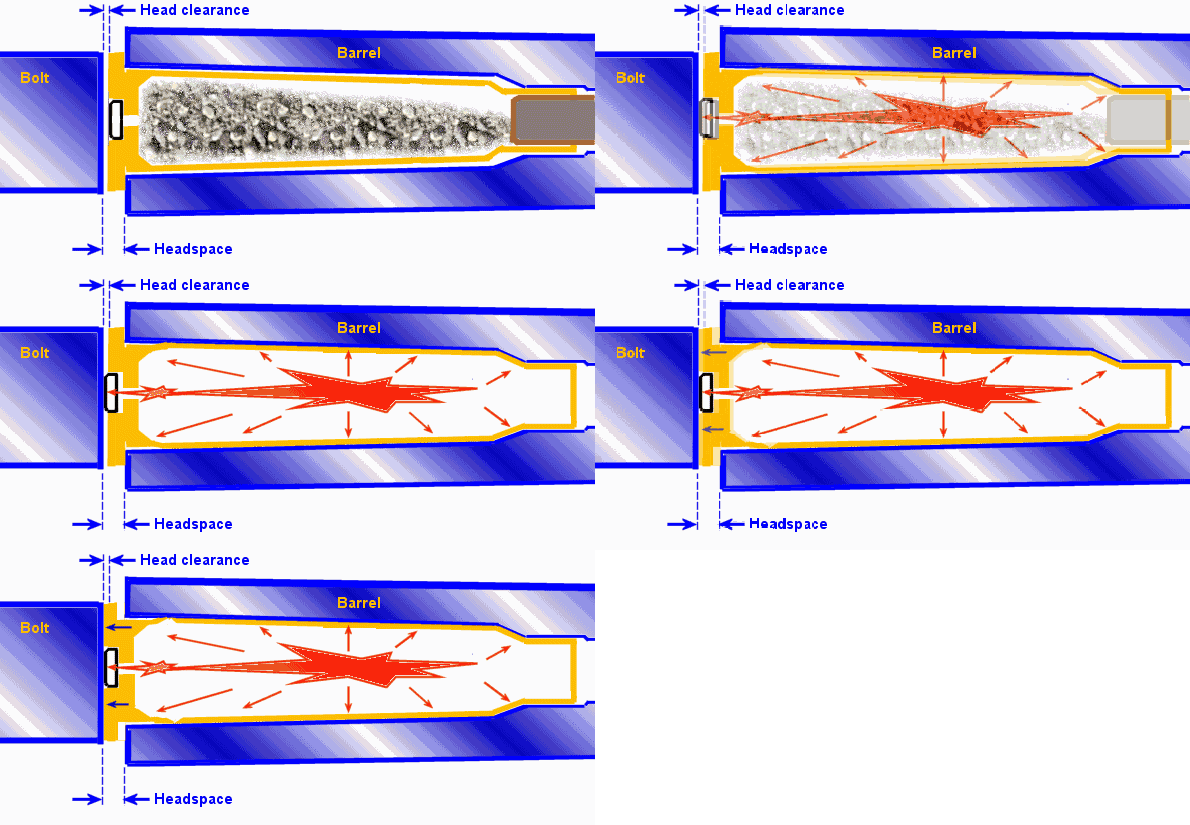
On a .303 Enfield at the maximum military headspace of .074 and a case with a rim thickness of .058 you have .016 head clearance or airspace between the rear of the case and the bolt face.

When resizing for a bolt action you only want to bump the case shoulder back .001 to .002 and this is well within the cases ability to stretch and then spring back without stretching.

Case stretching and case head separations are caused by excessive resizing and creating too much head clearance, meaning pushing the shoulder back too far.

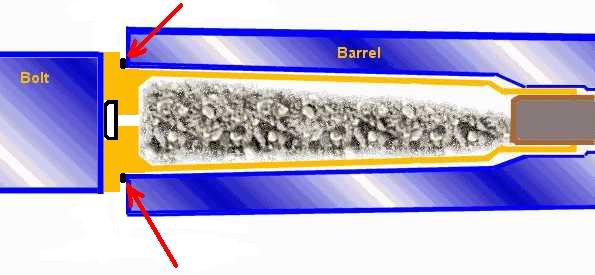
The ejector or the firing pin will push the case forward by the amount the case is shorter than the chamber. Then when fired the rear of the case will stretch to meet the bolt face, if this distance is too great the brass stretches and thins.

head%20clearance_zpsdsqq7guw.jpg


Below during resizing if the shoulder of the case is only pushed back .001 to .002 below the red dotted line normally the case can not stretch and thin in the base web area.

shouldersetback_zpsjizx9lok.gif


If you setup the die per the directions with the die making hard contact with the shell holder (green dotted line) you can push the shoulder back too far and the case will stretch.

Chambers and reloading dies vary in length and the die needs to be adjusted for proper shoulder bump for a custom fit in your chamber to prevent stretching.
 
Back
Top Bottom