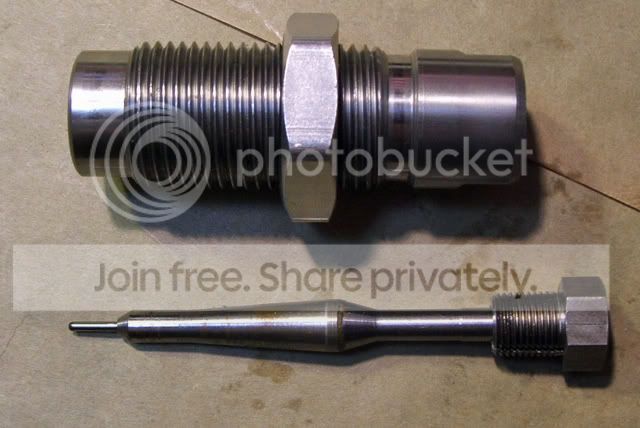
Case runout after sizing.

The Forster expander has no effect on shoulder bump with any die so you adjust the die as you normally would for the correct amount of bump.

The only problem you will have is expander hight adjustment with non-Forster dies. With a Forster die the bottom of the expander should be level with the lube vent hole in the die body.

Meaning you will need to go by feel when setting the expander ball height. You want the expander to enter the case neck while the neck of the case is still held and centered in the neck of the die.

Below from the Forster website and the vent hole in the die is shown.

Sizing_Die_Graphic-274x300.jpg


Above the “E-Z” Out Expander Ball is placed high on the Spindle in the Decapping/Expander Assembly, near the neck of the case. The figure at right shows the case being withdrawn from the die. Note how the elevated position of the “E-Z” Out Expander Ball supports the case neck in the neck sizing portion of the die, keeping the axis of the neck and the case in perfect alignment.

NOTE, from the Speer No.9 reloading manual, "the main cause of neck runout is from locking the expander spindle down off center with the die". And the high mounted floating Forster expander is aways centered in the case neck.

Realistically, you could set up any die brand with the expander to be higher like the Forster. You would have to decap in a separate step, but it's not like they are the only dies that can do that...
 
Realistically, you could set up any die brand with the expander to be higher like the Forster. You would have to decap in a separate step, but it's not like they are the only dies that can do that...

The expander spindle "MUST" be threaded high enough to raise it as far as the Forster unit, and add a rubber o-ring to allow the expander to float. And in my post #18 the RCBS expander was not threaded far enough to do as you stated. Meaning just buy the Forster expander and spindle unit with its flat rubber washer (W-10) as it was designed and reduce neck runout.

But again I do not understand why Redding has such long expanders (oblong) that create more drag inside the neck. But sell replacement carbide "ball" expanders, I ordered one and the expander ball was .2428 for my .243 dies????? Meaning the carbide ball was .0002 smaller than bullet diameter and why I adapted the Forster expander to the Redding die.
 
It will work with Hornady as they are threaded the full length of the rods and Lee with the collet type holder, the rubber washer is just to allow for play to allow the expander to center itself. Lee does this on the locking ring, you can accomplish the same with Hornady by gently tightening the spindle leaving some wiggle room.
Even with the expander as high as it can go, the case is still free of the die walls due to the taper every cartridge has so it's not being held any tighter then if the expander is at the mouth of the die. The key is to allow the expander to have some wiggle room so it centers in the mouth.
 
Ohhhh boy!! :bangHead: That's obviously not what he was talking about.

The sad part is the more we correct him about his goofed-up reloading postings the more he corrects himself in other forums passing it off as his 50 years of reloading experience.


RCBS? On some expander balls there is quite a small ring that gives the final ID. If you removed it, your neck ID may be smaller now.

W6o4Sqo.jpg


Ron AKA, when you polish any expander you will make it smaller, and Whidden custom dies sells a set of 5 expanders from bullet diameter to .004 smaller than bullet diameter.

I will tell you again what I told sunray, you need to read more and post "MUCH" less.
 
Last edited:
It will work with Hornady as they are threaded the full length of the rods and Lee with the collet type holder, the rubber washer is just to allow for play to allow the expander to center itself. Lee does this on the locking ring, you can accomplish the same with Hornady by gently tightening the spindle leaving some wiggle room.
Even with the expander as high as it can go, the case is still free of the die walls due to the taper every cartridge has so it's not being held any tighter then if the expander is at the mouth of the die. The key is to allow the expander to have some wiggle room so it centers in the mouth.

How is the rubber o-ring on the Lee die lock ring going to allow the expander to move and self center?????????

DSCF3279.jpg


And Forster full length benchrest dies are in a class far above Lee or Hornady dies.
 
I've got many different die sets ( Lee Hornady RCBS Forster etc) and I have to agree with bigepd51 the Forster bench rest is the best. The lee dies are good for a standard die but I dislike their lock ring. I find I can't get constant .002 bump on my case shoulders with the lock ring. I believe this may be due in part to that rubber o-ring on the die. I changed all the rings on my Lee dies to standard ones. I find they work much better. All said I really like my Forster dies.
 
Are the whidden dies on par with forster? I've been switching over to forster seating dies and have been looking at going with forster sizing dies as well.
But I have a strange attraction to the whidden dies but they are pretty much 2X the cost of the forster sizer.
 
I've never used the Whidden dies but i've read great things about them. Their seater die seems to use a caliber chamber like the Forster. Mabey someone on here has a set and give us a heads up on this die.
 
How is the rubber o-ring on the Lee die lock ring going to allow the expander to move and self center?????????

DSCF3279.jpg


And Forster full length benchrest dies are in a class far above Lee or Hornady dies.

It allows you to set the die up for some play (don't crank it down tight) so the expander can center itself. Same as a rubber washer or o-ring on the Redding/Forster or slack in the Hornady.
I could care less about getting into a "which brand is better" argument, I'm just addressing the "higher expander is better because the case is held straight by the die" which doesn't make much sense to me. As soon as you start lowering case out of cam-over, the case body is not touching the die body with any bottle neck cartridge due to the taper they have. So whether the expander is high or low in the die, as long as it's floating that seems to reduce run-out.
I've seen many real world tests for case run out among the various standard die makers, and it's very minimal... I'll try and dig one out for you.
 
Redding competition seating die corrects the majority of run out... I dont bother measuring runout anymore, it don't mean squat unless your competing in long range precision, then you will likely turn necks and use comp seating dies....no run out.
 
I could care less about getting into a "which brand is better" argument, I'm just addressing the "higher expander is better because the case is held straight by the die" which doesn't make much sense to me. As soon as you start lowering case out of cam-over, the case body is not touching the die body with any bottle neck cartridge due to the taper they have. So whether the expander is high or low in the die, as long as it's floating that seems to reduce run-out.
I've seen many real world tests for case run out among the various standard die makers, and it's very minimal... I'll try and dig one out for you.

When a Forster die is properly adjusted the case neck is still in the neck of the sizer die when it starts over the expander ball. You have to be careful not to adjust it too high or it will jam. And even with the bushing die set so the bushing only sizes part of the neck, the bushing slides down with the neck of the case and guides the case as it goes over the expander ball.

In my opinion the best die of them all is the Forster Bushing Bump Neck Die. In one step you can partially resize the neck, bump the shoulder, and guide the case neck over the expander ball. The interchangeable bushings allow you to do the very minimum resize on the neck for your brand of brass, while still allowing for a final ID kiss with the expander ball. You go a long way to minimizing runout by minimizing the amount you size down the neck before you run the expander ball through it. In a standard FL or even neck die the runout damage is done before the expander ball even gets into the act. When you oversize down the neck, then you must use the expander ball to get it back up again. So the sizing does the damage, and the ball get the blame....
 
I have had very good luck with Hornady dies and runout is very minimal with them.I don't no why but I have RCBS ,Lee and Redding and the hornady always gave me better runout .Probably not setting the redding right I guess after reading some earlier posts.RCBS wasn't to bad usally if I gave them a 1/2 turn and sized them again.
I have quit worrying about it anymore,i will check the first couple after sizing and then some near the end.My reloads shoot good enough for me but its always great to learn new tricks
 
Back
Top Bottom