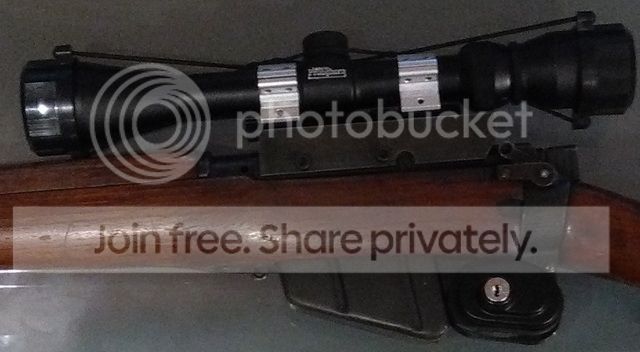
Just a few notes from the net...
"
The term "Jungle Carbine" was colloquial and never officially applied by the British Armed Forces,[5] but the Rifle No. 5 Mk I was informally referred to as the "Jungle Carbine" by British and Commonwealth troops during World War II and the Malayan Emergency.[3]
The No. 5 was about 100 mm shorter and nearly a kilogram lighter than the No. 4 from which it was derived. A number of "lightening cuts" were made to the receiver body and the barrel, the bolt knob drilled out, woodwork cut down to reduce weight and had other new features like a flash suppressor and a rubber buttpad to help absorb the increased recoil and to prevent slippage on the shooters clothing while aiming.[6] Unlike modern recoil pads the No. 5 buttpad significantly reduced the contact area with the users shoulder increasing the amount of felt recoil of the firearm. According to official recoil tests the No. 4 rifle yielded 10.06 ft·lbf (13.64 J) free recoil energy and the No. 5 carbine 14.12 ft·lbf (19.14 J). Of the No. 5 carbine 4.06 ft·lbf (5.50 J) extra recoil energy 1.44 ft·lbf (1.95 J) was caused by adding the conical flash suppressor.[7] The No. 5 iron sight line was also derived from the No. 4 marks and featured a rear receiver aperture battle sight calibrated for 300 yd (274 m) with an additional ladder aperture sight that could be flipped up and was calibrated for 200–800 yd (183–732 m) in 100 yd (91 m) increments. It was used in the Far East and other Jungle-type environments (hence the "Jungle Carbine" nickname) and was popular with troops because of its light weight (compared to the SMLE and Lee–Enfield No. 4 Mk I rifles then in service) and general ease of use,[8] although there were some concerns from troops about the increased recoil due to the lighter weight.[3]
Due to the large conical flash suppressor, the No 5 Mk I could only mount the No. 5 blade bayonet, which was also designed to serve as a combat knife if needed.[9]
A No. 5 Mk 2 version (or, more accurately, versions, as several were put forward) of the rifle was proposed (including changes such as strengthening the action to enable grenade-firing, and mounting the trigger from the receiver instead of on the trigger guard), but none of them was ever put into production and there was subsequently no No. 5 Mk 2 rifle in service.[10] Similarly, a number of "takedown" models of No. 5 Mk I rifle intended for Airborne use were also trialled, but were not put into production.[11]"