Neck sizing, bump sizing or FL Sizing, what is everyone doing?

mareshow

CGN Regular
Rating - 100%
38   0   0
Location
Edmonton, AB
So I'm trying to decide on what to do with a new rig i'm building in 6.5-284 Norma, After doing some research I think that Neck sizing is the best for brass life and accuracy, but that being said is bump sizing better if I want to use the gun for hunting?

So what is everyone else doing?

Also for Lapua brass prep what is everyone doing? I'm assuming a little bit of outside neck turning? how about primer pocket hole prep and such? Never bought brand new brass from lapua before so just curious. Does everyone FL size the first time?
 
Fire form your new brass in the rifle your going to use the rounds in. Bump size for hunting loads and neck size for your range (accuracy) loads. I would recommend that you check the fit in the rifle for all your hunting rounds.
 
I am doing neck and fl(with regular and small base die depending on the situation) only. (putting my hocky equipment on before saying the following. :) ). I did try the bump but thought it doesn't make sense because it's the same FL die which doesn't come down all the way, but still physically come down and in contact with the body which is just like FL sizing

and for brand new lapua case, I only have experience with 308, but thought, given the reputation, it should apply to all its cases. I measure all of them one-by-one with caliper and case gauge and found them all within spec, also load the brass into my rifle to see all of them were loaded and extracted without any issues. so for the first time, I just directly load them up. after fire forming the cases, neck sizing and then annealing when it's needed. haven't tried neck turning as I just started and don't think I need to do that as I just regular target shooting and hunting, not long range precision. don't want to spend too much time on prep the cases, rather on the range.
 
Last edited:
I usually neck size for target loads.
For hunting ammo, I full size (small base sizing die for the autoloader).
I haven't had to bump any shoulders yet.
 
Please note who wrote the post below.

Y3IiYL5.jpg
 
Please note who wrote the post below.

Y3IiYL5.jpg

Yes but there are varying opinions on everything. Although I agree that case life expectancy "may" not be increased, sizing the neck only part of the necks length ( about 50%) give enough neck tension to retain the bullet but also allows the fireformed cartridge to sit truly concentric with the bore and does not then allow the cartridge to have a couple of thou to rattle around in the chamber with.
For a hunting rifle, this may not be a huge deal but if the ultimate in accuracy is required in a target rifle this method WORKS!
 
++++1

Yes but there are varying opinions on everything. Although I agree that case life expectancy "may" not be increased, sizing the neck only part of the necks length ( about 50%) give enough neck tension to retain the bullet but also allows the fireformed cartridge to sit truly concentric with the bore and does not then allow the cartridge to have a couple of thou to rattle around in the chamber with.
For a hunting rifle, this may not be a huge deal but if the ultimate in accuracy is required in a target rifle this method WORKS!
 
Please note who wrote the post below.

Y3IiYL5.jpg

I've been saying this for years. Guys will argue about bushings, neck tension, tight chambers, neck turning...
I have tested these theories on a few of my custom and factory rifles and the results were inconclusive. Maybe it's the shooter, maybe my case prep or reloading procedure but I have found no benefit to most of these added steps.
Having said all of this, I don't shoot bench rest or even F class for that matter, maybe someone who has seen the positive results can chime in and explain it. All I know is that I've spent many hours chasing accuracy goals out of rifles that in the end were either shooters right out of the gate or they weren't.
 
OP, there will be many posts supporting this way or that way as you have likely anticipated. Personally I don't think one way of reloading/thinking is superior over another.

Below is a list of operations coming from a hunter who’s happened to fall into the rabbit hole of some bench rest techniques to solve reloading process issues for bolt action rifles. These operations have indeed solved reloading issues and the byproduct has been improved accuracy at the range. FWIW

Sizing
- Collet neck size – why? For myself I don’t have to worry about lubing operations or lube types
- Redding Body Size die – why? It’s a simple easy to understand operation. For myself, other dies that offer a partial shoulder bump and neck sizing at the same time seem complicated and if results aren’t as desired more troubleshooting may be involved. Being new at the time KISS principle was attractive and results have not prompted any reason for change.
- Noted it’s more operations however for myself easier to understand and control.

Other headstamp brass prep
- Neck turned to .012 or .013. to solve bullet seating/neck tension issues
- Flash hole deburred…lots of material from creating the flash hole left over I’ve found
- Primer pocket reamed

Lapua brass prep
- Neck turned to .012 or .013. to solve bullet seating/neck tension issues
- Primer pocket reamed on the odd occasion when primer seating just too tight

Just got into annealing. Why? Brass became way to springy and neck tension started to vary. (Something in the reloading process had to be solved.)

To be truthful I can’t speak to f/l sizing. Never had the need to. I’ve got a new set of RCBS dies that are still in a sealed box go figure. That being said, I respect guys like bigEd and the rest of the f/l fraternity. That works for them, this works for myself and my son.

I am interested in a bench rest build at some point and this caliber is on the list of considerations. Nice choice IMO.

Again FWIW.

Regards
Ronr
 
Please note who wrote the post below.

(image omitted)

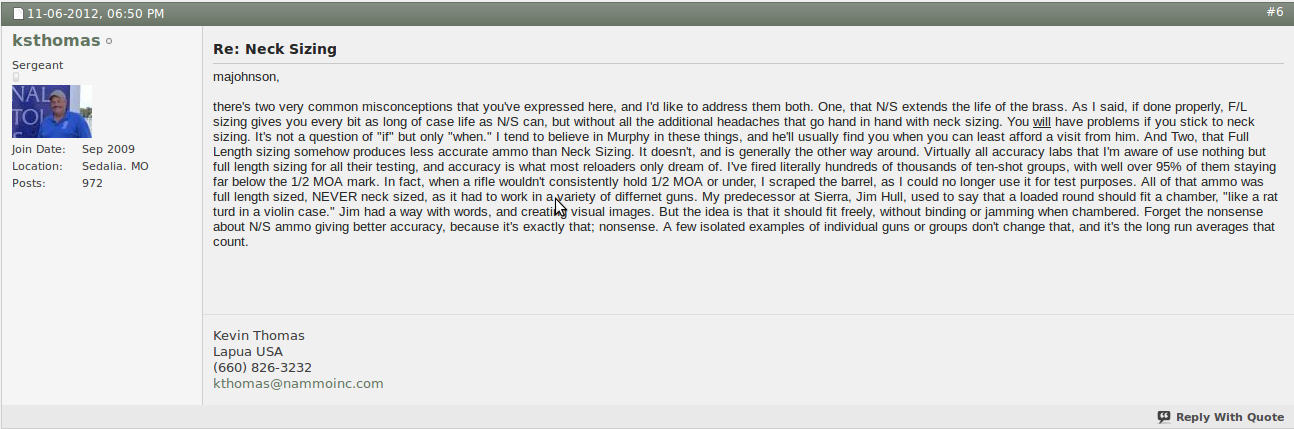
Thank you Ed, exactly the type of info we need from one of the most credible experts. Many of us are mere "wanna-bes". Kevin Thomas is truly a "been there, done that" expert in the field of ballistics.

The "like a rat turd in a violin case" belief certainly holds true with the Swiss 7.5x55mm GP11 military cartridge. Its only contact with the K31 chamber is a small portion of the shoulder and the head against the bolt face. The remainder of the case does not touch the chamber (lartiavc).The accuracy of this mass produced round is near legendary.

The difference is obvious in the photo below. BTW, the GP11 cartridges were far more accurate than any of the200+ neck-sized reloads that I built for testing. With F/L sizing, the accuracy improvement was very noticeable!

GP11%20with%20Berger%20VLD_zpssorbsdkt.jpg~original


I no longer neck size anything - F/L sizing rules imho...


Some info about Kevin Thomas prior to his departure from Sierra:

Spending his early years in Southern California, Kevin Thomas has been an avid shooter and student of firearms as far back as he can remember. Enlisting in the military immediately after high school, Kevin served four years in the U.S. Army, assigned to an Infantry Company with the 101st Airborne Division. His interest in marksmanship was noted by his commanding officer, and he was sent to and graduated from one of the first sniper schools to be taught by the division since the Vietnam war had ended. During that time, he also received his first exposure to formal competitive shooting, eventually spending nearly three years assigned to the 101st Marksmanship Training Unit (MTU). As part of his “duties” he engaged in NRA HighPower and Long Range competition, in which he holds a Master classification. After his military service, Kevin returned to Southern California, where he became a police officer in Los Angeles County. Combat Pistol IPSC/USPSA competition became Kevin’s primary competitive interest at that time, although he continued to shoot regularly at many of the area’s HighPower rifle matches. Frequently giving testimony or consultation on many criminal and civil court cases, Kevin became a court-accepted expert in the field of firearms and ballistics. He left law enforcement after six years, starting with Sierra in 1987 in the production department. Working with Sierra’s Chief Ballistician Martin (Jim) Hull, Kevin was one of the first technicians answering calls on the newly formed “tech-line.” Kevin took over as Manager of the Ballistic Service upon Hull’s retirement in 1989 and was promoted to Chief Ballistician in 1992. Since relocating to Missouri, he has continued to shoot a wide variety of disciplines, including HighPower, Rifle and Handgun Silhouette, USPSA Practical pistol and NRA Action pistol. At this writing, Kevin holds current classifications in at least eight different competitive disciplines (both rifle and pistol), and is a life member of both the NRA and the USPSA.

(http://www.exteriorballistics.com/ebexplained/authors.cfm)

 
this topic is right up there with "which cartridge is the most accurate". These debates go on for pages and pages and thread after thread until somebody gives up.

Personally, I f/l size my hunting brass, because I don't want any issues with a tight bolt and trying to chamber a round in the field. For target it seems to make the most sense to me to only touch the neck and bump the shoulder slightly. I haven't tested the theory, but it makes the most sense to me to have the brass aligned in the chamber. I understand why they'd f/l size brass in a testing scenario so they can compare the exact same loads to several different guns.

As far as neck turning and primer pockets go, I'd do what you can afford for cost and time and leave somewhere to go when you are out shooting your gun. The best part about target shooting is trying different things and learning for yourself what works and what doesn't. You'll quickly have an opinion of your own that differs from half of the people on this forum.
 
Below German Salazar is talking about the advantage of full length resizing, and minimizing the guiding effect of the case body and neck with the bullet and the bore.

Reloading: Partial Neck Sizing
by German A. Salazar
http://riflemansjournal.########.com/2010/06/reloading-partial-neck-sizing.html

"Now the last scenario, a full-length sized case in which the neck is also fully sized. There is clearance at the neck and in the body of the case, the closest fit anywhere is the bullet in the throat. If the neck to bullet concentricity is good (although it needn't be perfect), then the bullet will find good alignment in the throat and the case body and neck will have minimal influence. Let's not forget that the base of the case is supported by the bolt face or the extractor to a certain degree as well; this is yet another influence on alignment. As you can see, there are several points from base to bullet that can have an effect. My procedure is to minimize the influence of those that I can control, namely the case body and neck, and let the alignment be dictated by the fit of the bullet in the throat and to some extent by the bolt's support of the base. Barring a seriously out of square case head, I don't think the bolt can have a negative effect on alignment, only a slightly positive effect from minimizing "case droop" in the chamber. Given that a resized case will usually have a maximum of 0.001" diametrical clearance at the web, this isn't much of a factor anyway."


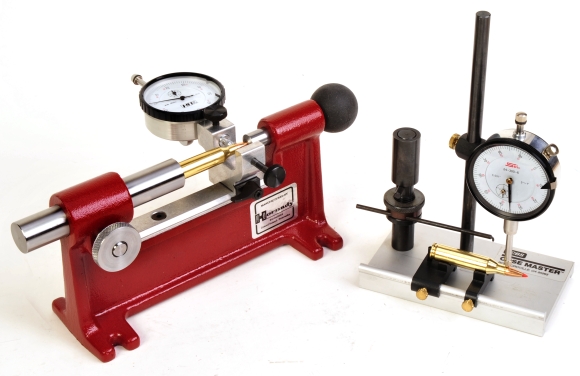
I have both the runout gauges below and the Hornady gauge holds the case as described above. Meaning the cartridge is held by the base and the bullet centered as it would be in the throat. And the RCBS runout gauge spins the bullet on the case body and this can and will effect the amount of bullet runout.

ed6Mwd8.jpg


Bottom line, a full length resized case has wiggle room to let the bullet be self aligning with the axis of the bore. And a neck sized case if the case wall thickness isn't perfectly symmetrical can influence the bullet alignment. And at the Whidden custon die website they tell you they get the most concentric ammunition from non-bushing full length resizing dies. ;)

 
Hmmm there is definitely some interesting points here, while I feel like this might be a Ford, Gmc ,or dodge topic; I think its likely to consider all sides. While I appreciate and understand neck sizing, I think FL sizing might be the way to go for me. Reason being time, While cost is essentially the same I think proper neck sizing will take more time and thus take away less time from shooting. I'm not going to be competition shooting or anything so I dont know if that extra time will pay off any dividends for me. The most important thing will be consistency, this is a target/hunting set up, I want what I practice to be the same as when I'm hunting.

I think I'll start FL sizing, then maybe go to a slight shoulder bump and go from there. If I see an increase in accuracy I'll try neck sizing, But I think in the mean time its important to consider time as a factor.

Edit:

I think it would be very interesting to see some real world testing of each method against each other. same day testing 3 five shot groups from each method, same time intervals and same shooter. If there is any accuracy to be gained I'm wondering how much, and if it's consistent for each shooter or with each shooter it varies. Another variable could be shooting style and how it lines up with your reloading method.
 
Hi OP, I think you misunderstood the purpose of FL vs neck sizing. in your situation(as per your first post), neck sizing actually saves more time and will give you way more accuracy out of your custom rifle.

the only time to do FL size(regular or small base) is you got range brass or you have multiple guns with the same caliber that use the same brass pool. FL sizing return the brass to spec, but NOT best fit to your chamber. Also, every time you do FL sizing, you have to lube the case which is an extra step that neck sizing does NOT need. Not to mention FL sizing is hard on the brass.

since you are only talking about one specific rifle, once you have the brass fire formed in it, all you need to do is to neck size it which keep the brass body perfectly fits your chamber. and since neck sizing doesn't require lube, it's also easier/faster. then after a few reload, if you want to prolong the case life, you would have to anneal the brass, FL sizing once again and then followed by neck sizing after fire form.

as for other shoulder bump and neck turning, it's for later if you find them useful for you as they require more time.


Hmmm there is definitely some interesting points here, while I feel like this might be a Ford, Gmc ,or dodge topic; I think its likely to consider all sides. While I appreciate and understand neck sizing, I think FL sizing might be the way to go for me. Reason being time, While cost is essentially the same I think proper neck sizing will take more time and thus take away less time from shooting. I'm not going to be competition shooting or anything so I dont know if that extra time will pay off any dividends for me. The most important thing will be consistency, this is a target/hunting set up, I want what I practice to be the same as when I'm hunting.

I think I'll start FL sizing, then maybe go to a slight shoulder bump and go from there. If I see an increase in accuracy I'll try neck sizing, But I think in the mean time its important to consider time as a factor.

Edit:

I think it would be very interesting to see some real world testing of each method against each other. same day testing 3 five shot groups from each method, same time intervals and same shooter. If there is any accuracy to be gained I'm wondering how much, and if it's consistent for each shooter or with each shooter it varies. Another variable could be shooting style and how it lines up with your reloading method.
 
Last edited:
Back
Top Bottom