223 Brass Quality

Sniffer

CGN Ultra frequent flyer
Super GunNutz
Rating - 100%
44   0   0
Location
Okanagan
Im in the market for some 223 brass but a little research suggests not all are created equal

From what I can tell Lake City seems to most considered the best quality

Lapua is known for high quality brass so I expect their 223 would be good

Remington gets good reviews

Not sure about Winchester

I`ve heard that PMC has some kind of coating on the inside of the cartridge that is to be avoided

Federal is to be avoided due to weak primer pockets

Does this sound accurate? Any other brands that are worth considering or to be avoided?
 
Norinco is the poorest quality IMHO
Federal is short typically 1.735" from the factory
Remington I generally like as commonly available brass as the beveled primer pocket mouth makes them easy to load and after processing they are fairly consistent.
Winchester is good also, I just prefer the primer pockets on the Remington more.

BSB
 
I basically shoot everything I can get my hands on. I have Winchester, CJ(norinco I think), Remington, Federal, Hornaday, Nosler, IVI, Lake city and the odd Lapua.

If you process the brass properly ( I swage the primer pockets , cut inside flash holes, trim and anneal) then it all shoots about the same. The best is still Lapua, Nosler and Hornaday for me.

The Chinese brass doesn't last as long and I like IVI better than Lake City for surplus but maybe I am bias. I notice Winchester sucks unless anealed and processed properly.

Rem and Federal brass are both good.

I really like my Hornaday brass but you need to swage primer pockets, most of thier ammunition is crimped and I have never bought just brass. I always buy once fired or loaded ammunition then reload after.
 
Older Winchester in the blue and white bags was good, new stuff in the red/black bag is garbage.
Federal is crap.
Rem is good.
PRVI is good.
Military is good once prepped.
 
Last edited:
Im in the market for some 223 brass but a little research suggests not all are created equal

From what I can tell Lake City seems to most considered the best quality

Lapua is known for high quality brass so I expect their 223 would be good

Remington gets good reviews

Not sure about Winchester

I`ve heard that PMC has some kind of coating on the inside of the cartridge that is to be avoided

Federal is to be avoided due to weak primer pockets

Does this sound accurate? Any other brands that are worth considering or to be avoided?

What are you using it for plinking or precision rifle? Big difference imo.
 
I love Remington 223, no crimped primers ftw

In terms of strength ivi is pretty good, but gotta swage pockets, Aguila is pretty tough too but crimped primers and off center flash holes makes it good for ar's only.
 
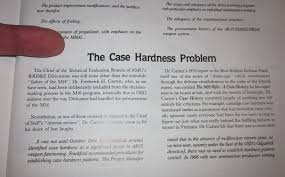
Just one of the early jamming problems with the M16 rifle was caused by soft brass. This was primarily commercial contract 5.56 ammunition made for the military. New requirements were made for case hardness and construction after the Congressional hearings on the jamming problem of the M16 rifle.

The image below came from the book "The Black Rifle, M16 Retrospective"

OujD1z7.jpg


Any 5.56 cases made for or by the military will be made to higher standards than commercial .223 cases. The real question is are you going to be shooting theses cases out of a AR15 or a bolt action .223. The .223 has a max rated chamber pressure of 55,000 psi and the newer M885 5.56 cartridge has a chamber pressure of 58,700 psi. Meaning the military 5.56 cases are made Ford Truck Tough. ;)

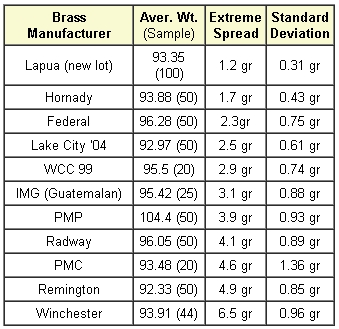
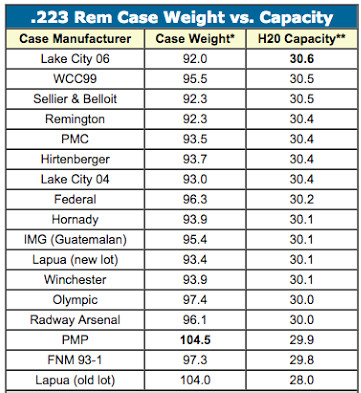
Below case weight, weight variations and case capacity.

PExmCCk.jpg


LjAQ7L9.jpg


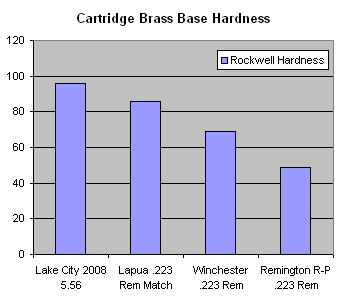
How Hard is Your Brass? 5.56 and .223 Rem Base Hardness Tests
http://bulletin.accurateshooter.com/2014/05/how-hard-is-your-brass-5-56-and-223-rem-base-hardness-tests/

brasstest03.png


Bottom line, I buy bulk once fired Lake City 5.56 brass at a fraction of the cost of new Lapua brass. And for my bolt action .223 I sort the cases by weight and neck thickness variations.
NOTE, the Lake City cases are more uniform in weight and neck thickness than either Remington or Winchester.

.223/5.56 - Cleaned, Deprimed & Swaged - LC Only - 500 Pieces $54.00 free shipping
http://www.brassbombers.com/223-556-Cleaned-Deprimed-Swaged-LC-Only-500-Pieces-2LC-S0050.htm
 
Federal brass has been working well for me. Got 2x 500 1F from Supersonic Supply. They were quite generous at about 25 extra cases per 500. Not a single cracked neck or defect in any of the cases.
 
I prefer military brass even though its a little more work initially. Make sure you swage your brass, don't ream or cut it! Your primer pockets will stay tighter, longer! I also like to de-burr my flash-holes, RCBS makes a great tool for this that fits on your trim mate. If you're really concerned with accuracy you can further sort your cases by weight and even neck thickness. The more time you put into brass prep, the better quality product you're going to have!

Lake City brass is great but it can differ slightly from year to year, its best to sort by date stamp if you're concerned with accuracy at all.

I use IVI because of its availability in Canada, also sorted by date stamp. You can generally buy this in bulk cheaper than you can buy any other brass. I usually pay about $60/1000 for un-prepped IVI range brass.

IMI and PMC military brass is pretty good as well! I've also had good luck with Remington, Winchester and Hornady commercial brass.

Commercial Federal 223 brass is very poor, generally too short and some flash holes are off-center. I've had a couple batches of the Federal 5.56 law enforcement brass which is a little better and the proper length. However, I generally reserve FC brass for my plinking loads.

The Norinco (CJ) stuff is garbage, you'll probably throw half of it out before you even get it reloaded. The majority of the flash holes are off center and many cases crack and burn through after the initial firing. These cases also seem to have some sort of coating and require a ton of time in the tumbler. Avoid this stuff if you can!
 
Just as kind of an FYI in regards to this. I have a Camdex .223 Processor on order. It is supposed to be ready by the end of July according to my last update. Once I have it in the shop and calibrated, I will probably try and source a skid of IVI or two to keep it fed. If you don't know what a Camdex is see below:

It checks for Berdan primers or cracked cases and then ejects them automatically. Full length resizes, swages (better then the swage on the 1050 platform as it adjusts automatically to different web thicknesses)
 
This is primarily for plinking purposes in an X95 (for now.....), my bolt gun is a Creedmoor

Gonna show my ignorance here on a couple of the points made

1) Regarding military brass - I haven't handled any in 223 but I know from 7.62x39 (non corrosive which I use in my AR) it seems very "robust" and looks like it would hard to work with (resize etc) - is this the case? I have some Winchester 223 waiting for my first round of reloading and it seems more like what I would expect from brass to be reloaded

2) What is swaging? I know its a process involving the primer pockets but whats the goal? Does it press them somehow to make them uniform? If so can it be incorporated into a progressive press (which leads to my next point)

What are people reloading 223 on? Progressive or single stage? I imagine single stage for bolt gun/accuracy and progressive for everything else

Whats the preferred method of trimming and how often (I know it depends on the brass/measurements but what the general average between trimmings)?
 
Sniffer,

by no stretch are you showing your "ignorance" I would rather see someone ask questions, then preach without knowing the actual technical details of what they are preaching.

1) "Military" Brass is a very broad term, you could classify everything from Norinco to Lake City to IVI as Military brass, quality is all over the place. North American & most NATO brass is of fairly good quality, I haven't seen too much European NATO brass, however I do have 2 x 45 gallon drums of British 5.56 that looked good, I haven't gotten into processing it yet though. For the most part, as long as the brass was not fired in an open bolt weapon... IE, C9, M249 it will not hard to resize beyond would be considered normal force. Open bolt weapons tend to have a bit extra head space for reliability purposes, along with occasionally tearing off pieces of rims and such.

2) Swaging removes the crimp from the primer pocket, and very slightly chamfers the mouth of the primer pocket to allow seating of a new primer. It doesn't uniform the pockets, it just opens the sides a bit. A Dillon Super 1050 has a built in primer pocket swage at the third station.

3) When I load .223 for myself, I do it progressively only, as I don't shoot "match ammunition" I just run Remington Brass with a 55 GR FMJ, CCI #41 and CFE 223 and away I go to the races. It still shoots better then Norinco, or Federal black box, however I run iron sights, so my accuracy is limited by my eyes and the stock trigger in my rifle.

Because I have all the processing equipment, I process and trim everything before I load it. Then I shoot it and leave it at the range (not on), there are the occasional guys who follow me around and pick my brass after me. They know it is all freshly processed and they will not have to do any work on the brass for a few loadings. I try and trim it to 1.747" +/- 0.003". Right now I am running a Honey Badger Trimmer, and will be ordering a Camdex .223 Trimmer here in a couple of months, however at $34,000 USD it is a tough pill to swallow.

Honey Badger Trimmer
Camdex Trimmer

 
Last edited:
Winchester takes a lot of prep compared to others I've used/seen. I would not go out of my way to buy it but would pick it up at the range. If you're looking for repeatable accuracy, I would select another brand. You will get several loadings from a case before you start having problems.


 
Back
Top Bottom