need help reading .300 whby brass/primer pockets

toddpotiphar

Member
Rating - 0%
0   0   0
Location
Hilda
I recently purchased a Weatherby Vanguard S2 in .300 Whby and began reloading. I've only put 22 rounds through the gun, all of which have been my handloads. I started with brand new Hornady brass, Winchester WLRM primers, 165 gr Nosler Ballistic Tips, and 81 grains of IMR 7828. I scaled every powder charge individually and trickled to within 1/10 of a grain.The primers all seated with significant resistance. The fired brass on those 15 rounds looks nice and clean.
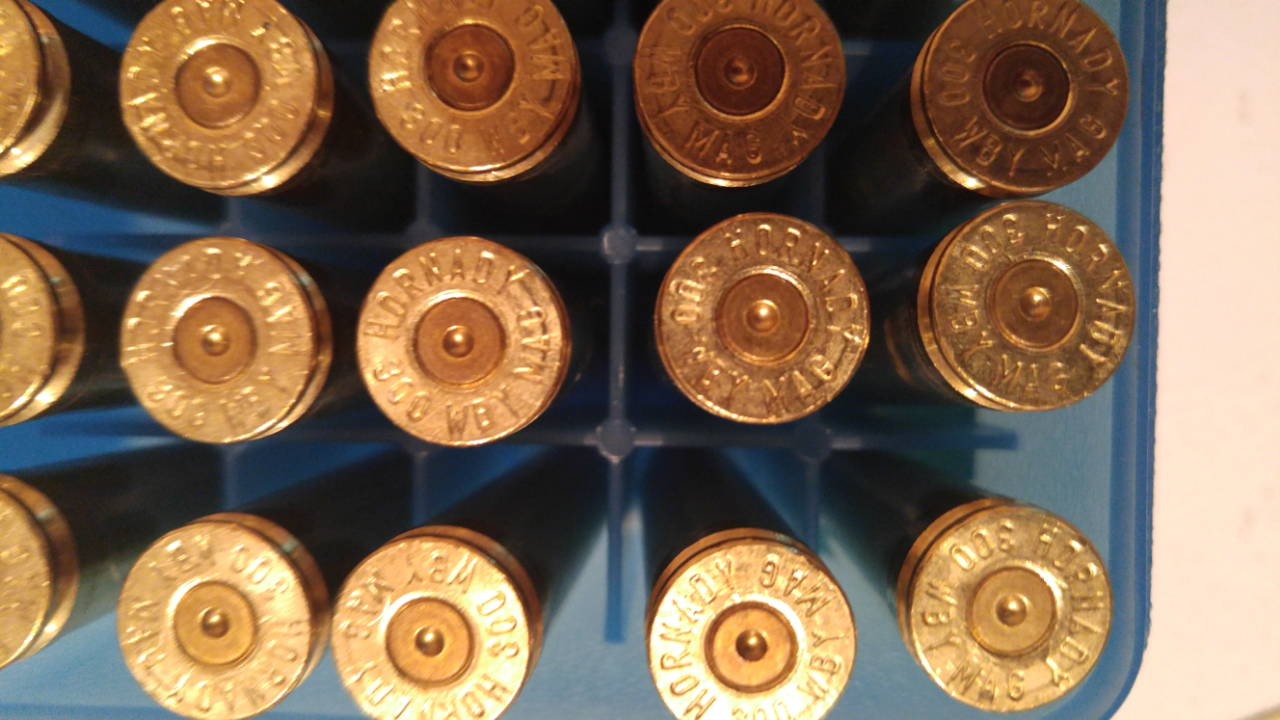
yDHQzUh.png


I loaded 10 more with 82 gr IMR 7828 and noticed that some of them have a black soot ring around the primer and also have a slight semi-circular ring impressed on them.
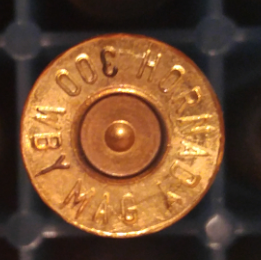
k05r1ks.png


The ring is around the "R" and the "N."
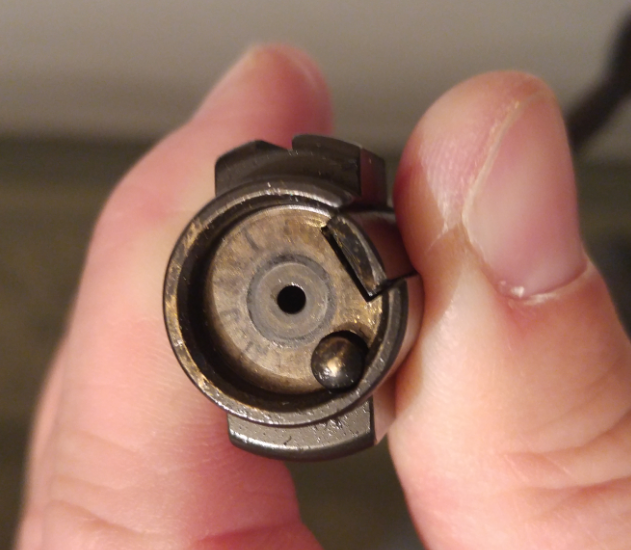
YHSDcIB.png

Is this anything to be concerned about? It would seem odd to me to be getting high pressure signs when the load is still well below maximum listed in the Lyman manual.
 
Last edited:
Don't continue to use any load that leaves the head of your brass with that "semi-circular" mark. You have exceeded the elastic limit of that brass, and the leaking primers simply reinforce that indication.
The fact that the load is not up to the book listed max means nothing. Each rifle is an individual, and a listed max load could be OVER or Under the max in YOUR firearm.
Back that load down a grain or two. D.
 
So would you throw those particular cases out? Or reload them again with a lighter load?

Pay Particular attention to how difficult it is to seat new primers after resizing them. If the primers seat with almost no effort, the pockets are enlarged, and the cases are probably scrap metal.
Also, If you have a Vernier micrometer [not caliper] at your disposal, measure the cases across the belt. Anything over .5305 is expanded too much to use, IMHO. Usually, New cases measure .5285 - .5290 at the belt.
D.
 
I'll measure them with my calipers (which measure down to half a thousandth, i.e. .5285, .5290, .5295, etc.) and compare them to the unfired cases.
Thanks again.
 
Ditch the Winchester primers, ever since they stopped nickel coating them they have been nothing but trouble. That's a mild load IMO for the 300 bee and you should Not be seeing primer leaks, get the CCI or Federal 215 M primers.
 
If there was leak by around the primers, the pockets are likely expanded beyond the usable limit. If primers can be inserted with your fingers, or with very little effort with a hand priming tool, discard the cases.
 
Ditch the Winchester primers, ever since they stopped nickel coating them they have been nothing but trouble. That's a mild load IMO for the 300 bee and you should Not be seeing primer leaks, get the CCI or Federal 215 M primers.

Certain lots of Winchester Primers [unplated] have been problematic, but it is not simple leaks, it is blowouts at the radius of the primer. This is NOT what the OP is talking about.
Also, the mark on the head of the case has nothing to do with primer choices, and everything to do with pressures. I agree, it looks like a light load for the w'bee, but it is
entirely possible to have high pressures even with loads that would normally be OK. I have one 308 Norma Magnum rifle [of 5 total] that is maxed out 3 full grains below what is normal in
any of the others. So many factors come into play that one cannot predict with any accuracy what a given rifle will accept as a maximum load. D.
 
The belts on the cases charged with 82 grains all read over the book measurement of .531. I'd like to think that I would have noticed that when I went to reload them.

One of the things that I noticed about the load data for 165 gr bullets with IMR 7828 is that it yields higher velocity at minimum charge and gains very little velocity from minimum charge to maximum charge when compared with other powders (i.e. H1000). Could that be part of the reason that I'm getting high pressure with a fairly light charge?
 
Quite a few things:

Leaking primers are bad; always.

I can't see your pictures; but it sounds like you are also describing ejector marks. Bad.

Don't count on always reaching the maximum load in the book with your rifle. That's why there's starting loads.

Hornady brass is notoriously soft.

Hodgdon's data has the 7828/ 165 max at 82 grains.

What does your chronograph say? Sometimes those light loads aren't light. Again, that's why there's starting loads.
 
Every vanguard I have shows ejector marks, even with min loads. So to me this is somewhat normal. Your pics don't show up for me, so I can't tell if it is the same or not. Never ever had a primer leak that you speak of. Certainly sounds like over pressure for that rifle to me.
 
Quite a few things:

Leaking primers are bad; always.

I can't see your pictures; but it sounds like you are also describing ejector marks. Bad.

Don't count on always reaching the maximum load in the book with your rifle. That's why there's starting loads.

Hornady brass is notoriously soft.

Hodgdon's data has the 7828/ 165 max at 82 grains.

What does your chronograph say? Sometimes those light loads aren't light. Again, that's why there's starting loads.

Interesting that Hodgdon's data shows 82 grains as max. Lyman gives minimum load for 165s as 81, max at 86. I've loaded some down to 80 gr and hope to get to the range later this week with them. I don't have a chronograph yet, but expect to pick one up before my next range session.
 
Last edited:

Every vanguard I have shows ejector marks, even with min loads. So to me this is somewhat normal.

Really??? I have 4 Vanguards, and have owned at least 5 others, and have never noticed any ejector marks on any of my brass.
Even my Lazerguard 30-06, driving 180's at very close to 2900 show no sign of such marks. I would not call it normal from my
experience. D.
 
Really??? I have 4 Vanguards, and have owned at least 5 others, and have never noticed any ejector marks on any of my brass.
Even my Lazerguard 30-06, driving 180's at very close to 2900 show no sign of such marks. I would not call it normal from my
experience. D.

What are you using for powder type on that 30-06 load? I've got some 30-06s that can stand a little waking up. One does churn out 2850 with H4350 though.
 
Really??? I have 4 Vanguards, and have owned at least 5 others, and have never noticed any ejector marks on any of my brass.
Even my Lazerguard 30-06, driving 180's at very close to 2900 show no sign of such marks. I would not call it normal from my
experience. D.

I have had 2 257's and a 300 weatherby, they all showed ejector marks even on factory ammo. The standard chambetings 270 and 30-06 did not. 240 did not show either. I don't think that weatherby brass is that soft it would show ejector marks...
 
Did you run the brass through the sizing die and trim if necessary before you reloaded for the first time?
Fed 215M primers are usually the norm for the 300 Weatherby. I also have a Weatherby Vanguard S2 in 300 WBY. I use Hornady brass. I have yet to have an issue.
 
Every vanguard I have shows ejector marks, even with min loads. So to me this is somewhat normal. Your pics don't show up for me, so I can't tell if it is the same or not. Never ever had a primer leak that you speak of. Certainly sounds like over pressure for that rifle to me.

Really??? I have 4 Vanguards, and have owned at least 5 others, and have never noticed any ejector marks on any of my brass.
Even my Lazerguard 30-06, driving 180's at very close to 2900 show no sign of such marks. I would not call it normal from my experience. D.

If the ejector hole in the bolt face has a sharp edge around its circumference it can leave a ring on the base of the case. The cure is to stone and polish the sharp edges of the hole.

If the ejector mark is a raised bump then you have brass flow and exceeded the elastic limits of the brass.

I only bring this up because of the quality short cuts that are being taken to reduce manufacturing costs today. I had a new Remington 700 that did this and the https://i.pinimg.com/564x/d5/28/65/d52865daca43137e481ab1c1e03be17a.jpgrecessed bolt face looked like a herd of angry beavers had been chewing on it.

Nothing worse than a angry Canadian beaver that can't get the top off the bottle.

d52865daca43137e481ab1c1e03be17a.jpg
 
If the ejector hole in the bolt face has a sharp edge around its circumference it can leave a ring on the base of the case. The cure is to stone and polish the sharp edges of the hole.

If the ejector mark is a raised bump then you have brass flow and exceeded the elastic limits of the brass.

I only bring this up because of the quality short cuts that are being taken to reduce manufacturing costs today. I had a new Remington 700 that did this and the https://i.pinimg.com/564x/d5/28/65/d52865daca43137e481ab1c1e03be17a.jpgrecessed bolt face looked like a herd of angry beavers had been chewing on it.

Nothing worse than a angry Canadian beaver that can't get the top off the bottle.

d52865daca43137e481ab1c1e03be17a.jpg

That's a very big beaver or a very small bottle... or the guy who photoshopped it got the proportions wrong.

"American beer is like ### in a canoe - it's fcking close to water." :)
 
Back
Top Bottom