












































You are using an out of date browser. It may not display this or other websites correctly.
You should upgrade or use an alternative browser.
You should upgrade or use an alternative browser.
Freebore and COAL?
- Thread starter Jetjock
- Start date

Leatherstocking
CGN Regular
- Location
- BC Rockies
COAL means cartridge overall length, although COL is also used. This is the dimension from the base of the case to the bullet tip, or metplat.
Don’t think the .361 freebore would be significant, as there are tolerances involved.
There are ways to measure the max COL for your particular rifle, then shorten this dimension to get a suitable bullet jump. Barnes TSX and TTSX supposedly like a jump of about .3 to .7.
Maybe just try the book COL to start.
Don’t think the .361 freebore would be significant, as there are tolerances involved.
There are ways to measure the max COL for your particular rifle, then shorten this dimension to get a suitable bullet jump. Barnes TSX and TTSX supposedly like a jump of about .3 to .7.
Maybe just try the book COL to start.
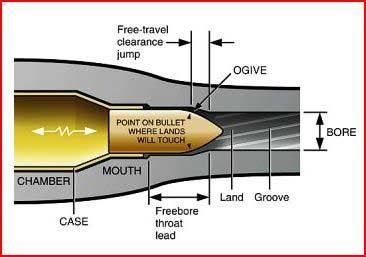

Free bore is just factory cut throat erosion.
With any rifle, seat the bullet long, chamber, look for rifling marks, seat bullet deeper, etc until you have load that just touches the rifling or is 20 thou off the rifling.
Then see if this OAL will fit the mag.
With any rifle, seat the bullet long, chamber, look for rifling marks, seat bullet deeper, etc until you have load that just touches the rifling or is 20 thou off the rifling.
Then see if this OAL will fit the mag.

There's a few ways of deciding what COL you're going to go with on a Weatherby cartridge; but unless you've got some freakish combination of custom throats and oddball bullet choice seating to the lands or just off isn't going to be one of them.
As you've correctly deduced, distance to lands is going to change with different bullets as well as different different COLs. Don't worry about it so much. It's kind of dumb for Westherby to
Be talking about free-bore in thousands of an inch when they have multiple bullets of
different designs and weights in their own ammo. They could have said "about 3/8" because it's about that.
You just have to pick a plan to start with. The plan could be seating to
Factory length on bullets they use on factory ammo. You could seat to the canulure on bullets that have one,
seat maybe .030" shorter than the mag length on a Vanguard, or figure out where the base of the bullet (or boat-tail) is even with the bottom on the neck and go with that. No matter what you decide, someone is going to agree with you and others will think you're wrong. On a long Mark V box I'd seat as long as I could and still have a decent grip on the cartridge. It's not going to be dangerous because you're going to work up your loads anyway.
If you do chose to go long, work up to solid working maximum and see what you get. If you feel you need to play with accuracy further, seat deeper in big increments and test for groups as you go. No use playing with thousands when they threw 3/8" at you to
star with. Maybe .030- .050" at a time, or one turn of your seater stem. It's not an exact science, but it can got to from
no hell to oh wow .
The last Weatherby I worked loads for was a .270. The particular build could set bullets way out, but didn't really start shooting until it got a .250" run at it.
Big thing with big Weatherby cases is to do whatever it takes to keep you barrel cold when testing loads. They go from cold to hot to branding iron in three shots and they aren't exactly famous for shooting hot. They do have a tendency to
Put the first shot right where it's supposed to though. That's the sort of thing that puts game on the truck.
As you've correctly deduced, distance to lands is going to change with different bullets as well as different different COLs. Don't worry about it so much. It's kind of dumb for Westherby to
Be talking about free-bore in thousands of an inch when they have multiple bullets of
different designs and weights in their own ammo. They could have said "about 3/8" because it's about that.
You just have to pick a plan to start with. The plan could be seating to
Factory length on bullets they use on factory ammo. You could seat to the canulure on bullets that have one,
seat maybe .030" shorter than the mag length on a Vanguard, or figure out where the base of the bullet (or boat-tail) is even with the bottom on the neck and go with that. No matter what you decide, someone is going to agree with you and others will think you're wrong. On a long Mark V box I'd seat as long as I could and still have a decent grip on the cartridge. It's not going to be dangerous because you're going to work up your loads anyway.
If you do chose to go long, work up to solid working maximum and see what you get. If you feel you need to play with accuracy further, seat deeper in big increments and test for groups as you go. No use playing with thousands when they threw 3/8" at you to
star with. Maybe .030- .050" at a time, or one turn of your seater stem. It's not an exact science, but it can got to from
no hell to oh wow .
The last Weatherby I worked loads for was a .270. The particular build could set bullets way out, but didn't really start shooting until it got a .250" run at it.
Big thing with big Weatherby cases is to do whatever it takes to keep you barrel cold when testing loads. They go from cold to hot to branding iron in three shots and they aren't exactly famous for shooting hot. They do have a tendency to
Put the first shot right where it's supposed to though. That's the sort of thing that puts game on the truck.
The early Weatherby rifles had chambers cut with purposely long "freebore."
Ganderite explains very clearly what it really is. Weatherby did this because the powders available at the time Roy Weatherby was trying to market his creations were to fast. He had to find some way to be able to stuff lots of powder into those huge cases but still keep pressures down. He did this by cutting "freebore" before the leade. This meant the bullet had to jump quite a distance before engaging the leade and pressure was slightly reduced and maybe even bled off as escaping gasses went past the bullet before a positive seal was made. Not much but enough. One of the early Weatherby rifles I used to own had 1.350 inches of freebore. It was a 300 WbyMag as well. It never was accurate and quite honestly, recoil was intense. Because of magazine limitations and bullet lengths it was impossible to seat the bullets close to the leade.
Later model rifles chambered for Weatherby cartridges either decrease or eliminate freebore to more advantageous depths. They also have tighter throat dimensions.
You don't mention the rifle you are loading for so follow Ganderites method to establish where the bullet ogive will contact the leade and if you wish, set it back a few thousandths at a time until you find the sweet spot.
Many of the new rifles have throat diameters that are so close that seating a bullet deep or close to the leade, or even on the leade has little effect on potential accuracy.
If you happen to have a rifle with a "sloppy" throat, seating the bullet so it is very close to or touching the leade is often a very good way to wring as much accuracy as your rifle is capable of with any given bullet.
Ganderite explains very clearly what it really is. Weatherby did this because the powders available at the time Roy Weatherby was trying to market his creations were to fast. He had to find some way to be able to stuff lots of powder into those huge cases but still keep pressures down. He did this by cutting "freebore" before the leade. This meant the bullet had to jump quite a distance before engaging the leade and pressure was slightly reduced and maybe even bled off as escaping gasses went past the bullet before a positive seal was made. Not much but enough. One of the early Weatherby rifles I used to own had 1.350 inches of freebore. It was a 300 WbyMag as well. It never was accurate and quite honestly, recoil was intense. Because of magazine limitations and bullet lengths it was impossible to seat the bullets close to the leade.
Later model rifles chambered for Weatherby cartridges either decrease or eliminate freebore to more advantageous depths. They also have tighter throat dimensions.
You don't mention the rifle you are loading for so follow Ganderites method to establish where the bullet ogive will contact the leade and if you wish, set it back a few thousandths at a time until you find the sweet spot.
Many of the new rifles have throat diameters that are so close that seating a bullet deep or close to the leade, or even on the leade has little effect on potential accuracy.
If you happen to have a rifle with a "sloppy" throat, seating the bullet so it is very close to or touching the leade is often a very good way to wring as much accuracy as your rifle is capable of with any given bullet.

DiabeticKripple
CGN Regular
- Location
- Red Deer, Alberta
COAL means cartridge overall length, although COL is also used. This is the dimension from the base of the case to the bullet tip, or metplat.
Don’t think the .361 freebore would be significant, as there are tolerances involved.
There are ways to measure the max COL for your particular rifle, then shorten this dimension to get a suitable bullet jump. Barnes TSX and TTSX supposedly like a jump of about .3 to .7.
Maybe just try the book COL to start.
Do you mean .03-.07 for the Barnes Bullets? .3-.7 is over half an inch!
Barnes recommends .050” of jumps to the lands
Leatherstocking
CGN Regular
- Location
- BC Rockies
Oops, .03-.07 would be correct.





















