












































You are using an out of date browser. It may not display this or other websites correctly.
You should upgrade or use an alternative browser.
You should upgrade or use an alternative browser.
.303 chamber problem?
- Thread starter lledwod
- Start date
Rayleigh_Scattering
Regular
- Location
- Under the arch
That’s a creepily clear throat/rifling ramp area. Mine all look much more blended. Almost makes me wonder whether it was recut recently.
If you have access to a lathe you could cut yourself a neck x case length cylinder and see if chambers.
If you have access to a lathe you could cut yourself a neck x case length cylinder and see if chambers.

303EppsFan
CGN Regular
- Location
- Almonte,Ontario
Make sure it is 303 British chamber and not the wild cat 303 Elwood Epps!
That isn't an Epps.

It looks like there's neither freebore, nor leade in that chamber. If that's the case, then there's no proper place for the brass to lengthen on firing, and hence it was forced around the knurling in the only space it could go.
This pic exaggerates the typical length of each:

A Throat Reamer could remedy this problem. If you don't want to spend money on this gun, but still want to shoot it, you could shorten your brass well below Max SAAMI, e.g. 2.175" and keep it there.
P.S. nice rifle!
This pic exaggerates the typical length of each:
A Throat Reamer could remedy this problem. If you don't want to spend money on this gun, but still want to shoot it, you could shorten your brass well below Max SAAMI, e.g. 2.175" and keep it there.
P.S. nice rifle!
Last edited:

After the OP posted the chamber photo I looked at a No. 1 and No.4 Enfield rifles lighted from the muzzle and they looked the same as the OPs photo.
I'm not saying your wrong Andy but any sporterized Enfield rifle coming from Europe would have been proof tested before sale. And the pictured rifle has a European look to the stock design.
And a No.1 Enfield like the OP has would have had the problem show up long before this when fired.
I'm now wondering if the cases are reloads and need trimming "but" the cases look new and thats even more confusing.
So again after looking at some of my Enfield rifles front lighted from the muzzle they looked the same as the OPs photo. Meaning some of the free bore is lost in the black shadow at the case mouth area of the chamber. I think we need more information from the OP about his ammunition and where the rifle was made.
I'm thinking of a question asked in a forum about how many people full length resize their "new" cases before loading them. And wondering if the cases were too long after manufacture or carbon buildup in the throat.
I'm not saying your wrong Andy but any sporterized Enfield rifle coming from Europe would have been proof tested before sale. And the pictured rifle has a European look to the stock design.
And a No.1 Enfield like the OP has would have had the problem show up long before this when fired.
I'm now wondering if the cases are reloads and need trimming "but" the cases look new and thats even more confusing.
So again after looking at some of my Enfield rifles front lighted from the muzzle they looked the same as the OPs photo. Meaning some of the free bore is lost in the black shadow at the case mouth area of the chamber. I think we need more information from the OP about his ammunition and where the rifle was made.
I'm thinking of a question asked in a forum about how many people full length resize their "new" cases before loading them. And wondering if the cases were too long after manufacture or carbon buildup in the throat.

Do you have more than one fired case from that rifle that looks like this?
If it is a one-off, it is a possibility that the bullet has "welded" slightly to the case.
Then, when fired, the bullet will try to take some of the case brass with it, causing
the smear that you see here.
I had a 38-55 do this to me, and when fired, the bullet took some of the case with it out the barrel.
When I ejected the fired case, it was shorter, and irregular in the mouth. It was evident that
some of the case was missing. Did no damage, but certainly got my attention.
This would occur ONLY with new or SS pin tumbled cases, not any with a light carbon coat inside.
Was this factory ammo? D.
If it is a one-off, it is a possibility that the bullet has "welded" slightly to the case.
Then, when fired, the bullet will try to take some of the case brass with it, causing
the smear that you see here.
I had a 38-55 do this to me, and when fired, the bullet took some of the case with it out the barrel.
When I ejected the fired case, it was shorter, and irregular in the mouth. It was evident that
some of the case was missing. Did no damage, but certainly got my attention.
This would occur ONLY with new or SS pin tumbled cases, not any with a light carbon coat inside.
Was this factory ammo? D.
This is why I dip my cases in graphite powder after wet tumbling, graphite is nothing more than powdered carbon. And when resized the expander smears and re-coats the inside in side of the case neck with new carbon.
The bullet bonding to the case neck was discussed in other forums like Benchrest Central and Accurate Shooter. And the fix was carbon between the neck and bullet.
At all these websites it turns into a argument about the best method to clean your brass. And the photo below was the best answer after wet tumbling to prevent bullet bonding to the case neck.
The second fix was to seat the bullets long and just before a shooting match to re-seat the bullets again lower to the desired OAL. (break any bullet bond)
The bullet bonding to the case neck was discussed in other forums like Benchrest Central and Accurate Shooter. And the fix was carbon between the neck and bullet.
At all these websites it turns into a argument about the best method to clean your brass. And the photo below was the best answer after wet tumbling to prevent bullet bonding to the case neck.
The second fix was to seat the bullets long and just before a shooting match to re-seat the bullets again lower to the desired OAL. (break any bullet bond)
Last edited:
Rayleigh_Scattering
Regular
- Location
- Under the arch
>shorten the brass
Should he pull the bullets from the rest of the batch and shorten the brass down? Shearing off the neck ring is going to retard initial bullet motion, which is awkward for any cartridge.
Mind you, OP reported no pressure signs and sounds like he'd know what to look for.
He can't full-resize the brass, or even neck-size with a commercial die "backed off" with that funny shoulder location, so he's either going to 1-time-through the brass or learn the "Every chamber is different, and that's OK." mantra.
At which point... This chambers OK too and all's well (assuming the rest is solid).
Should he pull the bullets from the rest of the batch and shorten the brass down? Shearing off the neck ring is going to retard initial bullet motion, which is awkward for any cartridge.
Mind you, OP reported no pressure signs and sounds like he'd know what to look for.
He can't full-resize the brass, or even neck-size with a commercial die "backed off" with that funny shoulder location, so he's either going to 1-time-through the brass or learn the "Every chamber is different, and that's OK." mantra.
At which point... This chambers OK too and all's well (assuming the rest is solid).

Thanks again for all the replies. I've fired about 10 rounds through the rifle. All chamber and eject smoothly. All look identical once fired; all look like the fired brass in the photo in my 1st post. (Both those rounds are sitting level on a flat surface). Saving the brass is not an issue at this time; I am using factory ammunition that has functioned perfectly in other rifles. I would like to solve the problem as I really like the rifle, but am not sure what the problem is! Would a cast of the chamber likely help solve the question of what is going on? I don't have access to a gunsmith unless I mail it to someone.
Thanks again for all the replies. I've fired about 10 rounds through the rifle. All chamber and eject smoothly. All look identical once fired; all look like the fired brass in the photo in my 1st post. (Both those rounds are sitting level on a flat surface). Saving the brass is not an issue at this time; I am using factory ammunition that has functioned perfectly in other rifles. I would like to solve the problem as I really like the rifle, but am not sure what the problem is! Would a cast of the chamber likely help solve the question of what is going on? I don't have access to a gunsmith unless I mail it to someone.
A Chamber Cast would be definitive concerning the dimensions of the chamber, particularly the Freebore and Leade, but there is an easy way to approximate them.
First off, your fired cartridges give you a good idea of the dimensions of the chamber (there's always some "spring-back", typically a few thou depending on pressure and the brass itself). For example, you already know that the chamber neck is at least 0.343" at one point, which is more than 0.009" clearance, which is plenty (more than preferred in fact).
What would be most interesting is to determine the distance from the end of the chamber to where the rifling is bullet diameter (total Freebore+Leade distance). Here's what you do:
- remove a bullet from an unfired cartridge. If it's flat-based, you're in luck. Measure the diameter of its body at its greatest - it should be 0.311" or 0.312";
- insert it backwards into the chamber until it engages the rifling and hold it there gently with the eraser end of a long pencil;
- insert a dowel or cleaning rod into the muzzle while holding the bullet in place, and carefully mark the place on the rod where it's even with the muzzle ( I use masking tape);
- remove the bullet and repeat the measurement with the dowel or cleaning rod pressed against the bolt face; and
- measure the distance between the lines. If should exceed 2.222" by at least 0.100" (which is still very short - I have rifles where that measurement is 0.250"+).
Tell us the number you came up with. This method is an approximation that's accurate to perhaps +/- 0.020", and can at least rule out too little Freebore+Leade (Throat).
To be honest, the absolutely quickest way to know if this is the problem is to chamber a round and then extract it unfired. The vast majority of Factory ammo will have more than 0.100" of full-diameter bullet seated outside the neck - I just can't tell if that's the case looking at the picture you provided of unfired ammo. If the act of chambering seats the bullet deeper, to the point where the full diameter part of the bullet is pushed into the neck or next to it that's evidence of a very short Throat.
Last edited:


Following Andy's post above I came out with 2.448" ; approximate distance from bolt face to bullet diameter rifling. Minus the .040" radius on the base of the bullet makes it roughly 2.4". These bullets measure .311" on my caliper.
Following Andy's post above I came out with 2.448" ; approximate distance from bolt face to bullet diameter rifling. Minus the .040" radius on the base of the bullet makes it roughly 2.4". These bullets measure .311" on my caliper.
That's a throat that measures about 0.190" That's very short, but doesn't prove that it's the cause.
The funny ring on the case mouth is Case material, not from the bullet. The neck on the unfired cartridge measures .334" about 1/8" back from the mouth. The fired cases measure about .343" at about the same point. The rifle is new to me. I fired 5 rounds and have no other ammunition to try at this time. I will try cleaning it!
What is the diameter of the neck on a fired case at the mouth ahead of the "smeared" brass, i.e. not 1/8" back?
It looks like there's neither freebore, nor leade in that chamber. If that's the case, then there's no proper place for the brass to lengthen on firing, and hence it was forced around the knurling in the only space it could go.
A Throat Reamer could remedy this problem. If you don't want to spend money on this gun, but still want to shoot it, you could shorten your brass well below Max SAAMI, e.g. 2.175" and keep it there.
It would be nice to understand the cause in detail, but at the end of the day what's BOLDED should remedy this problem.
Do you have other ammo to try?
It's a nice rifle and worth further exploration.
Last edited:
The rifle is a gunsmith conversion - one piece stock. Looks well done.
However, major work has been done. Is the barrel issue, unaltered? Has it been set back? Commercial replacement? What is going on with that gouge in the chamber? It is leaving marks on the brass. Because of the amount of customization done to the rifle, it is hard to say exactly what you have got.
Might be worth trying one round of ammunition other than the Ranger issue soft point, see if the problem is still there.
Only time I have seen fired cases that looked like that was with some early 50s European made 7.92x57 fired in a CA MG34. Other ammunition didn't present like that.
However, major work has been done. Is the barrel issue, unaltered? Has it been set back? Commercial replacement? What is going on with that gouge in the chamber? It is leaving marks on the brass. Because of the amount of customization done to the rifle, it is hard to say exactly what you have got.
Might be worth trying one round of ammunition other than the Ranger issue soft point, see if the problem is still there.
Only time I have seen fired cases that looked like that was with some early 50s European made 7.92x57 fired in a CA MG34. Other ammunition didn't present like that.

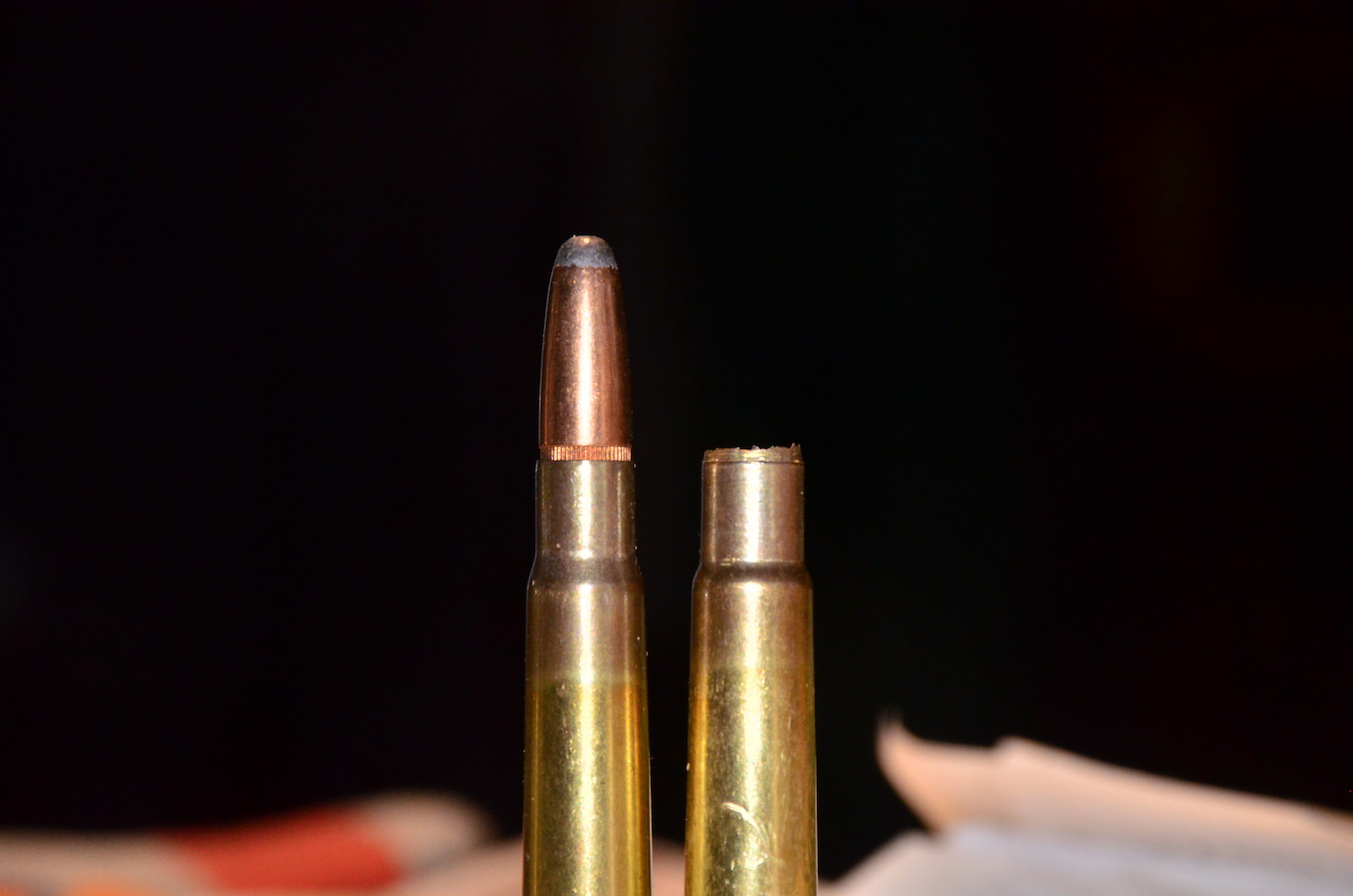
Just looks like Andy said, no leade in the chamber, factory brass fits fine, but when fired flows into the rifling. The mouth of the case is still in the same spot after firing.
I would send that off to a gunsmith to correct, and also have them look at the chatter mark or pitting in the chamber leaving that mark.
I would send that off to a gunsmith to correct, and also have them look at the chatter mark or pitting in the chamber leaving that mark.
Look at the last photo the OP posted from the case mouth below the brass flow. Max case length is 2.222 and trim length is 2.212 and the chamber should be a smidgen "longer" than 2.222.
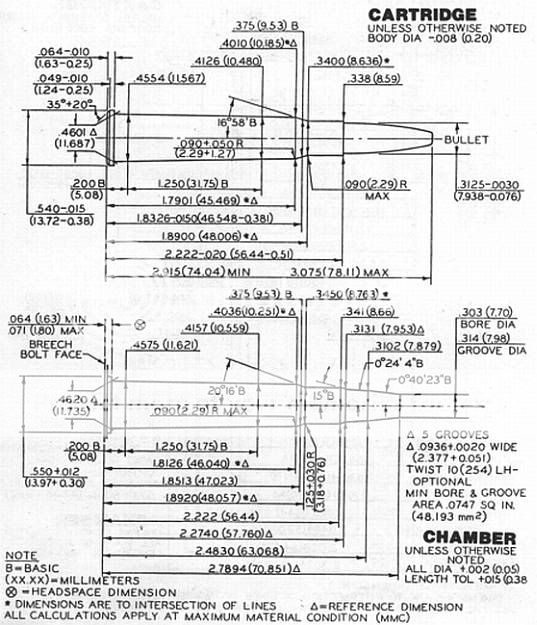
Is the chamber a little short or do I need new glasses? "BUT" looking at the SAAMI drawing I'm still wondering if this could be caused by a carbon ring formed ahead of "trimmed" brass.
Is the chamber a little short or do I need new glasses? "BUT" looking at the SAAMI drawing I'm still wondering if this could be caused by a carbon ring formed ahead of "trimmed" brass.
The rifle is a gunsmith conversion - one piece stock. Looks well done.
However, major work has been done. Is the barrel issue, unaltered? Has it been set back? Commercial replacement? What is going on with that gouge in the chamber? It is leaving marks on the brass. Because of the amount of customization done to the rifle, it is hard to say exactly what you have got.
Might be worth trying one round of ammunition other than the Ranger issue soft point, see if the problem is still there.
Only time I have seen fired cases that looked like that was with some early 50s European made 7.92x57 fired in a CA MG34. Other ammunition didn't present like that.
That barrel doesn't have a knox on it. I think you may have something here. Slightly short neck/throat/lead and MAYBE even a .308 in diameter bore to compound things????????????
If the chamber is gunsmith reamed, there is no way of knowing what reamer was used. The absence of a Knoxform suggests a commercial barrel. Might be worth slugging the bore.
Ganderite has made .30-.303s.
The chamber could be cleaned up, but the problem with introducing another reamer is that there is no way of knowing what is going to get cut. And no point in cutting the chamber oversize, even if headspacing is on the rim.
If it came to it, the barrel could be set back a turn, and rechambered.
A nicely cut SAAMI chamber results in cases with less fireforming than a military Lee Enfield chamber.
It is a nice looking sporting rifle; would be good to get it sorted out.
The late Ellwood Epps made one piece stock conversions, but there were other 'smiths as well.
Ganderite has made .30-.303s.
The chamber could be cleaned up, but the problem with introducing another reamer is that there is no way of knowing what is going to get cut. And no point in cutting the chamber oversize, even if headspacing is on the rim.
If it came to it, the barrel could be set back a turn, and rechambered.
A nicely cut SAAMI chamber results in cases with less fireforming than a military Lee Enfield chamber.
It is a nice looking sporting rifle; would be good to get it sorted out.
The late Ellwood Epps made one piece stock conversions, but there were other 'smiths as well.





















