Reloads wont chamber, Swiss K31

LeeEnfieldNo.4_mk1

CGN Ultra frequent flyer
Rating - 100%
28   0   0
Location
Alberta
So, Tried my first batch of Berden rimed Reloads today, had a bit of a problem.

For some reason my reloads will not chamber properly. Im using Surplus Berden GP-11 brass, resized with Hornady Full Length "7.5x55 swiss K31" dies, re-primed with Berden primers. I had a bit of trouble with light strikes at the range, turns out some of the cases were not clambering properly, A light tap of the bolt got most into battery but one would not chamber. Thinking back I should have stopped but I thought a light tap was alright. Hopefully nothing in the rifle got messed up.

Obviously something is wrong and I need to resolve this. I know the bullets are not touching the lands so rounds are not too long. I tried re setting the resizing die in case it was not all the way down, no change.

Suggestions?
 
I loaded bulk Win 150gr PPSP over 44gr of IMR 4895 in Privi brass with fed mag primers seated 2.893" OAL and shot .652" three shot groups from my K-31 at 100 yards. Killed a mule deer with it last fall.Harold
 
Just re-adjusted the die, took the crimp right out and loaded a dummy. Same problem. However, is a bit better then a last few dummies I loaded up.

Could case lenth do this? These are once fire brass so I didn't think to trim them.
 
I had same problem with some 308 reloads. I had to push the bullets in the case just a bit further and then they worked perfectly.
 
What type of bullets was used in this load? Bullets have to be in similar shape to what GP11 bullets look. If the ogive of the bullet is not correct, then no matter if the COL of the round is within speck it will still not chamber due to improper shape of the bullet.
K31s all have short throat and therefore require pointy bullets seated deep in the case.
 
What type of bullets was used in this load? Bullets have to be in similar shape to what GP11 bullets look. If the ogive of the bullet is not correct, then no matter if the COL of the round is within speck it will still not chamber due to improper shape of the bullet.
K31s all have short throat and therefore require pointy bullets seated deep in the case.

I am using berger 175g vld match. I measured the ogive of a gp11 round and seated the bullet to match.
 
If you have a fired case that has not been resized try chambering that case for ease of chambering. If it chambers easier than your resized case it could mean your die is not pushing the shoulder back far enough.

Below you can see the case gets "longer" as it is full length resized and squeezes the shoulder forward. And sometimes when the die is making hard contact with the shell holder with press camover the shoulder is still not pushed back far enough. When this happens you will need to lap the top of the shell holder a few thousandths at a time until the case chambers.

wm05ArY.gif


Chambers and dies vary in size and "sometimes" your die does not match your chamber and the case ends up too long after sizing. And then you decrease the hight of the shell holder to push the case further into the die. There is also the possibility the case diameter after sizing is too large, "BUT" most of these chambering problems are cause by the case shoulder not being pushed back far enough.

NOTE, normally when the die matches chamber size the die will push the shoulder back more than needed, and why having the gauge below is good to have.

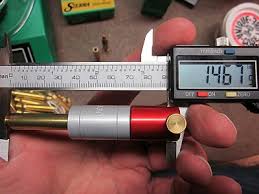
This is where having a vernier caliper and a Hornady cartridge case headspzes gauge is good to have to measure your unfired, fired and resized cases.

Below measuring a "fired" .223/5.56 case and then setting the die for .003 shoulder bump for my AR15 rifle. Meaning the resized case is .003 shorter than its fired length.

OJqNmQH.jpg


The older method without gauges was to color the case with a black felt tip marker and see where the color has been rubbed off in chambering.
 
I had a similar problem with my K31. It was my coal. The ogive of each bullet is different. Having said that try chambering a resized case without a bullet. If that's good, then seat a bullet to create a dummy round. Mark your bullet with a sharpie covering the entire bullet. Try chambering the dummy round, if it doesn't chamber then look at the bullet to see if then lands are biting it. I had to do this to find my coal using Hornady 168gr BTHP Match projectiles. The chambers in these rifles tend to be tight with no throat erosion.
 
Last edited:
Most shell holders have a bit of room that allows one to slip an ordinary feeler gauge below the case head. This allows you to get the case a bit further into the die with out filing or lapping the bottom of the die or the shell holder top. On several of my shell holders, I was able to get up to .010 feeler gauge inserted, which allows the case the be pushed up .010 more into the die, when the die is set to snap the press over center at the top of the stoke. Cheap quick way to check if the shoulder length is the issue, without making any permanent changes. Just keep trying a couple thousandths at a time while trying in your chamber, each time. I made some 7x61 S&H cases from some 7mm Rem Magnum cases that required a .005" feeler gauge under the case head to get the "full length sized" brass to chamber in that rifle
 
Most shell holders have a bit of room that allows one to slip an ordinary feeler gauge below the case head. This allows you to get the case a bit further into the die with out filing or lapping the bottom of the die or the shell holder top. On several of my shell holders, I was able to get up to .010 feeler gauge inserted, which allows the case the be pushed up .010 more into the die, when the die is set to snap the press over center at the top of the stoke. Cheap quick way to check if the shoulder length is the issue, without making any permanent changes. Just keep trying a couple thousandths at a time while trying in your chamber, each time. I made some 7x61 S&H cases from some 7mm Rem Magnum cases that required a .005" feeler gauge under the case head to get the "full length sized" brass to chamber in that rifle

That's one of the best ideas I've ever read on this forum lol. Thanks for that tip!

For my K31 I use Lee FL dies for first firing, and the collet die for subsequent loads. Never had an issue. I don't baby it when working the bolt either.
 
My first attempt to load the K31 had the same result. I had to seat the bullets a bit deeper. Humour us - try that.

Yes - K31 has a notoriously tight throat.

Use a felt marker on the cartridge - start with the bullet ogive and shoulder. Chamber it as far as you can then extract and look at the cartridge. The marks will tell you where the contact is. Then you'll actually know what the issue is and can take steps to fix it.
 
Last edited:
Just re-adjusted the die, took the crimp right out and loaded a dummy. Same problem. However, is a bit better then a last few dummies I loaded up.

Could case lenth do this? These are once fire brass so I didn't think to trim them.
I once reloaded some .308 for friend using brass he had only fired once. Reloads wouldn't chamber. Pulled the bullets, trimmed the cases, reloaded them and the rounds chambered fine. It's hit and miss. In some guns fired cases seem to stretch very little while in others they stretch more. It's worth checking the length of your sized cases to make sure they aren't over the max length.
 
Most shell holders have a bit of room that allows one to slip an ordinary feeler gauge below the case head. This allows you to get the case a bit further into the die with out filing or lapping the bottom of the die or the shell holder top. On several of my shell holders, I was able to get up to .010 feeler gauge inserted, which allows the case the be pushed up .010 more into the die, when the die is set to snap the press over center at the top of the stoke. Cheap quick way to check if the shoulder length is the issue, without making any permanent changes. Just keep trying a couple thousandths at a time while trying in your chamber, each time. I made some 7x61 S&H cases from some 7mm Rem Magnum cases that required a .005" feeler gauge under the case head to get the "full length sized" brass to chamber in that rifle

The problem with using feeler gauges in the shell holder is the case should be able to move and self center with the die. Meaning there should be slop in the shell holder to allow the case to move around freely and let the case self center with the die. Using feeler gauges will restrict the case movement and you can end up making a lopsided tilted case.

The Forster Co-Ax press is famous for its floating die and shell holder that allows the case and die float and self center.

The slop in the shell holder was put there for a reason, and its for case alignment with the die. And restricting the case movement in the shell holder is not a good idea.

Many reloaders remove the snap ring on the top of the ram and use a rubber O-ring to hold the shell holder. This allows the shell holder to move more freely and makes more concentric ammo.

RELOADERS CORNER: 4 Steps To Improve Standard Die Performance
http://www.mssblog.com/tag/dies/

Squeeze More Accuracy
https://gunsmagazine.com/squeeze-more-accuracy/
 
Never had issues with Redding dies K31.......I know Hornady is supposed to be for the K31 but never tried them.
 
Back
Top Bottom