Powder Problems

BOHROK

CGN Regular
Rating - 100%
64   0   0
Location
SW Ontario
Hi, I am hopeing to get some advise and input here, as I had a issue with my reloads yestarday. I made 50 rounds of 8x56r useing 39grains of Reloader 15, with cci primers and 208grain fmj bullets. I made them in early November when it was about -15 in a nonheated garage, brought them home to my place where they sat untill yestarday when I went out to shoot them. About 20 of the 50 failed to fire, the primers went off and the bullet left the caseing but the powder was not burnt at all and was still in the caseing discoloured(kinda pale looking). I wad thinking this was a condensation issue, or mabey not a good powder for the climate. I am very new to reloading and would greatly appreciate any help or input.

Thank you.

 
Do you wet tumble? Is it possible your brass wasn't completely dry before you loaded those rounds? I don't suspect condensation is the issue, but I have been wrong on occasion.
 
Can't tell you with certainty but moisture was my first thought. You wouldn't think such a small space would have enough water vapour to be an issue but if that's the only place it could have come from barring wet brass as mentioned above....

Also, you should move your powder and primers indoors at the very least if not all your reloading gear components. Temperature fluctuations are bad for causing them to degrade. Don't know how bad but it's something I've heard all my life and makes sense. Might be a contributing factor in your situation.
 
I know this is 3 weeks or so ago, but what did you do to the brass before you loaded these...? Tumble? Assuming it is water, it had to come from somewhere, and there isn't a lot of water vapour present at -15 C.

How was your powder stored; and did it pour cleanly into the hopper? Maybe get a look at the powder either in the hopper or in the container now and see if it is contaminated somehow.
 
It was new brass so I didnt tumble it before loading, I found it odd that only some of them failed. I do store my powder and primers in a unheated garage, and reload in it there, by the sounds of it I should move my reloading system indoors. Thank you for the help!
 
Mine has always been out of the house unheated and never had an issue
What type of container was the powder in and was it opened prior
If gone bad why only 20 and not 50

Cheers
 
Temperature (cold) is not a problem. Water vapour in the air would be about nil, so not a condensation issue.

Is there a lot of air space in the case? Is it a mild load?

if yes and yes, try more powder and a magnum primer.
 
There is a lot of space, I could up the load but I dont want to push it too far, my Steyr is 100 years old, is there something I could use as filler instead? Would that help? Also is it safe to use a magnum primer?
 
Temperature (cold) is not a problem. Water vapour in the air would be about nil, so not a condensation issue.

Is there a lot of air space in the case? Is it a mild load?

if yes and yes, try more powder and a magnum primer.

My first thought was too mild a load. 39.0 grs of Re15 with a 208 gr bullet is below a typical starting load in the 8X57, and the 8X56R has a bit more capacity than the 8X57. Some M95 rifles have very generous throats which exacerbates the situation.

Did you use a 0.329" bullet? What's your OAL? How far from the rifling is the bullet seated?
 
There is a lot of space, I could up the load but I dont want to push it too far, my Steyr is 100 years old, is there something I could use as filler instead? Would that help? Also is it safe to use a magnum primer?

The load data is published for that rifle. Either add more powder or switch to slower powder that would fill the case more - like 4350 or 4831 if you have it.

And a magnum primer will help with a marginal load.
 
What would be a better load for this rifle, I am open to suggestions! I do use a .329 bullet and the over all length is as close to the length suggested by the lee reloading data as I could make it. The Lee data sheet suggested 3 powders that I cant seem to find, I have used reloader 15 for my other milsurps so I used it for my steyr. I do not know how to measure bullet seat to rifleing so I cant help there sorry
 
CCI primers are very mild, and have hard cups. Add a 100 year old striker spring, and a cold day and you get what you got.Too many things pullin the wrong way.

Change to a Federal primer which has a softer cup and more sensitive compound and you'll probably solve the issue with no
other changes. A magnum primer is even more likely to work, because you can add hotter flame to the list of factors pulling in the right direction.


In a general sort of way I treat a magnum primer like one extra grain of powder as far as expected pressures go. Not a big deal with mild loads.
 
What would be a better load for this rifle, I am open to suggestions! I do use a .329 bullet and the over all length is as close to the length suggested by the lee reloading data as I could make it. The Lee data sheet suggested 3 powders that I cant seem to find, I have used reloader 15 for my other milsurps so I used it for my steyr. I do not know how to measure bullet seat to rifleing so I cant help there sorry

There's no real "trick" to loading the 8X56R in the M95 rifle. Use 8X57 loads, of which there are many. The 8X56R has slightly more case capacity and a slightly larger bore, so the 8X57 loads will be at slightly lower pressure when loaded in the 8X56R.

As for the M95 rifle in which it will be shot - the 8X57 loads will be safe in it. It's a very strong action in which many thousands were rebarelled in 8X57, e.g. the M95M.


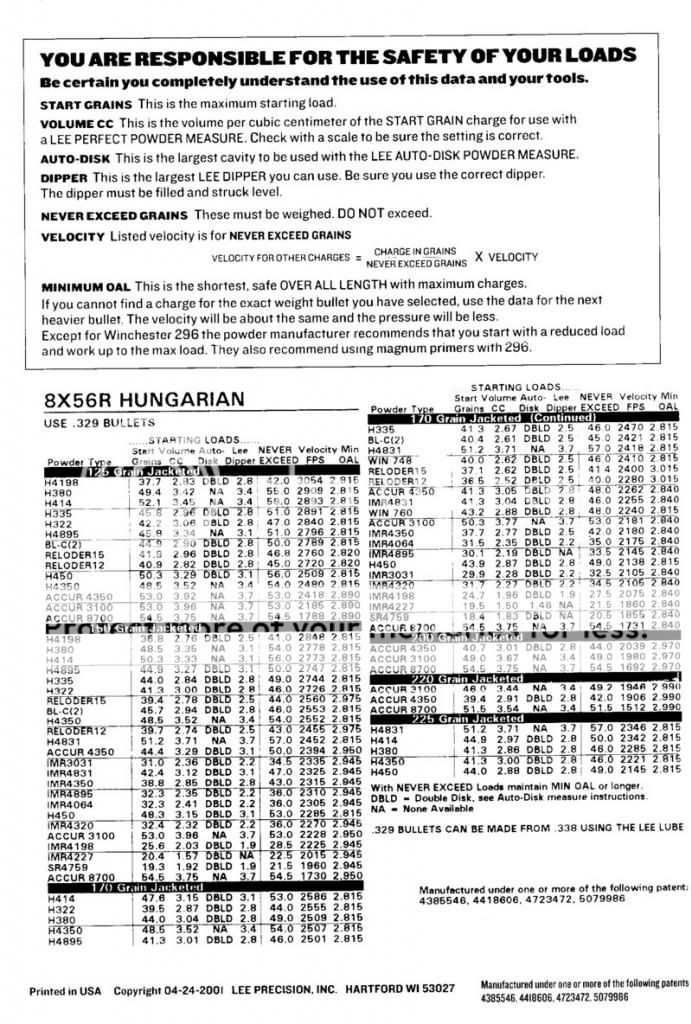
Below is the Load Data Sheet included with the Lee Dies. I was reluctant to share it, as while I don't see any of the loads as unsafe, there is no apparent rhyme nor reason to what's included:

Examples - A very zippy load for the 150 gr with H4198, and hotter loads for the 225 gr jacketed than most for the 170 gr. That said, the value is that there is a vast collection of powders used including some that are good for cast bullets.

I especially liked the "out of the box" idea at the bottom suggesting that 0.329" bullet can be made by resizing 0.338" bullets using the Lee Lube-Sizer. I've done it and it works.

8x56loaddata.jpg
 
Last edited:
Thank you everyone for the advise on reloading this round. This is why I love this site! I will for sure be trying some new loads soon and I will post on this forum when I do.
 
What would be a better load for this rifle, I am open to suggestions! I do use a .329 bullet and the over all length is as close to the length suggested by the lee reloading data as I could make it. The Lee data sheet suggested 3 powders that I cant seem to find, I have used reloader 15 for my other milsurps so I used it for my steyr. I do not know how to measure bullet seat to rifleing so I cant help there sorry

I can suggest two ways:

1. seat the 208 gr bullet in a sized, but uncharged cartridge and seat it progressively deeper by about 0.050" increments until you can easily chamber the dummy round. Don't force it. Once done, the resulting OAL will approximate the OAL at which the bullet is engaged with the rifling. With this method, problems can ensue in that sometimes the bullet is not engaged in the neck enough to resist the pull of the rifling when it is extracted and will be pulled from the cartridge; or
2. take one of the 208 gr bullets and drop it nose-first into the chamber. The rifling will stop its fall. Hold it gently against the rifling with a pencil or dowel and measure the distance from the bullet point to the muzzle with another dowel or the flat tip of a cleaning rod. Remove the bullet and repeat by measuring from the muzzle to the bolt face. The difference is the OAL at which that bullet engages with the rifling. If done carefully, this is more accurate than Method #1.

That said:

I have never heard a reliable account where the situation you described was due to contaminated powder or primers. It has almost always been related to the powder used, and most often the amount of powder used, with the reloader going well below recommenced Start Loads. With all of the cautions against overloads, it's easy to understand why the notion of "the lower the safer" comes about. The reality is that all rifle powders have a lower pressure limit beneath which ignition is unreliable. With pistol powders, the lower limit is much lower, and the problem becomes bullets that don't reliably exit the bore.

Here's hoping that you can make that old girl shoot well. I have owned several M95's and was never able to get one to shoot accurately enough to satisfy me, but others have.
 
Last edited:
Back
Top Bottom