













































Python Problems

Ganderite

CGN Ultra frequent flyer
Rating - 99.7%
355   1   0
I took 9 different 357 revolvers to the range today to test some ammo. Doing a load development for a new powder.

Tested 9.0, 9.5 and 10.0 gr of powder, generating 1150 to 1300 fps with a 158 gr Lead SWC.

Ammo worked well in all but one of the guns, with most grouping best with the 9.5 gr.

The Python shot fair with 9.0 gr. 25 yards.
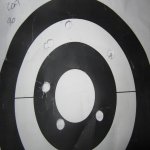
IMG_1628.jpg

But both the 9.5gr and 10.0 gr loads tumbled. Any idea why? I have not looked to see if there is adequate rifling.
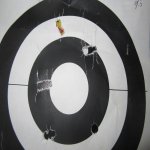
IMG_1629.jpg

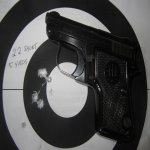
Ignore the 22 short picture. I don't know why it is there and I can't seem to get rid of it. Shot at 5 yd, BTW.

 

Attachments

  • IMG_1628.jpg
    IMG_1628.jpg
    54 KB · Views: 558
  • IMG_1623.jpg
    IMG_1623.jpg
    65.8 KB · Views: 560
  • IMG_1629.jpg
    IMG_1629.jpg
    58.6 KB · Views: 555
Commercial DRG lead bullets. Will check diameter.

Just looked at the gun. I see severe leading in the barrel. This is almost the first time I shot it, and had not cleaned it before. I had better clean it and re-test.
 
Projectiles too hard? Undersized throat? What secret powder are you using? lol. Blue Dot? AA#7?
 
Last edited:
These bullets have worked well in 50 other 357s and 38Spls, so it is not a bullet issue, unless there is a diameter incompatibility.

There is heavy leading from one end of the barrel to the other. I will clean and polish it and try again.

Powder is a non-cannister powder. Flatened ball a little slower than Unique. Around N-350 ish. I have 36 pounds of it, so will use it in ammo like 357, 9mm, 40 S&W and 357 SIG.
 
These bullets have worked well in 50 other 357s and 38Spls, so it is not a bullet issue, unless there is a diameter incompatibility.

There is heavy leading from one end of the barrel to the other. I will clean and polish it and try again.

Powder is a non-cannister powder. Flatened ball a little slower than Unique. Around N-350 ish. I have 36 pounds of it, so will use it in ammo like 357, 9mm, 40 S&W and 357 SIG.

There it is...

Start measuring, lol.
 
Powder is a non-cannister powder. Flatened ball a little slower than Unique. Around N-350 ish. I have 36 pounds of it

You have 36 lbs of an unknown powder you're playing around with? Isn't that a little risky?

M
 
Last edited:
These bullets have worked well in 50 other 357s and 38Spls, so it is not a bullet issue, unless there is a diameter incompatibility.

There is heavy leading from one end of the barrel to the other. I will clean and polish it and try again.

Powder is a non-cannister powder. Flatened ball a little slower than Unique. Around N-350 ish. I have 36 pounds of it, so will use it in ammo like 357, 9mm, 40 S&W and 357 SIG.

Lead and 1150 fps/no GC. It's a no-brainer leading will be rather heavy IMO.
Yeah, clean before AND after firing friend.

cheers
 
Lead and 1150 fps/no GC. It's a no-brainer leading will be rather heavy IMO.
Yeah, clean before AND after firing friend.

cheers

Hmmmm. Come to think of it, this is the first time I have loaded cast bullets to higher velocity. I usually shoot 38Spl velocity in the 357s.

I looked in the others, and I see some leading. Much more than usual. So if the barrel was leaded before I started, it could build up quickly and cause the tumbling.

I will clean and shoot the same ammo again. I still have some.

IS unknown powder risky? Yes, it is, but this is not exactly "unknown". The maker supplies it with a fair amount of technical data that allows me to estimate a start load and I pick a max velocity suitable for that general speed or powder. In this case I found 10.5 was 1385 and I thought that was too hot, so I tested 9.0, 9.5 and 10.0. I have done this type of thing many, many times.

Non-canister grade powders can come with an huge range of burn rates. Some 4895 is as slow as 4320 or as fast as 3031. Each lot has to be tested and a load developed to deliver the intended velocity.
 
^Yeah, respectfully I kind of find it unusual such a handgun enthusiast as yourself has made this odd powder known/unknown omission.
Plus Colts DA revolvers are known to have slightly tighter bores than other revolvers of different make IIRC.

Be safe friend.

Edit: I only feel qualified to answer here, because I own a Colt Model 3-5-7 made in 1956.
 
Last edited:
^Yeah, respectfully I kind of find it unusual such a handgun enthusiast as yourself has made this odd powder known/unknown omission.
Plus Colts DA revolvers are known to have slightly tighter bores than other revolvers of different make IIRC.

Be safe friend.

Edit: I only feel qualified to answer here, because I own a Colt Model 3-5-7 made in 1956.

Colts in .38 & .357 including the Python have a .355" groove diameter. They will shoot very well with .358" lead bullets and .357" jacketed. Keep the velocity under 1000fps for the lead bullets without a gas check to prevent excessive bore leading.
 
Velocities well above 1000 ft/s can easily be obtained without a gas check. I doubt velocity is your problem. I think you have a bearing surface issue with a unknown powder sprinkled on top, lol.

I could be wrong, I probably am, but when you resolve the issue please make sure to update us.

Cheers.
 
Thanks. Was unaware about Colt having a tight bore. This is my first foray into higher velocity with cast bullets. 99% of my shooting is medium to mild lead bullets and 1% with jacketed.

I just cleaned the Python. I was sprayed with lead particles.

Out of respect for it, I will just develop some target loads for it. Around 800 fps.
 
Velocities well above 1000 ft/s can easily be obtained without a gas check. I doubt velocity is your problem. I think you have a bearing surface issue with a unknown powder sprinkled on top, lol.

I could be wrong, I probably am, but when you resolve the issue please make sure to update us.

Cheers.

I don't understand what you mean by bearing surface and sprinkled powder. The 158 SWC is not exactly a new concept in bullets. And this powder has worked well in 500,000 9mms, a similar pressure as my 10.0 gr load.
 
I took 9 different 357 revolvers to the range today to test some ammo. Doing a load development for a new powder.

Tested 9.0, 9.5 and 10.0 gr of powder, generating 1150 to 1300 fps with a 158 gr Lead SWC.

Ammo worked well in all but one of the guns, with most grouping best with the 9.5 gr.

The Python shot fair with 9.0 gr. 25 yards.

View attachment 135134

But both the 9.5gr and 10.0 gr loads tumbled. Any idea why? I have not looked to see if there is adequate rifling.

View attachment 135142

Ignore the 22 short picture. I don't know why it is there and I can't seem to get rid of it. Shot at 5 yd, BTW.

Anyone shooting lead bullets in a handgun should look at investing in a Lewis Lead Removal Kit. They are still available from Brownells. I started using one in my PPC guns in 1981 and have been using one ever since.
 
I am not a expert in this , but I would run a batch of jacketed bullets in the python, and see what happens.
I have found that some pythons seem a bit tighter in the barrel than say S-W.
But that in itself should not create a big leading problem, but I think you are pushing lead a bit fast, if no gas check.
That much powder should keep you in the game for a little while at least.
I know some handloaders just hate to buy jacketed ammo, but I would give it a shot in the python, that is agun you don't want to mess up.
Good luck
 
I have access to a Lewis. Until now, hardly ever needed it because I have not shot at higher velocity.

This has been educational. I thought it would be a good idea to make 1000 rounds of near max 357 so I could feel what a 357 is supposed to feel like from time to time. I will get some Campros for that project.

The other thing that I learned is that the standard Fiocchi primer craters at high pressure and jams the revolver. I don't have any magnum pistol primers, so will try some CCI small rifle. I have lots of those.
 
Back
Top Bottom























