Reloading 223 AR15

Weremey59

Member
Rating - 100%
2   0   0
Location
Calgary
Het Gent''s

So I just bought my first AR this week and I am wondering about ammo. I reload absolutely everything for my rifle's however I'm wondering what to look for when it come to the rifle cycling properly, over/under gassing etc. I have never owned a semi auto (other then my sks but that doesnt count:) before let alone a direct impingment. I made up to loads last night. 21gr of imr4198 and 18.8gr of H4895 on a 55gr pill. The rifle is a DDM4V7 16" barrel. Mid length gas system. This is more of a general question to find out what to look for in my AR that may effect it negatively.
 
I load for my MV,which is basically a AR15.

I don’t do anything different, I use my FL dies and load to specs, no crimp.
I don’t have any issues.
 
I would not load without a crimp personally. Rounds are stripped with some force and you would never know if a projectile has been compressed, until you find out the hard way.
 
Below is a link to a PDF from Sierra on reloading for AR-15's. It should give you a good idea of what you need to consider when reloading for an AR compared to reloading for a bolt action.

https://www.google.ca/url?sa=t&sour...FjAAegQICRAB&usg=AOvVaw0ewAFy0QVDzkj9RAWDK5Lw


Are the two loads you built just random powder charges picked from somewhere between book max and min?

The biggest mistakes I see people make when reloading for a semi are:

-Try to make match grade ammo like they do for a bolt action by trying to load projectiles out as long as possible rather than just loading to the COL suggested by the bullet manufacturer. This will sometimes reduce reliability, I just load to the suggested COL and rarely have feeding issues. Once I find a load my barrel likes I may try to fine tune it by playing with the length but I always keep them short enough to fit the magazine and I always watch for binding as it strips the cartridge from the magazine. To me reliability is more important than trying to squeeze 0.2 moa more out of a load.

- they don't use a full length die set and instead just neck size which will typically result in feeding issues. Always use a full length sizing die and test your sized brass in your chamber. If it's difficult or sticks in the chamber you may need to try a small base die. This is different for every rifle but so far I've been lucky and haven't need to use small base dies for any of my 223's.

-they try to run too heavy of a projectile because that's what people think is needed for precision accuracy, you can run projectiles as high as 77gr and still get them into the magazine but if you're not shooting past 300 yards you probably won't see much difference in accuracy regardless of twist rate. Many people seem to think that a 7 twist barrel won't shoot a light bullet well and that it needs a heavy projectile which is wrong. A tight twist is needed to stabilize a heavy (long) projectile at extended ranges but it will still shoot light projectiles just fine at shorter distances, you can't over stabilize a projectile but you can spin a thin jacketed varmint bullet so fast it comes apart as it leaves the muzzle. I've done this and it's pretty neat but you figure it out pretty quick and you just pick a different projectile and try again.

When reloading for my semi autos I usually try to use a powder a little on the slower side for the bullet weight. This gives the action a smoother gas pulse which is easier on the rifle than the sharper hit it would get from a faster powder.
It's pretty easy to load for an AR as long as you take a little time to understand what the action requires for it to cycle smoothly. AR's are pretty forgiving but some rifles like an M14 or Garand can be a little more sensitive to powder burn rates.
 
Last edited:
dont forget the primers, I use the CCI 450( small magnum primer and or Federal 205AR), this is just precautionary to avoid slam fire.
 
dont forget the primers, I use the CCI 450( small magnum primer and or Federal 205AR), this is just precautionary to avoid slam fire.

I've loaded thousands of rounds of 223 with CCI400 standard small rifle primers and have never had a slam fire. I don't think this is as big of an issue as some make it out to be but there's also nothing wrong with being a little more cautious since the price difference is negligible.
I wouldn't bother with a magnum primer though, it isn't needed and will increase the pressure created in the cartridge which will throw off your reloading data. This can again be worked around with good load development techniques but just don't use a magnum primer and go straight to a load just under book max.
 
24 grains of imr4895 underneath a campro 55gr fmj works great for me. More accurate than I am with an iron sighted rifle, and brass ejects at 4:00 in a consistent pile.
 
I am just going to chime in with a more broad perspective for loading to feed an AR-15. I have kind of defaulted to my Soldiering days when we considered the C7A1 / C7A2 with the C79 Elcan a 2MOA rifle on average. That kind of stuck with me as a reasonable litmus test. One of the If that was not accurate enough for you then you are shooting too far, or you aren't using the weapons system correctly.

When I look at loading ammunition I am looking for reliability and positive functioning before absolute accuracy. I run iron sights on my AR-15's just so I do not get in the habit of pursuing anything beyond reasonable accuracy, if I can keep it in a 4" circle at 100 yards with iron sights off of a field improvised rest then I am happy. Slap an optic on and I do my part I see it drop to about 1.5" at 100. I tend not to be able to go smaller than that as I run a mil-spec trigger.

Because I value reliability over accuracy I ensure that everything is crimped, this significantly reduces the probability of bullet setback. When I did my load development I did it in the winter first and found the point in which I wasn't reliably getting the action to cycle then went up from there. Once it got hot out I confirmed that I wasn't showing pressure signs with the same ammunition. There is a bit of POI shift in summer/winter. However, the 4" circle just moves up and down a bit.

Re: Primer selection.

Primer selection is a relatively important especially if using a ball powder like CFE or Win 748 in cold weather (Canada). That is usually why the specify small magnum rifle primers as they have a higher brisance. Also, another thing is to ensure that you are actually seating your primers to SAAMI specification of 0.003" below flush +/- 0.001"
 
Ok all that makes sense from my reloading knowledge and what I have read. Now what about overgassing? I hear a lot said about that. Is it easy to feel? Is it quite violent? The loads I came up with above is out of my Lee book, that book hasn't ####ed me yet so I don't see why it would start now haha
 
Oh I used Cci 400 and I put a heavy crimp on it. Learned that one from my lever guns, seeing as how getting a collapsed round out of a tube mag sucks.
 
I've loaded thousands of rounds of 223 with CCI400 standard small rifle primers and have never had a slam fire. I don't think this is as big of an issue as some make it out to be but there's also nothing wrong with being a little more cautious since the price difference is negligible.
I wouldn't bother with a magnum primer though, it isn't needed and will increase the pressure created in the cartridge which will throw off your reloading data. This can again be worked around with good load development techniques but just don't use a magnum primer and go straight to a load just under book max.

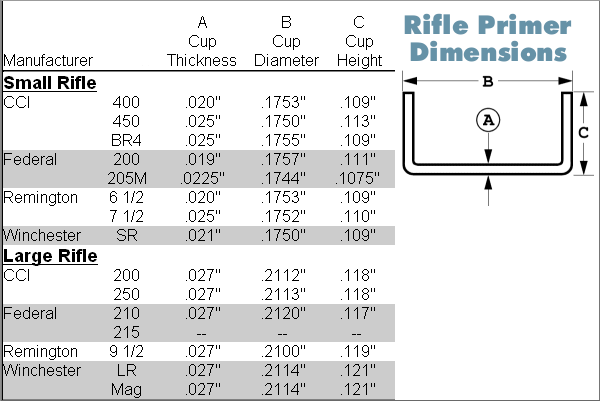
It is recommended that you use primers with a cup thickness of .025 to help prevent slamfires. The firing pin was lightened on the M16 rifle during field testing to lower inertia. The highest probability of a slam fire is when loading a single round without the magazine in place to slow bolt velocity. "BUT" a dirty bolt with carbon buildup or small brass slivers around the firing pin can cause a flam fire.

I have a simple answer, Remington ran our American Lake City Army Ammunition Plant from 1941 until 1982 and used the 7 1/2 primer for the M16 rifle. The initial ammunition used in testing had the 6 1/2 primers but slam fires occurred. The firing pin was lightened and the primer was switched to the 7 1/2 primer to help prevent slam fires.

calhoonprimers02.png


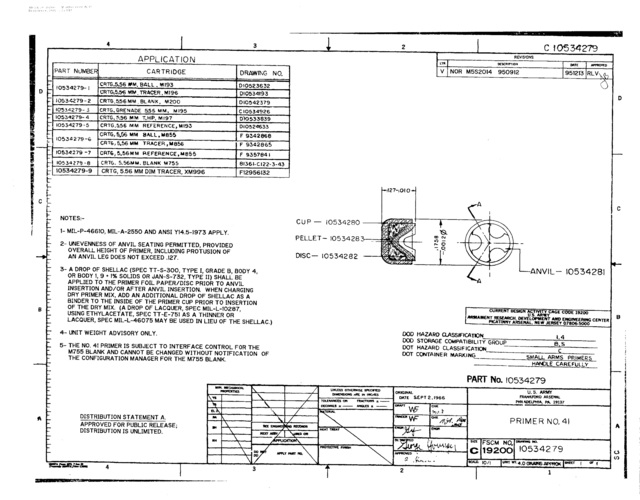
Below is the newer CCI #41 primer used at Lake City and you can see the primer cup is thicker in the base. The primer anvil is also shorter and the thicker cup and requires more force to set it off. That being said primer cups of .025 were used by Remington and then Winchester at Lake City until ATK got the contract in 2002 to produce ammunition at Lake City.

n8TOU36.jpg


Below are the gas port locations and the port pressures, and I made sure my carbine had a mid-length gas system and not pound the rifle as hard.

223plot.gif


Bottom line, use the reloading data for the M16/AR15 5.56 rifles as these loads have the proper port pressures.

Both the .223 and M193 5.56 ammunition was loaded to 55,000 psi "BUT" the later M885 5.56 ammunition is loaded to 58,700 psi and why you are told to not shoot it in .223 rifles.

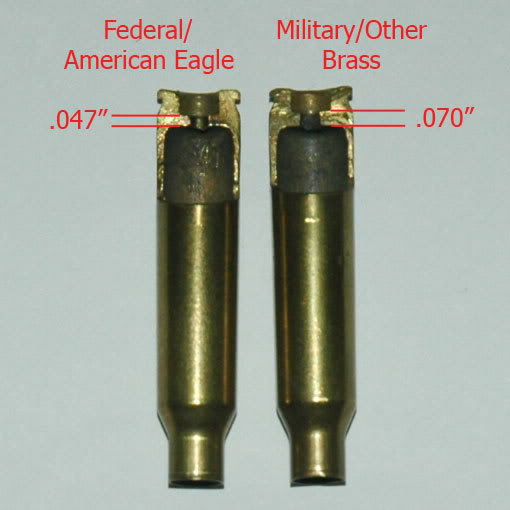
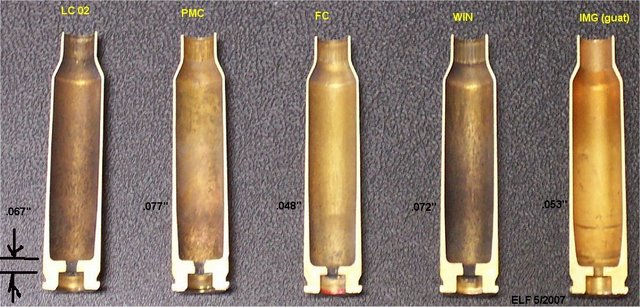
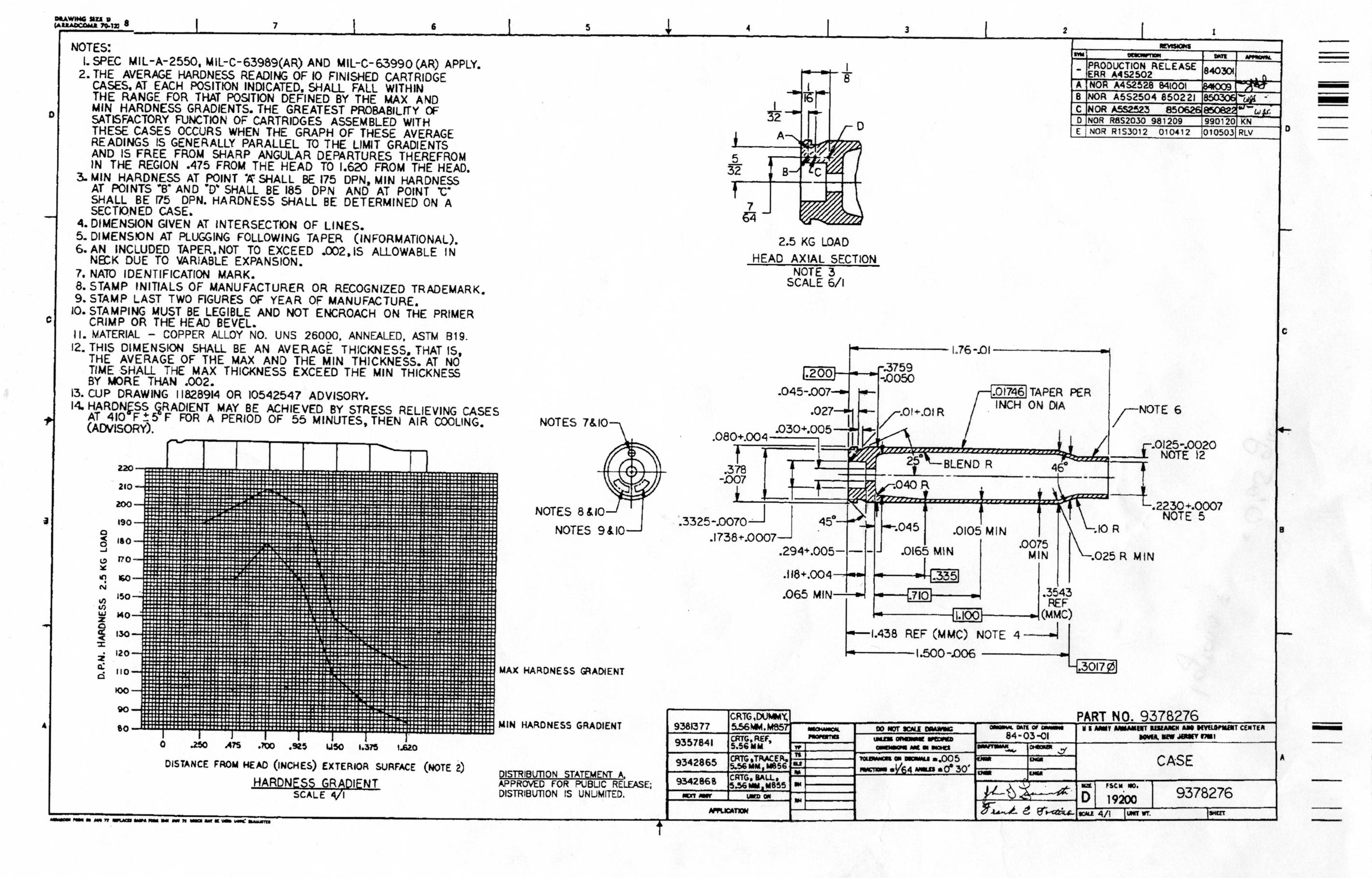
Also 5.56 Lake City military cases are made of harder brass and have a thicker flash hole web for added strength.

Below I have had brand new factory Federal .223/5.56 cases with oversized primer pockets after the first firing and could not be reloaded. Meaning pick good hard military type cases and your primer pockets will last a long time.

cYeTsDp.jpg


ohI86Bf.jpg


JcVlKzc.jpg


At the link below is some very good info on the .223/5.56 and free Sierra loading data on the .223 and 5.56.


223 Rem + 223 AI Cartridge Guide
http://www.accurateshooter.com/cartridge-guides/223rem/

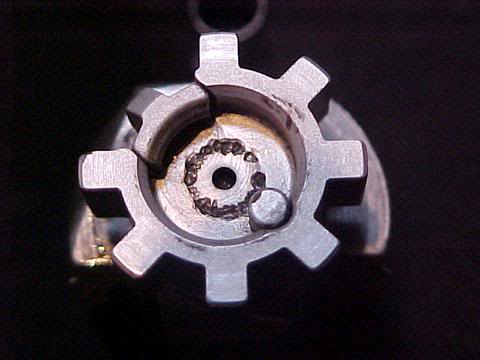
Below is what happens when you use cases with loose primer pockets. A over gassed AR15 can have the bolt moving to the rear while there is still pressure in the barrel. Meaning cause a etched bolt face and a primer can fall out of the primer pocket and jam the trigger group.

VMkEdYr.jpg


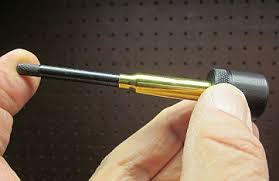
I use a Lee depriming tool to check the case if the primer seats easily, if I can move the primer with just finger pressure the case goes in the scrap brass bucket.


m1PlERq.jpg
 
Last edited:
Het Gent''s

So I just bought my first AR this week and I am wondering about ammo. I reload absolutely everything for my rifle's however I'm wondering what to look for when it come to the rifle cycling properly, over/under gassing etc. I have never owned a semi auto (other then my sks but that doesnt count:) before let alone a direct impingment. I made up to loads last night. 21gr of imr4198 and 18.8gr of H4895 on a 55gr pill. The rifle is a DDM4V7 16" barrel. Mid length gas system. This is more of a general question to find out what to look for in my AR that may effect it negatively.


Isn't 18.8 of H4895 a lot on the light side? How did it work out? Did it cycle properly?
 
Ok all that makes sense from my reloading knowledge and what I have read. Now what about overgassing? I hear a lot said about that. Is it easy to feel? Is it quite violent? The loads I came up with above is out of my Lee book, that book hasn't ####ed me yet so I don't see why it would start now haha

I have 5 ARs. Gassing is quite different.

Take your powder (say 4895) and load 5 of each, in 0.5 gr increments from 17.0 to 25 gr. (55 gr bullets) Shoot these and watch for 2 things. Did the action cycle? How did they group?

In your log book, note the power charge where all 5 cycled the action. This is the absolute minimum load. I would not load anything less than 1 gr more than that load. And I try to avoid shooting anything much hotter than 2 gr more, unless it is really required for an accuracy issue.

Over gassing. If the action cycles well with 21 gr and is very accurate at 23 gr, why load any hotter? You will notice that if the light loads cycle, the hot loads will really slam the action. This is what I try to avoid.

If you have 2 powders, run the same test with both. For the 4198, load 16 gr to 23 gr, and if the action is running at 19, don't shoot the 23.
 
This the kind of discussion that encourages men to do reloading, just pure no nonsense contribution to the topic.
 
What Ganderite said,
I'll add that if you are really overgassed you'll feel the carrier slam the back of the buffer tube and the worst I've experienced was with a 16" NEA barrel that was so overgassed that the trigger reset was actually painful, you couldn't hold the trigger then slowly release it to hear the click as it reset, it would slam so hard that it would force the reset and bruise the trigger finger after a hundred rounds. I sold that barrel.
Depending what you are reloading for, ie, competition, long range, plinking, just to save money, you can go with what he said and just find what the minimum needed to cycle and load a grain hotter to ensure reliability as the action gets dirty or continue a little hotter till you find a nice accuracy node then change your buffer weight and/or recoil spring as required to tame it down if it's a little out of balance with the recoil system.
Reloading for a semi auto is about balancing the system, you can do it through the ammunition or you can adjust the rifle to compensate for the ammunition if you are getting good accuracy and no pressure signs and want to use a certain load. The options are pretty endless.
Typically you shouldn't need an adjustable gas block unless you are shooting competitively and switch to a low mass carrier and want to tune the rifle to reduce felt recoil as much as possible.
If you need an adjustable gas block to tame a factory built rifle shooting factory ammo there is a problem with the manufacture of the rifle.
Most of the guys who have issues with their rifles seem to be the guys that don't understand this balance that must be achieved and they take a 20 inch rifle and swap in a 10 inch barrel and think that it should just work. They usually find out there is more to it than that though and get frustrated trying to get their rifle to run correctly.

bigedp51
I won't try to argue any of what you posted as it's all true, I just think it gets a little blown out of proportion on the forums considering most of the problems experienced were many years ago and guys running a modern semi auto AR-15 will most likely never experience a slam fire no matter what primers they use or how they drop the bolt. I'm sure it's possible though and for utmost safety and considering the cost difference is negligible it is sound advice to just use the thicker cup primers. I use CCI400 because I have a few thousand of them and most of my 223 shooting these days is through my ACR and bolt action rifles.
 
Last edited:
While it is prudent to maintain techniques and standards to prevent slam fires, they are not something one needs to necessarily worry about in a modern AR. Mods were made early on with firing pin design, and outside of a serious collector, it is very highly unlikely someone as a new hand loader is loading for an early M-16.

I use Fed 205m and 210m match primers, arguably the softest primers out there, in my AR-15 and my AR-10 match loads.
I’ve fired tens of thousands of rounds with both and never an issue. Good case prep and proper seating (including depth) is what matters with primers, not the brand or type.
Proper cleaning and maintenance of the firearm is a given, but I suppose should be mentioned.
 
Last edited:
One thing I forgot to mention in my last post is that all that talk about balancing the system is a little overkill, things have to be pretty far out of whack to actually need to change components in the rifle. They are fairly forgiving as long as you stay away from short barrels with pistol length gas systems and as long as your barrel has the correct size gas port.
 
One thing I forgot to mention in my last post is that all that talk about balancing the system is a little overkill, things have to be pretty far out of whack to actually need to change components in the rifle. They are fairly forgiving as long as you stay away from short barrels with pistol length gas systems and as long as your barrel has the correct size gas port.

Based on the factory-made ARs I have and have had, 3 out of 7 are over gassed. One is badly over-gassed.

This is not a problem for my shooting. I shoot CQB, which is all short range, so down loading ammo is no problem. If I was shooting Service Rifle (up to 500 yards) I would have to change something in the rifle.
 
Based on the factory-made ARs I have and have had, 3 out of 7 are over gassed. One is badly over-gassed.

This is not a problem for my shooting. I shoot CQB, which is all short range, so down loading ammo is no problem. If I was shooting Service Rifle (up to 500 yards) I would have to change something in the rifle.

Yup, mild (regular) overgassing is not really a problem and can be worked around pretty easily, severe overgassing like some of the older NEA barrels you're pretty much stuck with buying an adjustable gas block or a new barrel.
 
Back
Top Bottom