Case neck spring back

Lead hammer

CGN Ultra frequent flyer
Rating - 100%
3   0   0
Location
Saskatoon
So as most of you know I have been playing with my new Lee collet die. I noticed something that I did not pay attention too with my Redding neck die. ( plan to look at that )
With the Lee collet and once fired brass, i get spring back, and is what I expected, what I did not think about was the NEW case spring back in the opposite direction. As in after sizing, the mandrel does not fit the case mouth. I was focusing on getting enough tension on the once fired, now on the NEW brass set up, you have to focus on not enough and too much since neck tension apparently. I found this interesting.
( As I am a stay at home dad, I ask questions too much since I have trouble waiting for a moment in the day to test, sorry )

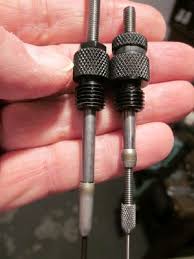
EDIT Added picture, one thing to note is that this was a sample of one of each. As my reloads were previously developed with the Redding neck die, and new brass, it will be interesting to see if I need to sand down the mandrel on the lee to get 0.003" neck tension or if it will like 0.002" the same or maybe better. Also interesting to see how much spring back I will gain on the 3rd reloading. Makes a guy wonder if on every consecutive load, a different mandrel can be used instead of annealing since Hornady brass supposedly suffers from primer pocket failure and not cracked necks?

QyEsOwHh.jpg
[/IMG]
 
Last edited:
If too much force is used with the Lee collet die it can pucker the case neck. Meaning the gaps in the collet will allow brass flow into these gaps and when compressed the inside of the neck is not perfectly round.

This is just one thing that I have against the lee collet die and prefer full length resizing with a expander.

Google polishing the Lee collet die and this includes sanding between the collet slots to remove any sharp edges and burs. Then follow the Lee directions for die setup and stop using camover. I have had Remington .223 cases with over .009 thickness variations and case neck like this do not size properly in the Lee collet die. Meaning when using the Lee die the thick side of the neck is compressed more than the thin side and distorts the neck.

So again follow the Lee dies instructions and size the case once, then rotate the case 1/8 turn and size again. If you see raised vertical ridges on the case neck you are squeezing the neck too hard. This is why I do not like the Lee collet die, I use a Redding neck thickness gauge to sort cases and did not like the raised speed bumps on the case neck from the Lee collet die.

B0haSAX.jpg


Bottom line, I prefer full length resizing with Forster FL benchrest dies because I only have to size the case once to get very concentric cases. I sort my cases for neck thickness uniformity into two groups, and the rejects are used as blasting ammo in my AR15 rifles. I do this because it is "less" work than turning the case necks for the same results in a factory rifle.
 
Bigedp51, thanks for the reply. Actually I did stop using the cam over, for a while, worked ok, it's just hard to feel when it's good and took longer, I was able to size to the case neck ID maximum before any marks though. I do the same thing in less time with cam over, sized to the max, no marks, 2 pulls of the handle. This post was more of a die/springback for interest sake. It shows that the Redding neck die is capable of making the same neck tension with both new and once fired brass, the Lee die, not so much. However the run out is better on the Lee. I may order a 0.001" under mandrel to try so I can use either 0.002 or 0.003" neck tension.
 
The reason so many people use the Lee collet die is because it does have "Less" runout than a bushing die when it come to neck sizing in larger factory chambers. But they also polish the die and lube the collet fingers. And if the collet was over compressed by too much force it will not spring open as far as it once did. Try shoving a phillips screwdriver or a rod in the the collet and gently open the collet finger sections. This is why the directions tell you to "NEVER" use the die without a case in the die. As this causes the collet to close up in diameter and make it hard to slide over the case neck. And the lube eases sizing effort as the collet closes under pressure.

But at the Whidden custom die website they tell you with their dies they get more concentric cases with a non-bushing die.

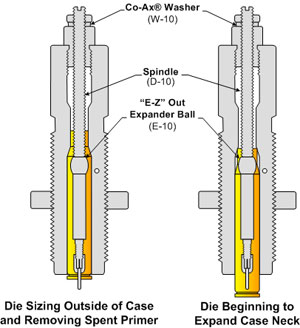
This is simple, if you remove the expander from a full length die and size the case it will be as concentric as it ever will be. The problem is if the expander is locked down off center it will pull the case neck off center on the down stroke of the ram. Some people remover the expander on a full length die and then use a expander die to expand the neck to the proper diameter.

Or some very smart, good looking and modest people ;) use the Forster full length die that can not pull your case necks off center and size the case once.

Sorry but I just can't make myself like the cheaply made Lee collet die that needs polishing and tweaking by its owners. :stirthepot2:

C8rGyKI.jpg
 
Last edited:
Yep, my die is functioning properly, not sticking, greased fingers, case neck slides up easily.
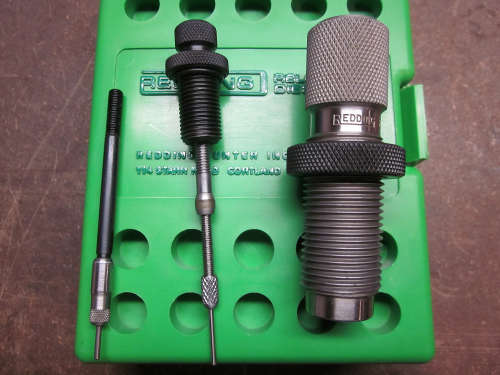
Yes the Redding die I have makes more run out than the Lee.
Yes the Redding die makes more consistent neck tension from new to once fired brass.

Does that Forster die have a bushing then?
 
Does that Forster die have a bushing then?

NO! The Forster full length benchrest die has a high mounted floating expander. The expander enters the case neck when the case neck is held and centered in the neck of the die. And this prevents the expander from pulling the neck off center and inducing runout.

Y7Iyv8o.jpg


You will get the most runout with bushing neck sizing dies for two reasons.

1. A bushing can move from side to side and even tilt when reducing the neck diameter .004 or more.

2. A neck sizing die does not fully support the case body, meaning the case body can be out of alignment with the neck of the die and its bushing.

So again a standard full length die with the expander removed will produce the most concentric cases. And the biggest cause of neck runout is when the expander is locked down off center.

Below I retrofitted Forster expander and spindle assemblies to all my RCBS dies. On the left a RCBS expander raised as high as it will move and the right a Forster expander that will fit RCBS dies.

5kfnKwd.jpg


Below a modified Forster expander and spindle assembly fitted to a Redding full length .243 die to reduce neck runout.

kWbieba.jpg


Bottom line, the Forster Co-Ax press and Forster dies are noted for making very concentric ammunition. The dies float in the Co-Ax press and the high mounted expander floats in the die.

The Forster benchrest seating die keeps the bullet in perfect alignment with the case neck and the bullet can not tilt when it is seated.

MomXeUI.gif
 
I agree with you, on the bushing dies, for sure necks would need to be turned, kinda why I had asked. I have a Forster Ultra mic seater die for one of my other rifles, it's nice. I actually tried bumping the shoulder back with my FL Redding die with the expander assembly removed, it worked but was a tight neck for sure. I have never used just an expander die, no idea how they work. Looking back in time, I would have totally got the Co-ax as well. So what kind of run out are you getting with the Forster FL??
 
I would worry less about measuring runout and listen to what the target tells you,,,, there are a lot of variables that can induce runout.... you can purchase the very best in concentric gauges but unless you become proficient in their use your beating yourself up
I shoot gophers at long range 600 yrds +, and shoot competitive srbr , 2-3 thou runout is norm in my world... just learn to accept it

custom ground dies is where its at.... neck turning for consistency is required, buy in or live with runout more than you like
 
I would worry less about measuring runout and listen to what the target tells you,,,, there are a lot of variables that can induce runout.... you can purchase the very best in concentric gauges but unless you become proficient in their use your beating yourself up
I shoot gophers at long range 600 yrds +, and shoot competitive srbr , 2-3 thou runout is norm in my world... just learn to accept it

custom ground dies is where its at.... neck turning for consistency is required, buy in or live with runout more than you like

Good point.

I have 3 different reloaded test batches ready to shoot. Maybe all or none of them will do better than my original load. Too cold to shoot, might as well share ideas and learn something new. I can do milk jugs at 600, it would be fun nailing gophers that far.
 
Back
Top Bottom