
Double post, dyslexic fingers
I do it all the time, no worry's













































Double post, dyslexic fingers

But man you can get some nice iron in while she is away..there are sacrifices to be madeNo, in June my wife and I are going to visit Vancouver, and I would rather visit Canada than stay home and eat peanut butter and jelly sandwiches and watch the dog and cats.


but when I shoot from the bench I love one hole groups. I enjoy making quality ammo.
But man you can get some nice iron in while she is away..there are sacrifices to be made

I really can't complain about my better half, last year 2017 I got three pistols and a .308 rifle.
Besides when we go to Vancouver I'm going to buy all the #3 Enfield bolt heads I can find. Then sell them for 10 times what I paid for them here in the U.S. and then buy some Lapua brass.
One other thing, I found this video last night and you people be the judge. But after testing many type and brands of .223 dies the Forster full length benchrest dies out performed every brand of die especially bushing dies.
Please note the variations in neck runout when using a bushing die below, bushing dies work best with neck turned brass in tight neck chambers. The problem is when you reduce the neck diameter .004 or more with a bushing die it can induce neck runout. And if you do not neck turn your brass Redding recommends sizing the inside neck diameter .004 smaller than bullet diameter and use the expander that comes with their bushing dies.
NOTE, in the video the Forster expander was removed and a expander die was used. To me this makes no sense because all of my Forster dies using their high mounted floating expander produced the most concentric cases with the least neck runout. That being said if you do not have Forster dies and use other brands a expander die will reduce neck runout vs the standard lower mounted expanders that can be locked down off center.
Bottom line, why buy Lapua brass and then use a die that causes neck runout.

I'm a cheap bastard and buy bulk once fired military 5.56 and 7.62 cases and sort the case into practice plinking and the best cases for more accurate ammo.ck
The problem today is Remington and Winchester are not what they once were and quality control is governed by the company share holders.
And it would also be a waste of money to buy Lapua brass and not have good dies and gauges to check concentricity
Your question depends on the caliber and the type hunting and range you do the hunting at.
Just remember when you are standing on your hind legs shooting off hand and pumped with adrenalin you will not see any difference in cases.
P.S. I cry even if I loose a Winchester case.
Example below of .223/5.56 cases, weight variations and case capacity. And you can see the military Lake City 5.56 cases come in fourth place for weight uniformity at a fraction of the cost of Lapua
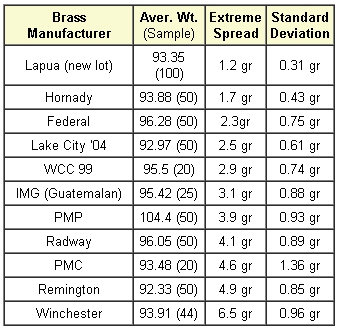
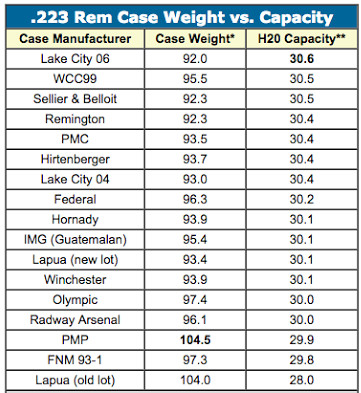
That's my goal to reach, I can see the finish line in the not so far future.I'm retired and my spending is supervised by my Finance Minster and she wants to go on another caribbean cruise to get warm.
The advantage to Lapua brass is the cases are more uniform and they need very little case prep.
But by buying cheaper brass and doing "more" case prep you save money.
And I'm retired with nothing to do and all day to do it.
I buy 1F brass off EE and load and shoot batches of the same headstamp. Keeps me under 1 MOA@100.
You will like Vancouver,it's a pretty neat place to visit.No, in June my wife and I are going to visit Vancouver, and I would rather visit Canada than stay home and eat peanut butter and jelly sandwiches and watch the dog and cats.






















