There are a number of older low pressure rounds and I was wondering what most people do now there are programs like quick load where pressure is indicated. Take the 9.3x62 for example max pressure is listed at 56500 psi. The 30-06 is listed at 60,000 psi. Why not have load data for modern rifles. The only data difference I have seen is for the Swede. Commercial vs Military. Is the problem the brass is still made to the original spec and can't take the increase in pressure?













































You are using an out of date browser. It may not display this or other websites correctly.
You should upgrade or use an alternative browser.
You should upgrade or use an alternative browser.
What pressure do you load to in modern firearms?
- Thread starter Shakky
- Start date

Pressure standards are governed by the oldest or weakest action the cartridge will be fired in. Example the 45-70 has three pressure levels in the reloading manuals depending on the age and type action. Factory .303 British is also loaded to the design pressures of the older Enfield rifles, but the newer No.4 Enfield was later chambered in .308/7.62.
Example below, the .270 Win is loaded to 65,000 psi but the older 30-06 is loaded to 60,000 due to older rifles still being used. Meaning a new Remington 700 30-06 bolt action could be loaded to the same chamber pressure as a .270 Win.
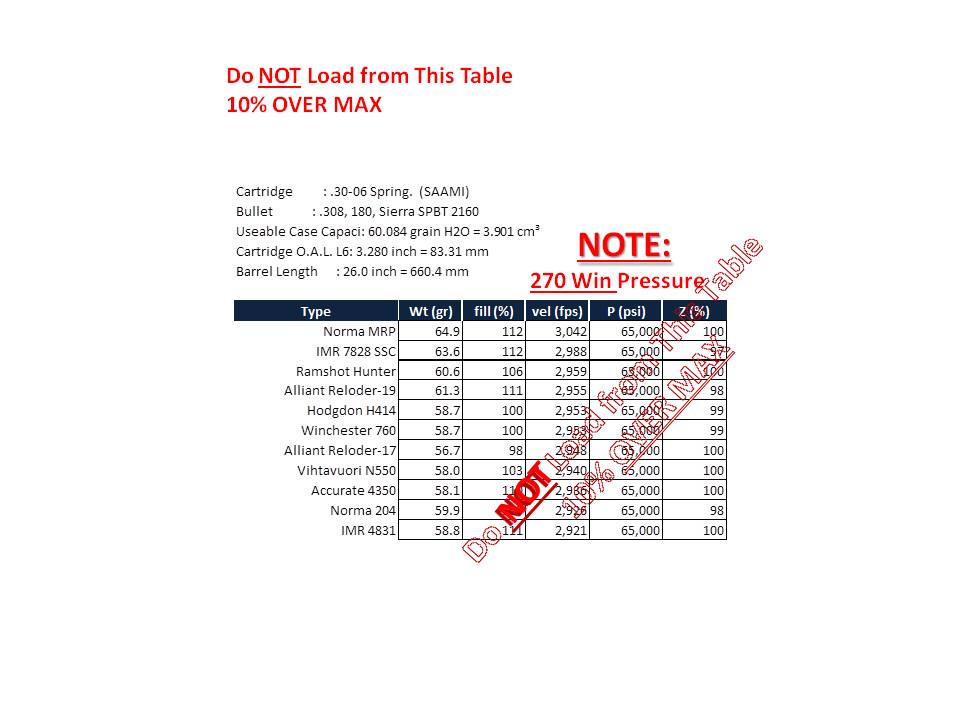
Cartridge Pressure Standards
http://kwk.us/pressures.html
Example below, the .270 Win is loaded to 65,000 psi but the older 30-06 is loaded to 60,000 due to older rifles still being used. Meaning a new Remington 700 30-06 bolt action could be loaded to the same chamber pressure as a .270 Win.
Cartridge Pressure Standards
http://kwk.us/pressures.html
There are a number of older low pressure rounds and I was wondering what most people do now there are programs like quick load where pressure is indicated. Take the 9.3x62 for example max pressure is listed at 56500 psi. The 30-06 is listed at 60,000 psi. Why not have load data for modern rifles. The only data difference I have seen is for the Swede. Commercial vs Military. Is the problem the brass is still made to the original spec and can't take the increase in pressure?
The chamber is what takes all the pressure, not the brass. A tin piece of brass would just explode under 56k psi of pressure.
The reason that most sources don't publish load datas for multiple guns is twofold:
1-For SAAMI calibres, they'll obviously publish only the SAAMI pressures. That's the minimum pressure a manufacturer of new rifles is supposed to support, so normally any rifle of the calibre should support any commercial ammo of the calibre;
2-For non-SAAMI, they'll mostly publish loads that will be ok in pretty much every rifle chambered with that calibre. For example, if you bought an old carcano rifle in 6.5×52mm Carcano, and a brand new rem700 in 6.5×52mm Carcano (suppose it exists), you could obviously make a hotter load in the rem700, but whoever publishes loads has no idea which rifle you're gonna use it in, so they go with the weak one, to make sure they don't get sued by some idiot who thought it would be funny to load a 100 years old rifle to today's pressure.
Even the +P and +P+ pressures sometimes seen (mostly for handguns) are not SAAMI and are not regulated in any way. They're kind of use-at-your-own-risks datas. That's why most of these you'll see in revolver calibres, as most people know not to use them in old wheelguns but newer revolvers are built like tanks (mostly anyway...). Also, it's just common sense that you can use 38spl +P in a 357 magnum revolver.
As for using quickload, you can do it, but you've got 2 problems:
1-It's a simulation, it's not reality. Reality can differ quite a bit from simulation; even the simulator was perfect (it isn't), just because you can't measure input parameters with 100% accuracy you wouldn't get a perfect result;
2-Even if the simulator was perfect and your inputs were perfect, how do you know what's the maximum pressure your rifle can take? Even if you're pretty sure that rem700 can take more than the 100 years old carcano, how much more? And what about a tikka or a savage? All these manufacturers had to do was build the rifle so it can take the old carcano's pressure, no one said anything about hotter loads. So the only way to find out is to increase the pressure until your rifle breaks. That's not my idea of fun.

- Location
- In the shadows of the Rockies
QuickLOAD is an approximation that makes a lot of assumptions. Only way to determine the actual pressure of any given load in your particular rifle is to measure it with appropriate instrumentation. Note that ANSI/SAAMI Z299.4 (2015) lists maximum average pressure limit (MAP) for the 9.3x62 as 57,500 psi (not 56,500 psi). See p.24.
Also note that for the 9.3x62 the case base diameter is 0.476". For the 30-06 it's 0.473". So for a given chamber pressure the thrust acting on the bolt face is higher for the 9.3x62.
http://www.saami.org/specifications_and_information/publications/download/Z299-4_ANSI-SAAMI_CFR.pdf
Also note that for the 9.3x62 the case base diameter is 0.476". For the 30-06 it's 0.473". So for a given chamber pressure the thrust acting on the bolt face is higher for the 9.3x62.
http://www.saami.org/specifications_and_information/publications/download/Z299-4_ANSI-SAAMI_CFR.pdf

QuickLOAD is an approximation that makes a lot of assumptions. Only way to determine the actual pressure of any given load in your particular rifle is to measure it with appropriate instrumentation. Note that ANSI/SAAMI Z299.4 (2015) lists maximum average pressure limit (MAP) for the 9.3x62 as 57,500 psi (not 56,500 psi). See p.24.
Also note that for the 9.3x62 the case base diameter is 0.476". For the 30-06 it's 0.473". So for a given chamber pressure the thrust acting on the bolt face is higher for the 9.3x62.
http://www.saami.org/specifications_and_information/publications/download/Z299-4_ANSI-SAAMI_CFR.pdf
Sheesh, Slamfire, do you really think that the bolt thrust is going to be noticeably greater for a diameter difference of .003"?
It works out to a area difference of .0022 sq. in. At 65000 psi this is a diminutive 143 lbs of extra thrust. At 57,500 it's 126 lbs.
I'll bet that shot to shot shows more difference than that. EE.
- Location
- In the shadows of the Rockies
Well let's see...
F = P x A
A = pi/4*d^2
Case head area ratio, 9.3 vs. 06: (0.476/0.473)^2 = 1.01273, so 1.3% more bolt face thrust on the 9.3 for any given chamber pressure compared to the '06.
1.3% > 0.0%.
F = P x A
A = pi/4*d^2
Case head area ratio, 9.3 vs. 06: (0.476/0.473)^2 = 1.01273, so 1.3% more bolt face thrust on the 9.3 for any given chamber pressure compared to the '06.
1.3% > 0.0%.

Purple shoulder
Regular
- Location
- Winnipeg MB
You didnt factor in the added friction of the larget case circumference to the chamber walls reducing bolt thrust. Better fire out a spread sheet.
The chamber is what takes all the pressure, not the brass. A tin piece of brass would just explode under 56k psi of pressure...
In almost any firearm design there are areas where the cartridge case is unsupported by the chamber walls or bolt face. Some more than others. Drop specimen cartridges into different barrels and observe how much cartridge is exposed. The cartridge case is a major factor in containing the pressure.

Well let's see...
F = P x A
A = pi/4*d^2
Case head area ratio, 9.3 vs. 06: (0.476/0.473)^2 = 1.01273, so 1.3% more bolt face thrust on the 9.3 for any given chamber pressure compared to the '06.
1.3% > 0.0%.
So what do your calculations prove? Is 1.3% more thrust causing a dangerous condition in this case? What do you recommend?
I think your calculations prove conclusively that Eagle Eye's assessment was correct - it's not enough to matter. But it might be interesting for some people.
As pressure ramps up the case undergoes strain and presses against the rigid chamber to withstand the pressure.
The brass does need to be strong enough to seal the chamber and withstand pressure in places where the chamber does not provide support.
The brass does need to be strong enough to seal the chamber and withstand pressure in places where the chamber does not provide support.
The brass doesn't withstand the pressure. If it did, it wouldn't seal the chamber.
When the powder is burning, the brass acts like a tube in a bicycle tire. The brass is the tube and the chamber is the tire. Without the brass (or without the tube), pressure would escape. But just like a tube you would inflate to 100psi would expand until it would blow up, the brass would expand until it would blow up.
Case in point, some models of glock had "bad" chambers, that wouldn't contain the brass correctly. So the 35kpsi or so of a 9mm bulged the brass until it found something to support it or pressure is relieved (by the bullet leaving the case or through enough case expansion).
The whole point of the case is that it's thin enough to be stretched while the chamber is tough enough not to lose its shape.
Slamfire, your math is flawed. The difference is .13% not 1.3%. Try again. Area: pi [r x r] Thus the .473 case head diameter = .1756 sq in. The .476 case head diameter = .1779 sq in.
.1756/.1779 = .987 or .13% [.013] difference. Negligible for a fact. EE
.1756/.1779 = .987 or .13% [.013] difference. Negligible for a fact. EE
The upper annealed and softer section of the case seals the chamber and the harder and thicker base can withstand higher pressures.
And when the base of the case just above the extractor groove expands approximately .0005 you have exceeded the yield strength of the brass.
My 30-30 at a chamber pressure of 38,000 cup or 42,000 psi always has the primers protruding from the base of the case. This is because at this chamber pressure the base of the case does not stretch to meet the bolt face. Meaning the 30-30 brass is hard and strong enough to contain this pressure and not yield and stretch.
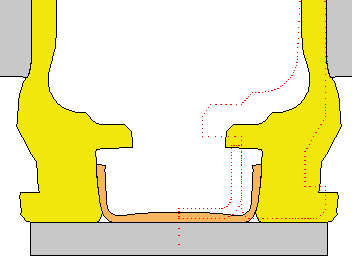
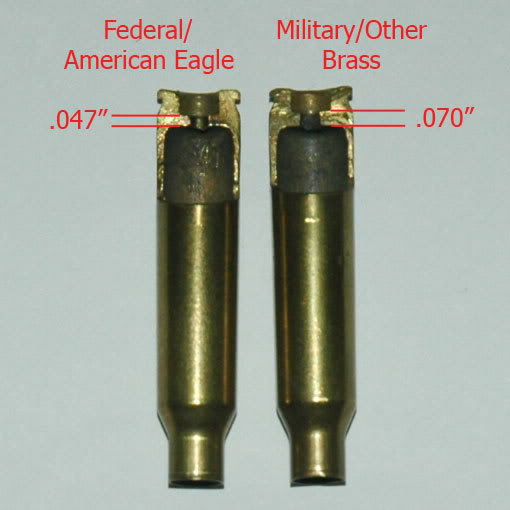
Many of you know that Federal cases are known for loose primer pockets much sooner than other brands of brass. This is because softer brass is used and the flash hole web is not as thick that adds strength to the base of the case.
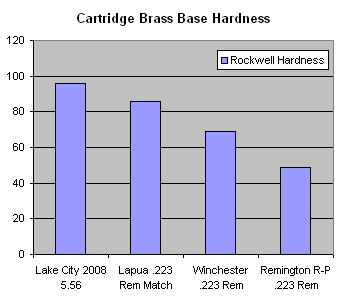
Brass hardness and case design has a great deal to do with how much pressure the case can withstand. And base expansion just above the extractor groove and ejector marks on the case are signs of excess pressure for that brand of brass. And these signs simply tell you the yield strength and elastic limits of the brass and they are not the same with all brands of brass.
How Hard is Your Brass? 5.56 and .223 Rem Base Hardness Tests
http://bulletin.accurateshooter.com/2014/05/how-hard-is-your-brass-5-56-and-223-rem-base-hardness-tests/
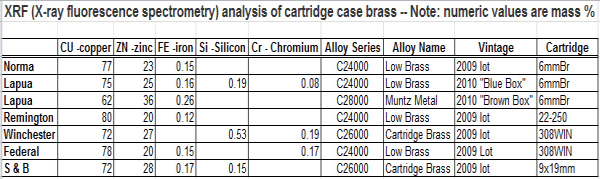
X-Ray Spectrometry of Cartridge Brass
X-Ray Spectrometers Reveal Metal Content of Major Cartridge Brass Brands
http://www.accurateshooter.com/technical-articles/x-ray-spectrometry-of-cartridge-brass/
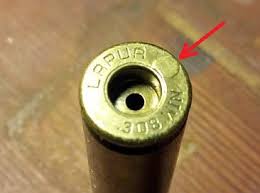
Below this photo was posted at Accurate Shooter and this long range shooter stated he increased the load until he had brass flow into the ejector. He then backed the load off 1 or 2 grains and knew the yield strength of the case and how "HOT" he could load. Meaning how long his primer pockets would last before becoming too loose.
And when the base of the case just above the extractor groove expands approximately .0005 you have exceeded the yield strength of the brass.
My 30-30 at a chamber pressure of 38,000 cup or 42,000 psi always has the primers protruding from the base of the case. This is because at this chamber pressure the base of the case does not stretch to meet the bolt face. Meaning the 30-30 brass is hard and strong enough to contain this pressure and not yield and stretch.
Many of you know that Federal cases are known for loose primer pockets much sooner than other brands of brass. This is because softer brass is used and the flash hole web is not as thick that adds strength to the base of the case.
Brass hardness and case design has a great deal to do with how much pressure the case can withstand. And base expansion just above the extractor groove and ejector marks on the case are signs of excess pressure for that brand of brass. And these signs simply tell you the yield strength and elastic limits of the brass and they are not the same with all brands of brass.
How Hard is Your Brass? 5.56 and .223 Rem Base Hardness Tests
http://bulletin.accurateshooter.com/2014/05/how-hard-is-your-brass-5-56-and-223-rem-base-hardness-tests/
X-Ray Spectrometry of Cartridge Brass
X-Ray Spectrometers Reveal Metal Content of Major Cartridge Brass Brands
http://www.accurateshooter.com/technical-articles/x-ray-spectrometry-of-cartridge-brass/
Below this photo was posted at Accurate Shooter and this long range shooter stated he increased the load until he had brass flow into the ejector. He then backed the load off 1 or 2 grains and knew the yield strength of the case and how "HOT" he could load. Meaning how long his primer pockets would last before becoming too loose.





















