What pressure do you load to in modern firearms?

That is kinda my point. Even in such an event I doubt you could get a Barnard to fail. To my knowledge there has never been a failure of a Barnard action. There have been failures of Bats, Rems, Tikka, Sako, Winchster, ruger etc etc but never heard of a Barnard failing.

Could be that a baranard action is stronger, but you'd need better data than that to back it up. How many barnards are there worldwide, compared to Tikka, Remington, Sako, Winchester? Not much of a comparison. OTOH if you were able to say the barnard is stronger because of some specifics of design or the metal / metallurgy, etc., then you would have a reasonable argument.
 
There are a number of older low pressure rounds and I was wondering what most people do now there are programs like quick load where pressure is indicated. Take the 9.3x62 for example max pressure is listed at 56500 psi. The 30-06 is listed at 60,000 psi. Why not have load data for modern rifles. The only data difference I have seen is for the Swede. Commercial vs Military. Is the problem the brass is still made to the original spec and can't take the increase in pressure?

9.3x57 is 37,000 psi max for no good reason that I can understand. Using the 37K max, the best that can be got from a 9.3mm 280gr bullet is 2000-2100 fps. Using 55K max it's possible to get 2300-2400 fps. Using modern brass loaded in a Husqvarna FN98 mauser, 55K is a conservative pressure level and 400 fps is a 20% gain in velocity. Not too shabby.

Seems like a no-brainer, but there is no published data for 55K 9.3x57 loads. There is data for similar cartridges that we can use for a starting point. Quickload and a chronograph are useful. We can watch case head expansion and brass markings and "feel" the bolt lift.

Brass has variance and case head expansion isn't uniform for all makes and maybe even between different lots from the same manufacturer. Chambers are different dimensions. What worked in your buddy's rifle might be too hot for yours. Which all seems complicated and dangerous - but really is not much different than using published data. Start low and work up.

Some people say there is no good reason to exceed the maximum SAAMI / CIP pressure limit. But reloading manuals show different levels of 45-70 load data for use in different rifles - Trapdoor, Marlin lever, Ruger #1. The people who write the manuals expect us to have the sense to understand the difference.
 
Last edited:
9.3x57 is 37,000 psi max for no good reason that I can understand. Using the 37K max, the best that can be got from a 9.3mm 280gr bullet is 2000-2100 fps. Using 55K max it's possible to get 2300-2400 fps. Using modern brass loaded in a Husqvarna FN98 mauser, 55K is a conservative pressure level and 400 fps is a 20% gain in velocity. Not too shabby.

Seems like a no-brainer, but there is no published data for 55K 9.3x57 loads. There is data for similar cartridges that we can use for a starting point. Quickload and a chronograph are useful. We can watch case head expansion and brass markings and "feel" the bolt lift.

Brass has variance and case head expansion isn't uniform for all makes and maybe even between different lots from the same manufacturer. Chambers are different dimensions. What worked in your buddy's rifle might be too hot for yours. Which all seems complicated and dangerous - but really is not much different than using published data. Start low and work up.

Some people say there is no good reason to exceed the maximum SAAMI / CIP pressure limit. But reloading manuals show different levels of 45-70 load data for use in different rifles - Trapdoor, Marlin lever, Ruger #1. The people who write the manuals expect us to have the sense to understand the difference.

Jethunter, you have it nailed!

The reason the 9.3X57 is loaded to such low pressure may be that it was chambered in the early Haenel-Mannlicher sporting rifles. I had two of them, one in 9mm and the other in 9.3. Both had full-length solid ribs on the barrel, and were in very finely-figured walnut. Sold them when we bought our first home here. The fellow here who bought them, still has them both.

A few years later I had Bevan King barrel up a matching pair of 9.3X57s on two Turkish Mausers. Understanding that they were 98 actions (and having already built both a 270 Win and a 358 Norma Mag using the same action), I did exactly what you are speaking about, and loaded them to 2300 fps with 286 Norma bullets ahead of Ball C2 and magnum primers. It is still a great powder for this cartridge.

Gave one of them to a bush pilot friend of mine, who promptly went out and dusted a big bear with it. Can't remember where the other one ended up. It gets better as you get older. ;)

Ted
 
Ganderite; What make of brass is that? Santa Barbara? Looks like a very shallow web. Some rifles have some unsupported case head. For such a rifle one wants to know how thick the web is.[/QUOTE said:
I do not recall the make. It was North American. Sectionned a number of 9mm cases - that one was the extreme example.
 
Jethunter, you have it nailed!

The reason the 9.3X57 is loaded to such low pressure may be that it was chambered in the early Haenel-Mannlicher sporting rifles. I had two of them, one in 9mm and the other in 9.3. Both had full-length solid ribs on the barrel, and were in very finely-figured walnut. Sold them when we bought our first home here. The fellow here who bought them, still has them both.

A few years later I had Bevan King barrel up a matching pair of 9.3X57s on two Turkish Mausers. Understanding that they were 98 actions (and having already built both a 270 Win and a 358 Norma Mag using the same action), I did exactly what you are speaking about, and loaded them to 2300 fps with 286 Norma bullets ahead of Ball C2 and magnum primers. It is still a great powder for this cartridge.

Gave one of them to a bush pilot friend of mine, who promptly went out and dusted a big bear with it. Can't remember where the other one ended up. It gets better as you get older. ;)

Ted

I didn't know the 9.3x57 was originally chambered in the Haenel-Mannlicher rifles, that explains the 37K pressure standard. I've gotten past 2400 fps with H335 at medium pressure levels. Taken to .308 win pressure level it might get to 2500 fps with a 280 gr bullet.
 
Last edited:
Some people say there is no good reason to exceed the maximum SAAMI / CIP pressure limit. But reloading manuals show different levels of 45-70 load data for use in different rifles - Trapdoor, Marlin lever, Ruger #1. The people who write the manuals expect us to have the sense to understand the difference.

The example of the 45-70 is exactly the reason that common sense must prevail. Yes, there are old Rolling Blocks and Trapdoors that would disintegrate if you fired 500gr Buffalo Bore or Garrett ammo through them, but they are vastly outnumbered by Browning 1885s, Marlin 1895s and Ruger #1s that easily digest ammo at that pressure level. Just as there is a certain responsibility to ensuring that you don't fill your Honda Civic with Diesel, so too is there an obligation to know what you're feeding your Trapdoor.

OP, there is no reason that you couldn't load the 366 Wagner to the same pressures as the 30-06. In fact, plenty of people do. Hell, you can buy identical rifles in both chamberings so what real-world difference would it make?
 
pressure

What pressure do I load in modern action? I have no idea as I do not own pressure testing equipment.

What chambering's are available in that action? Check out those, and you'll have an answer.

R.

I don't have any pressure measuring equipment either, and even with my MagnetoSpeed chronograph and Quickload I only have a ball park idea.

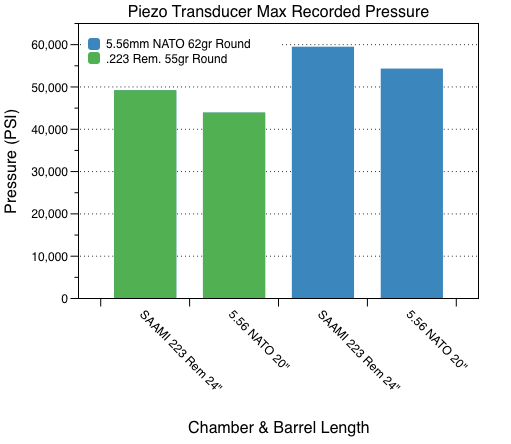
The image below is from the Lucky Gunner Labs website, but look at the green bar on the far left. It is factory loaded .223/5.56 ammunition and slightly below 50,000 psi and 5,000 psi below the max rated pressure for the .223 at 55,000 psi. Meaning the factory loaded ammunition is deliberately loaded below max pressure.

barnes-pressure.png


5.56 vs .223 – What You Know May Be Wrong
https://www.luckygunner.com/labs/5-56-vs-223/

Bottom line, the vast majority of my reloads are for practice and loaded well below max so my brass lasts a lot longer. And the people who complain about loose primer pockets after just a few reloads are loading too hot. Meaning your cases will tell you what they like regardless of the actual chamber pressure.
 
Back
Top Bottom