












































HELP!!! Resizing issue!

So many mistakes in that Video I don't know where to start.

The #1 mistake is never cam over the ram using Competition shell holders.
Raise the ram with a standard shell holder turn in the die and touch the shell holder, lower the ram and turn the die in about a 1/2 turn. Then start with the .010 holder.

David

I use Redding competition shell holders and always have my RCBS Rockchucker reach cam over. And "NO" reloading die manufacture tells you to turn their dies 1/2 of a turn after making contact with the shell holder. Because this can over stress the press and cause excess wear on the pivot pins and linkages.

The reason for press cam over is to remove all the slop from the press. Meaning when the press reaches cam over and the die and shell holder are pressed firmly together you will have less case shoulder length variations. And if you pause at the top of the ram stroke for 4 to 5 seconds any brass spring back will be greatly reduced. And this is caused by variations in annealing, hardness and thickness of the brass.

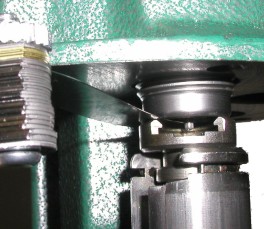
In the past I used feeler gauges to adjust the dies air gap and amount of shoulder bump as pictured below. "BUT" this method does not remove any slop from the press and you will get "more" variations in the case shoulder after sizing. And the reason for the dies instructions for 1/8 to 1/4 turn more after contact with the shell holder.
7FfXhJ7.jpg


The problem with using feeler gauges and the die not making hard contact with the shell holder is more variations in the shoulder location after sizing.

And the only difference between a standard shell holder and Redding competition shell holders is the deck height. And a standard shell holder has a deck height of .125.

th_ShellHolder1.jpg


And the Redding five competition shell holders start at .127 to .135 and do not push the case as far into the die. And you still follow the die manufactures instructions which is screw the die down until it contacts the shell holder and then 1/8 to 1/4 turn more.

And the best part with using the competition shell holders is you do not need to touch the die to adjust the amount of shoulder bump.

Competition Shellholder Sets
http://www.redding-reloading.com/online-catalog/35-competition-shellholder-sets
Makes every die a custom die!

"Now you can control headspace. The new Redding Competition Shellholders are packaged in five piece sets in .002” increments (+.002”, +.004”. +.006”, +.008” and +.010”). Each shellholder has a distinct black oxide finish and is clearly marked to indicate the amount it will decrease case-to-chamber headspace. You can now easily adjust the shoulder bump to customize cases to your specific chamber."

Tech Line & Tips (FAQs)
http://www.redding-reloading.com/tech-line-a-tips-faqs/132-faqs1

Question: I have my Full Length Resizing Die/Body Die adjusted so that it is touching the Shellholder and I cannot push my shoulder back. Is there something wrong with my Sizing Die?

Answer: Probably not. In most instances, using Cam-Over will allow the reloader to push the shoulder back sufficiently.

To set a Full Length/Body Die up to Cam-Over:

1) Install the appropriate Shellholder into the Ram of your Press.

2) Raise the Ram so that it is in its uppermost position.

3) Screw the Full Length Resizing Die/Body Die down into the press until it firmly contacts the Shellholder.

4) Back the Ram away from the Die.

5) Screw the Die down FURTHER into your press an additional 1/8th to ¼ turn.

Note that you will feel the Ram/Shellholder contact the resizing Die before the stroke is completed. Completing the Ram Stroke will feel as though you are snapping the latch on a toolbox.

These directions apply only to standard Single Stage Presses. If your single stage press was not manufactured by Redding Reloading Equipment, please contact the manufacturer to see if using Cam-Over is appropriate for your particular Reloading Press.
 
Last edited:
EE, Dave is the rim recess in the die deep enough to allow you to remove material from the end of the die?
It mush be a guess, I have never reloaded for a belted case.

David

This recess for the belt is plenty generous in most resizing dies, since the belt is not sized. If you had to size the belt down, I
would be seriously concerned about what sort of pressures were being generated in the previous losd, Dave.
 
I have several 308 Norma Mag rifles, and several sets of dies. I have one
FL resizing die that I ground .005" off the bottom of so I can size the fired brass enough to
rechamber the brass with just a slight drag. This applies to 2 of my custom rifles.
Dave.

My experience with the same problem resulted in a die being sent to the trash can. Fooling with a shell holder a better idea. Redding sometimes has custom shellholders, beyond the 002 > 010.

Belted magnums have some unique issues, the SAAMI tolerance spec for the shoulder is app -020.

I purchased a Hornady Lock-N-Load Headspace Gauge, which is used to measure shoulder setback. Adjust the FL die as per instructions, Measure the case, Resize the case, measure again. The difference in measurements is the setback. BTW, the case has to be one fired in your rifle, with a regular load, not a mouse sneeze (fart) load.
 
If ammo is meeting resistance when chambering, it's either a case not sized enough, or bullet seated too long hitting the rifling, or you have a crimp/seat die set up incorrectly.
 
I use Redding competition shell holders and always have my RCBS Rockchucker reach cam over. And "NO" reloading die manufacture tells you to turn their dies 1/2 of a turn after making contact with the shell holder. Because this can over stress the press and cause excess wear on the pivot pins and linkages.

The reason for press cam over is to remove all the slop from the press. Meaning when the press reaches cam over and the die and shell holder are pressed firmly together you will have less case shoulder length variations. And if you pause at the top of the ram stroke for 4 to 5 seconds any brass spring back will be greatly reduced. And this is caused by variations in annealing, hardness and thickness of the brass.

In the past I used feeler gauges to adjust the dies air gap and amount of shoulder bump as pictured below. "BUT" this method does not remove any slop from the press and you will get "more" variations in the case shoulder after sizing. And the reason for the dies instructions for 1/8 to 1/4 turn more after contact with the shell holder.

7FfXhJ7.jpg


The problem with using feeler gauges and the die not making hard contact with the shell holder is more variations in the shoulder location after sizing.

And the only difference between a standard shell holder and Redding competition shell holders is the deck height. And a standard shell holder has a deck height of .125.

th_ShellHolder1.jpg


And the Redding five competition shell holders start at .127 to .135 and do not push the case as far into the die. And you still follow the die manufactures instructions which is screw the die down until it contacts the shell holder and then 1/8 to 1/4 turn more.

And the best part with using the competition shell holders is you do not need to touch the die to adjust the amount of shoulder bump.

Competition Shellholder Sets
http://www.redding-reloading.com/online-catalog/35-competition-shellholder-sets
Makes every die a custom die!

"Now you can control headspace. The new Redding Competition Shellholders are packaged in five piece sets in .002” increments (+.002”, +.004”. +.006”, +.008” and +.010”). Each shellholder has a distinct black oxide finish and is clearly marked to indicate the amount it will decrease case-to-chamber headspace. You can now easily adjust the shoulder bump to customize cases to your specific chamber."

Tech Line & Tips (FAQs)
http://www.redding-reloading.com/tech-line-a-tips-faqs/132-faqs1

Question: I have my Full Length Resizing Die/Body Die adjusted so that it is touching the Shellholder and I cannot push my shoulder back. Is there something wrong with my Sizing Die?

Answer: Probably not. In most instances, using Cam-Over will allow the reloader to push the shoulder back sufficiently.

To set a Full Length/Body Die up to Cam-Over:

1) Install the appropriate Shellholder into the Ram of your Press.

2) Raise the Ram so that it is in its uppermost position.

3) Screw the Full Length Resizing Die/Body Die down into the press until it firmly contacts the Shellholder.

4) Back the Ram away from the Die.

5) Screw the Die down FURTHER into your press an additional 1/8th to ¼ turn.

Note that you will feel the Ram/Shellholder contact the resizing Die before the stroke is completed. Completing the Ram Stroke will feel as though you are snapping the latch on a toolbox.

These directions apply only to standard Single Stage Presses. If your single stage press was not manufactured by Redding Reloading Equipment, please contact the manufacturer to see if using Cam-Over is appropriate for your particular Reloading Press.

Your explanation is right out of the book.
As far as cam over of your press, I also use an RCBS Rockchucker, at the point of cam over is where the highest point of stress is on that type linkage. The closer you get to that point is where the most stress is applied to the linkage, and for me that is abusing my press.

As far as using feeler gauges, that is only a suggestion if you are not using competition shell holders. It has worked for me and using the tools that I have made to measure base to datum line I have only been able to see a .001" difference in length. This is the only time that I can justify cam over of my press.

Setting your die with Competition shell holders, If I screw my die into my press 1/4 more after the die comes into contact with the ram in the raised position there is not a chance that I can cam over the linkage unless I was to use a 3 foot extension on the handle, If you can I would think that that your press has issues, I hope not. The 1/2 turn is not as issue with me as it guaranties that I cannot can over.
All my reloading is now done with Competition shell holders as I can truly control chamber fit.

Thanks for your input bigedp.

David
 
Last edited:
This recess for the belt is plenty generous in most resizing dies, since the belt is not sized. If you had to size the belt down, I
would be seriously concerned about what sort of pressures were being generated in the previous losd, Dave.

EE as I mentioned I have never loaded for a belted cartridge and I was wondering how deep the recess for the belt is.
Thanks for the info Dave.

David
 
If ammo is meeting resistance when chambering, it's either a case not sized enough, or bullet seated too long hitting the rifling, or you have a crimp/seat die set up incorrectly.

I was thinking this too...

Before I started modifying dies, I'd check to see what is binding and where. A die might have to be altered in the end, but it'd be prudent to confirm bullet isn't jamming into lands, or shoulder isn't bellowed a bit with seating/crimp.

OP: Have you tried chambering a sized case with no bullet in it? Still binding? Gone over the outside of a loaded case with a sharpie to see where it's rubbing?
 
I just got a new .308 and had chambering issues I'd never seen before. I had nice fresh polished cases that wouldn't chamber but when I extracted them I noticed the scratches and burnishing from contact wasn't at the base of the case like it has been with previous rifles; it was just below the shoulder. I mic'ed a bunch of cases (best to use a micrometer and not a caliper) and found that the base of the case could be quite large and not be an issue. I have 5 sets of .308 win dies (purchases, gifts from people who quit reloading, and inheritances) an RCBS, a Hornady, and three sets of Lee dies. I sized oversized range brass through all of them and measured before and after. Turns out the Hornady, RCBS, and one set of Lee dies left the case .001"-.002" larger below the shoulder than the other two Lee sets; those cases wouldn't chamber. I guess the chamber is so tight and so close to minimum tolerance in that area that cases not brought right down to minimum spec wouldn't fit.

Just food for thought if you're having chambering issues. Maybe colour a case with a sharpie, chamber it a few times, and see where it's rubbing. I've seen the shoulder itself not getting sized back far enough and dies not sizing far enough down to the rim causing this issue but it was the first time it was the case wall below the shoulder doing it for me.
 
I use Redding competition shell holders and always have my RCBS Rockchucker reach cam over. And "NO" reloading die manufacture tells you to turn their dies 1/2 of a turn after making contact with the shell holder. Because this can over stress the press and cause excess wear on the pivot pins and linkages.

The reason for press cam over is to remove all the slop from the press. Meaning when the press reaches cam over and the die and shell holder are pressed firmly together you will have less case shoulder length variations. And if you pause at the top of the ram stroke for 4 to 5 seconds any brass spring back will be greatly reduced. And this is caused by variations in annealing, hardness and thickness of the brass.

In the past I used feeler gauges to adjust the dies air gap and amount of shoulder bump as pictured below. "BUT" this method does not remove any slop from the press and you will get "more" variations in the case shoulder after sizing. And the reason for the dies instructions for 1/8 to 1/4 turn more after contact with the shell holder.

7FfXhJ7.jpg


The problem with using feeler gauges and the die not making hard contact with the shell holder is more variations in the shoulder location after sizing.

And the only difference between a standard shell holder and Redding competition shell holders is the deck height. And a standard shell holder has a deck height of .125.

th_ShellHolder1.jpg


And the Redding five competition shell holders start at .127 to .135 and do not push the case as far into the die. And you still follow the die manufactures instructions which is screw the die down until it contacts the shell holder and then 1/8 to 1/4 turn more.

And the best part with using the competition shell holders is you do not need to touch the die to adjust the amount of shoulder bump.

Competition Shellholder Sets
http://www.redding-reloading.com/online-catalog/35-competition-shellholder-sets
Makes every die a custom die!

"Now you can control headspace. The new Redding Competition Shellholders are packaged in five piece sets in .002” increments (+.002”, +.004”. +.006”, +.008” and +.010”). Each shellholder has a distinct black oxide finish and is clearly marked to indicate the amount it will decrease case-to-chamber headspace. You can now easily adjust the shoulder bump to customize cases to your specific chamber."

Tech Line & Tips (FAQs)
http://www.redding-reloading.com/tech-line-a-tips-faqs/132-faqs1

Question: I have my Full Length Resizing Die/Body Die adjusted so that it is touching the Shellholder and I cannot push my shoulder back. Is there something wrong with my Sizing Die?

Answer: Probably not. In most instances, using Cam-Over will allow the reloader to push the shoulder back sufficiently.

To set a Full Length/Body Die up to Cam-Over:

1) Install the appropriate Shellholder into the Ram of your Press.

2) Raise the Ram so that it is in its uppermost position.

3) Screw the Full Length Resizing Die/Body Die down into the press until it firmly contacts the Shellholder.

4) Back the Ram away from the Die.

5) Screw the Die down FURTHER into your press an additional 1/8th to ¼ turn.

Note that you will feel the Ram/Shellholder contact the resizing Die before the stroke is completed. Completing the Ram Stroke will feel as though you are snapping the latch on a toolbox.

These directions apply only to standard Single Stage Presses. If your single stage press was not manufactured by Redding Reloading Equipment, please contact the manufacturer to see if using Cam-Over is appropriate for your particular Reloading Press.


The printed instructions for the Comp Shellholders used to say 1/2 turn past contact. I remember that like yesterday and also remember thinking its a lot. Its probably where he got the 1/2 turn from. Myself; I don't think that one size fits all instructions are appropriate for all presses anyway, whatever gets the spring out works for me.
 
The printed instructions for the Comp Shellholders used to say 1/2 turn past contact. I remember that like yesterday and also remember thinking its a lot. Its probably where he got the 1/2 turn from. Myself; I don't think that one size fits all instructions are appropriate for all presses anyway, whatever gets the spring out works for me.

I agree that one size fits all is not appropriate for all presses and dies. I bought my RCBS Rockchucker press in 1973 and I assume it has some slop in it from use.

Before buying my Redding competition shell holders and using a Hornady cartridge case headspace gauge I noticed my shoulder locations varied after sizing.

This was caused by the air gap between the die and shell holder and adjusting the die for minimum shoulder bump.

Once I started using the Redding competition shell holders and press cam over the shoulder location became more uniform.

The problem when adjusting the die to 1/2 turn is the press does not reach cam over. And you are depending on your arm for the amount of force and dwell time.

I buy a lot of bulk once fired Lake City 7.62 and 5.56 cases fired in a multitude of chambers and my arm would get very tired using his method.

Meaning I pause at the top of the ram stroke for 4 to 5 seconds to reduce brass spring back and let the cam over hold it for that time.

If I did it 257Roberts way I would look like a crab with one bigger claw holding the press handle. (over developed right arm humor) ;)

130716075837_1_900x600.jpg


Bottom line, the best part about reloading is the person pulling the press handle decides how to do it. And if 257Roberts is happy with his method thats all that matters.
 
Last edited:

My Redding Competition shellholder sets might be the best money I ever spent on reloading equipment. Three sets cover almost all of my rifle calibers. Besides more consistent sizing, the ease of using the same dies for multiple rifles is worth it by itself.

Funny thing is, I never gave them a thought beyond assuming that they were only of interest to benchresters or something. That changed when a trusted friend mentioned them and how well and how easy they worked. Bought one set to try and never looked back.:)
 
My Redding Competition shellholder sets might be the best money I ever spent on reloading equipment. Three sets cover almost all of my rifle calibers. Besides more consistent sizing, the ease of using the same dies for multiple rifles is worth it by itself.

Funny thing is, I never gave them a thought beyond assuming that they were only of interest to benchresters or something. That changed when a trusted friend mentioned them and how well and how easy they worked. Bought one set to try and never looked back.:)

Same here Dogleg, they are worth every penny.
They have saved me their cost in brass alone.
One set allows me to load 6 of the cartridges I load for.

David
 
Good old 700s... every thing ive read about them point to horrible inconsistancies in reaming the chamber. Mine is the oposite of yours. with the bolt close i have too much slop. great advise posted above though... good luck.
 
Back
Top Bottom




















