7mm RM Head / Case separation

Chefboubou

Member
Rating - 0%
0   0   0
Location
Quebec City
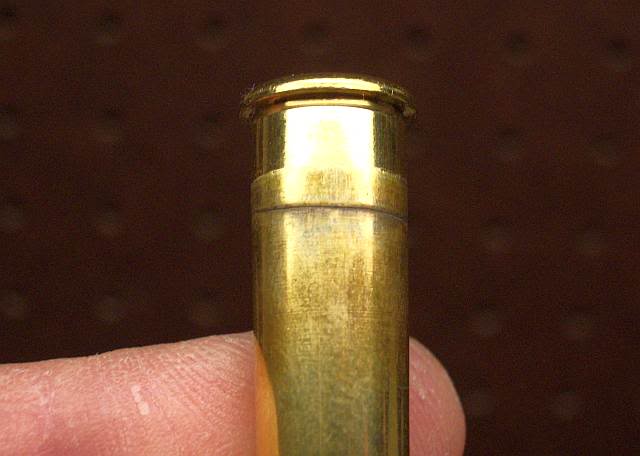
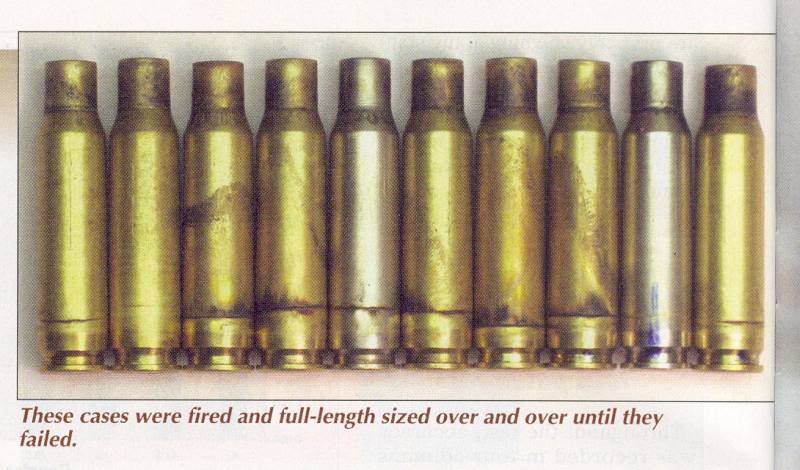
I've just started reloading and I've used remington cases 3 times and Hornady cases 3 times. These Hornady had head case separation after only 3 firings.... not impressed. I bump the shoulders 0.002-0.003 so I was expecting a longer life for these hornys....

So how many reloads do you guys make out of your 7mm RM cases?

FYI, I am now testing H1000 and RL26, but haven't completed my tests yet so I can't recommend any load/bullet for now.
 
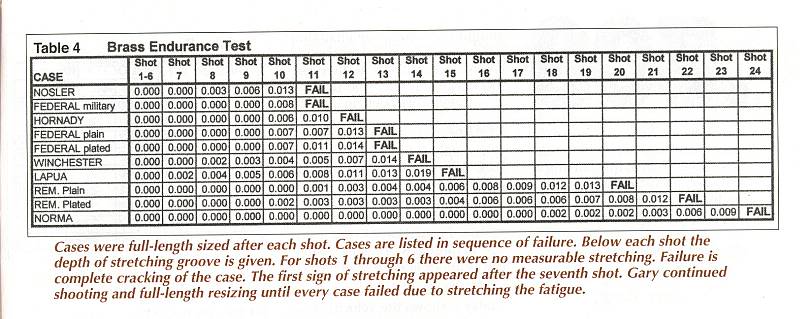
I've used Rem, PRVI, Win, and Nosler, I use a Redding neck sizer, never had an issue and the primer pockets loosen up at 10+ loads and get tossed.
PRVI is pretty thick compared to the others...265gr vs 220gr from what I remember weighing them at. I dropped my charges by 2gr when using it.
 
I see there is similar stretch thinning occurring with the Remington cases? Do they require the same amount of shoulder bump?

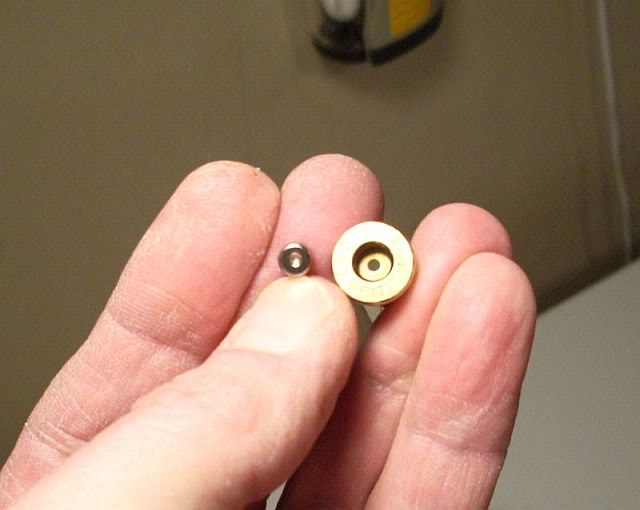
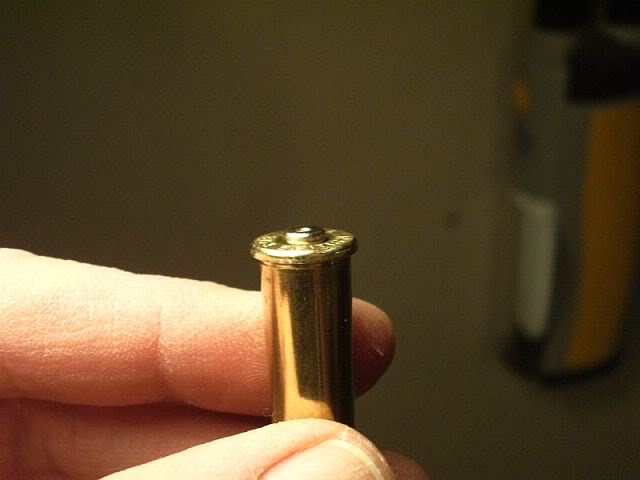
If this is happening this quickly, I'd be thinking about taking the rifle to a gunsmith to get the headspace and bolt lock-up checked. When the rifle is fired, from your description of the resulting case, it sounds like the neck and upper body of the cartridge is sealing against the chamber properly and holding the case in position so that it can't move when under pressure, but there is something loose at the bolt face end allowing the case head to move rearwards, stretching the case excessively.

You could also buy a set of go/no-go guages but you have to use them properly which involves removing the extractor and ejection pin. On some bolts this is a simple straightforward process; others are easy to remove but require new retaining pins when replacing.
 
You are bumping the shoulder too much for your rifles chamber.
Blacken the shoulder area of an unsized, but fired case with a candle,
then size it and note how much contact is being made at the shoulder level.
Back off your die, until NO contact is made. Then advance the die until you
just see the contact at the shoulder. Try chambering the case. If it fits OK
stop right there, If closing the bolt on the case requires too much effort, screw
the die in 1/16th of a turn, size the case, and try again. Once you can just feel
a slight drag as you close the bolt, tighten the lock ring and size your fired cases.
You should have no separations with that setting. Dave.
 
It is worth noting that 7mm Rem Mag chambers vary in dimension a fair amount,
particularly in older rifles, but to this day, the base to shoulder dimension varies
more than do many others. This means adjusting the die to match YOUR chamber,
not a generic setting. Dave.
 
This is one Rem shot 3 times.... would you still use it? There is no visible ring on the outside... but I can see this thinned ring when I look from the neck...

https://i.imgur.com/w2hKQMH.jpg

The way that expansion ring is tapered makes me think your bolt face is not square to the chamber. That sort of issue will have the rifle eating cases regardless how you set your resizing die.
 
Yeah, I have to agree, it looks 'angled' to me too with more stretch on one side than the other. The bolt face is not square and there is room for the case head to move back when firing. If you don't take the rifle to a gunsmith to check it out, keep the neck bump to an absolute minimum and toss the brass as soon as you see any sign of thinning. According to that pic, now would be a good time to crush them so they don't get re-used. Personally, I would get it checked out sooner rather than later.
 
You have variations in chambers, the brass cartridge case and resizing dies. I just looked at the SAAMI 7mm Magnum chamber and cartridge drawing and there can be .008 cartridge manufacturing tolerances from the face of the belt to the rear of the case. And this can be fixed by letting belted cases headspace on its shoulder and not the belt.

The chambers headspace on this SAAMI drawing is listed as min and max with .007 between the two. And there can be .009 variation in the diameter between the case just forward of the belt and the chambers diameter at the same point. And then you have any manufacturing tolerances for the resizing die.

NOTE, I have had new Winchester .243 cases that were .011 shorter than chamber headspace and had to fire formed the cases by jamming the bullet into the rifling. This held the rear of the case against the bolt face and prevented the case from stretching on the first firing. Meaning new cases can stretch more on the first firing that causes case head separation.

Rimmed and belted cases date to a time in the past when manufacturing were not as precise as they are today. And Remington/DuPont and Winchester/Olin are a thing of the past and exist in name only. And rimmed and belted cases even today can have excessive head clearance when chambered.

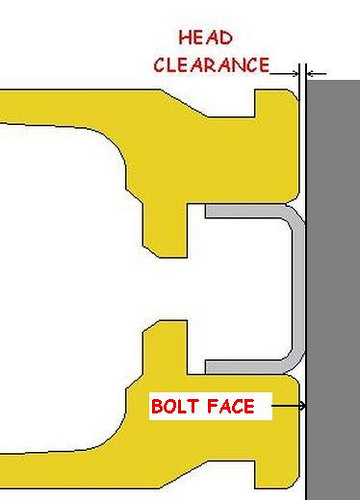
Below head clearance is the "air space" between the rear of the case and the bolt face. And once the case is fire formed to your chamber your shoulder bump should be the same as your head clearance.

HK76WCp.jpg


Bottom line, I would take case measurements before and after firing and only neck size the case until resistance is felt chambering. Meaning making sure the case shoulder is formed to your chamber and then only bump the shoulder back .001 to .002.

I prefer to full length resize but sometimes like with the .303 British you are forced to neck size only in order to get longer case life.

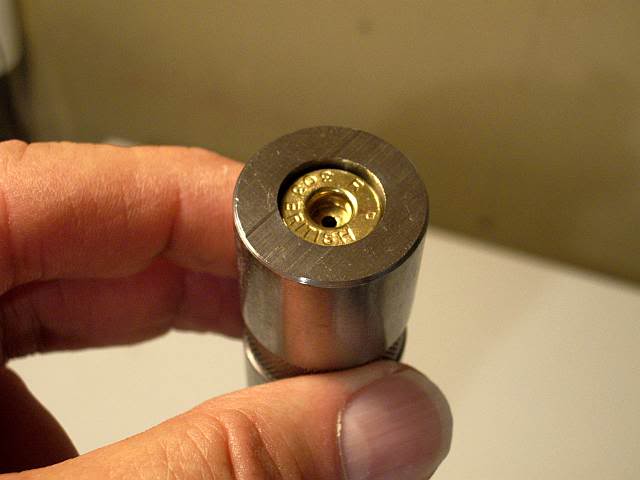
Below is a new unfired Remington .303 British case in a Wilson type case gauge and the case shoulder is far shorter than it should be. But it is a rimmed case so the shoulder location is not critical. The Enfield rifle that these cases were fired in was within SAAMI headspace limits, "BUT" it still had .009 head clearance. Meaning on a rimmed or belted case the rim or belt thickness can add to your head clearance. And this can add to how far the case can stretch to meet the bolt face.

RBeuevm.jpg


So again you need to measure your new cases and your fired cases to see how much they stretch and expand when fired. And then compensate for this by fire forming the cases and when sizing your cases the minimum amount.
 
Part Two

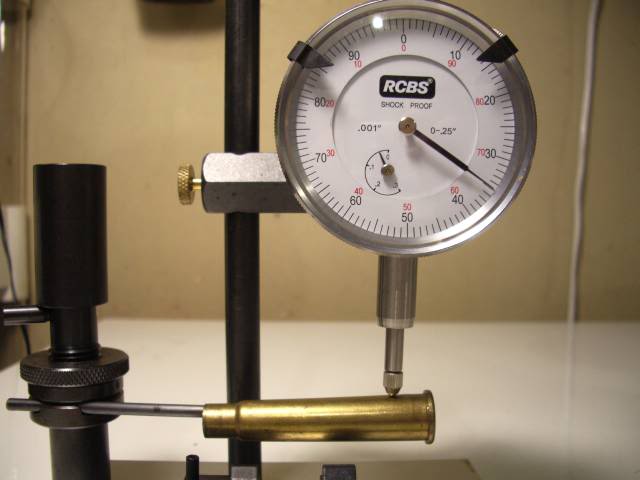
I have a multifunction RCBS case mastering gauge below, and one of its functions is checking for case stretching and thinning.

CCntXIg.jpg


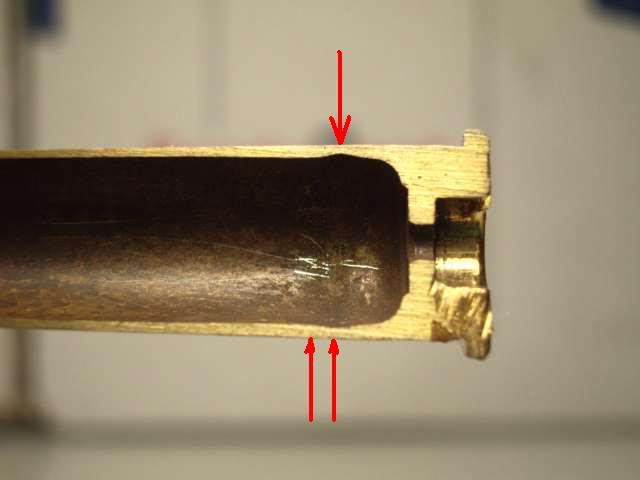
The factory loaded Winchester .303 British case below stretched and thinned .009 the first time it was fired.

B1hY7TM.jpg


These same Winchester cases when full length resized failed and split the second time they were reloaded.

DVy4C4T.jpg


You can check the head clearance on any type case with a very simple method.

Measure the case length and write it down.

SgwqgaU.jpg


Now use a fired spent primer and just using your fingers start the primer into the primer pocket.

oNIvIiX.jpg


zQxlYGp.jpg


Now chamber this case and slowly close the bolt and let the bolt face seat the primer.

Now extract the case and remeasure the case from the base of the primer to the case mouth and write it down.

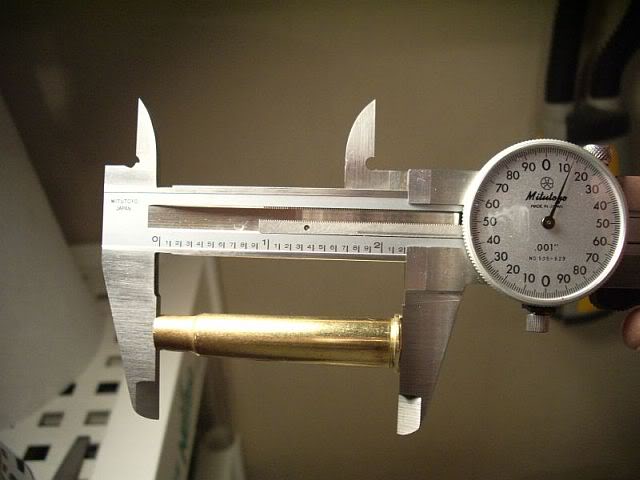
Now subtract your first case measurement from the second and this will be the amount of head clearance the new case has, and how far the case has to stretch when fired.

Case life has many variables, below these .308 cases were fired in a new Savage rifle. "BUT" no attempt at minimum shoulder bump was done, meaning the die was setup per the instructions with hard contact with the shell holder and press cam over.

TDwPD1Q.jpg

XEuny9C.jpg
 
I don't fully understand the adversion to neck sizing on here, I have neck sized for my K31 for about 15 years with no issues chambering and it has way less camming ability then a traditional bolt action.
 
If the case body is thinner on one side the case will stretch more and bulge on the thin side. This causes the base of the case to tilt and no longer be 90 degrees to the axis of the bore. And the case ends up banana shaped and these type cases will increase your group size a good amount.

I'm 67 and and have been reloading for over 47 years, and Remington and Winchester cases are not the same quality they once were. And Peterson cartridge company is the only American company that is making cases the same quality as Lapua.

Food for thought, how many new cartridges have belts today? The biggest problem is fat chambers and skinny new cases and a die that over resizes the cases.

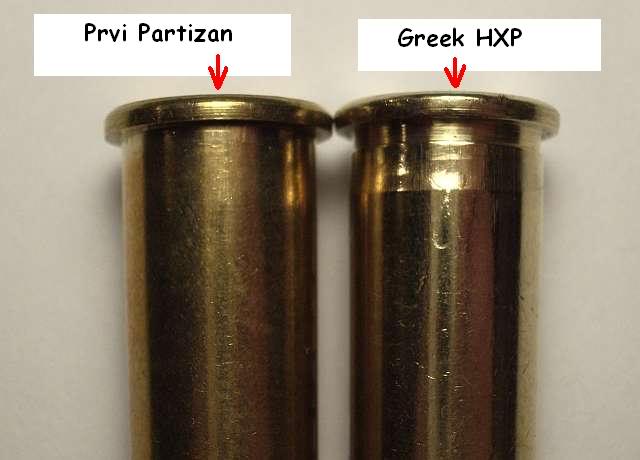
Example below, both of the cases below were fired in the same Enfield rifle. The Prvi Partizan case is larger in diameter, has .010 thicker case walls in the base and has a thicker rim. And you can see on the HXP case is smaller in diameter and the case had further to expand to reach the chamber walls. And on a belted case this can be a problem area just above the belt with case wall thickness and diameter.

Bottom line, find a brand of case that is a good fit to your chamber and what other posters say is long lasting.

eM3H3ls.jpg


Sorry I do not have any belted magnum photos, I grew up reading Jack O'Connor hunting stories and know the .270 Winchester is the worlds best non-belted magnum.;)
 
I don't fully understand the adversion to neck sizing on here, I have neck sized for my K31 for about 15 years with no issues chambering and it has way less camming ability then a traditional bolt action.

and I don't see where anyone, especially the OP has suggested anything about sizing. He said he is bumping the shoulder and the discussion is about the results he is seeing. I am going to go out on a limb and guess that he MUST be neck sizing as well. Don't know that he is or isn't full length sizing at the same time but it is damn hard to keep a bullet in the case otherwise.
 
and I don't see where anyone, especially the OP has suggested anything about sizing. He said he is bumping the shoulder and the discussion is about the results he is seeing. I am going to go out on a limb and guess that he MUST be neck sizing as well. Don't know that he is or isn't full length sizing at the same time but it is damn hard to keep a bullet in the case otherwise.

Using dies other then dedicated neck sizing dies... every company makes them, there is a lot of discussion on here that they are bad, yet every case seperation I read on here is when someone was partial FL, or bumping the shoulder, etc.
Maybe I've just been lucky that I neck size (with proper neck sizing dies) and never once had a case separate. Or maybe they remove some of the user error when bumping/FL sizing cases...who knows.
 
I'm starting to wonder about a couple of things here. When you say you are bumping the shoulder back 0.002 to 0.003, where are you measuring this from? For a bolt gun you should really only need to bump the shoulder back about 1 to 1.5 thou from the fully expanded second or third time fired position. Bottom line is that takes a couple of firings to fully expand the brass and start the hardening process sufficiently that it doesn't spring back fully any longer. It expands to fully fill the chamber the first firing but like a spring will partially collapse back towards its initial size. If it is not resized, the second time it is fired, it again expands fully and collapses back towards where it started from, but as the brass stretches and collapses it starts to work harden slightly and it does not spring back quite as much each time. This means that each time it starts from a slightly larger expanded size. Repeated firings continue this process and eventually if it is not resized, the brass will reach a point where it will fill the chamber fully. When it is fired, it will expand but it will not collapse back sufficiently to release the pressure it is 'gripping' the chamber walls with. Bolt lift will start to stiffen as the brass is pushing back on the bolt face. At the same time or very soon thereafter, extraction may start to become difficult. All this can happen rapidly or slowly depending on the charge applied, the initial brass quality, the initial brass size, any chamber or bolt deviations, etc.

Somewhere during this process it becomes useful to bump the shoulder back. With brand new brass, full length resizing at this point should not be required. Shoulder bumping should be done minimally for a bolt gun, 0.001 to 0.0015" - 1 to 1.5 thou. When to do it is kind of up to the above process of firing and work hardening and the initial conditions of everything involved. A 7mm Rem Mag carries a fairly large charge of powder in a moderately large case. It is also a belted case which we will come back to in a bit. Bottom line is that moderately large magnum cartridges run pretty high pressures and go through the expansion and hardening process pretty quickly. Could be that by 2 or 3 at max firings, the shoulder requires bumping and by 3 or 4 firings the shoulder and case should both be resized - full length resizing. Now comes the part about that belt. Never bump the shoulder back based upon shoulder to belt measurements. This goes for shoulder bump or full-length resizing. If you do this, the shoulder bump may end up being massive when measured to the cartridge head and could well be part of what is going on. The shoulder should be bumped back far enough for the cartridge to fit the chamber without having to overcam the round in to battery (camming the bolt closed with excessive force). On the other had, excessive shoulder bump based upon belt headspacing will invariably result in rapid brass failure.

This is just a quick overview. There is a lot more to this. I would heartily suggest getting a couple of current reloading manuals and reading and then re-reading those parts. It is easy to think that you fully understand the first time through, but I can guarantee that re-reading parts in conjunction with what you are learning by doing will bring forth some "ooooh, so that's what he meant" and "ah-ha!" moments.
 
I've been bumping since day 1 and clearly, either I over bump, or bumping is simply not what my rifle likes.... I bought a set of 3 redding dies so I'll start using the neck die... case life can't really be worst than what it is right now....

That being said, I have a box of new Nosler cases. I weighted these cases and they are light weight (214 gn) compared to the Rem (231 gn) or Hornady cases (229 gn). I'm afraid these thin cases won't last very long. At least I told my wife I'm reloading to save money! [Chuckles]
 
All good info, thanks to everyone! So, Rick357, I measure the shoulder length using the Hornady comparator bushing (0.420 in.), from the head. However, I've been bumping since day 1 so I guess I should've waited until the bolt gets harder to close.

I'll try your method, it seems very logical to me!

I'll post the results later!
 
Using dies other then dedicated neck sizing dies... every company makes them, there is a lot of discussion on here that they are bad, yet every case seperation I read on here is when someone was partial FL, or bumping the shoulder, etc.
Maybe I've just been lucky that I neck size (with proper neck sizing dies) and never once had a case separate. Or maybe they remove some of the user error when bumping/FL sizing cases...who knows.


I guess in simple terms the difference between full length resizing and neck sizing is uniformity. Meaning a full length resized case is more uniform in size than a neck sized case.

Even Lapua cases can have variations in case wall thickness and any case with variations in case wall thickness will have a effect on how a fired case fits in the chamber.

And by full length resizing you give the case body clearance between the case and chamber walls. Meaning a full length resized case minimizes the chances of the case body having a effect on bullet alignment with the bore.

We talk about shoulder bump on a full length resized case, this means the rear of the case will have .001 to .002 head clearance between the rear of the case and the bolt face. And this shoulder bump if the case warps when fired helps keep the base of the case from tilting the rear of the case and causing the bullet to be misaligned with the bore.

And a full length resized case gives the case wiggle room to let the bullet be self aligning with the bore.

This is not just my opinion, because the vast majority of competitive shooters today are full length resizing.

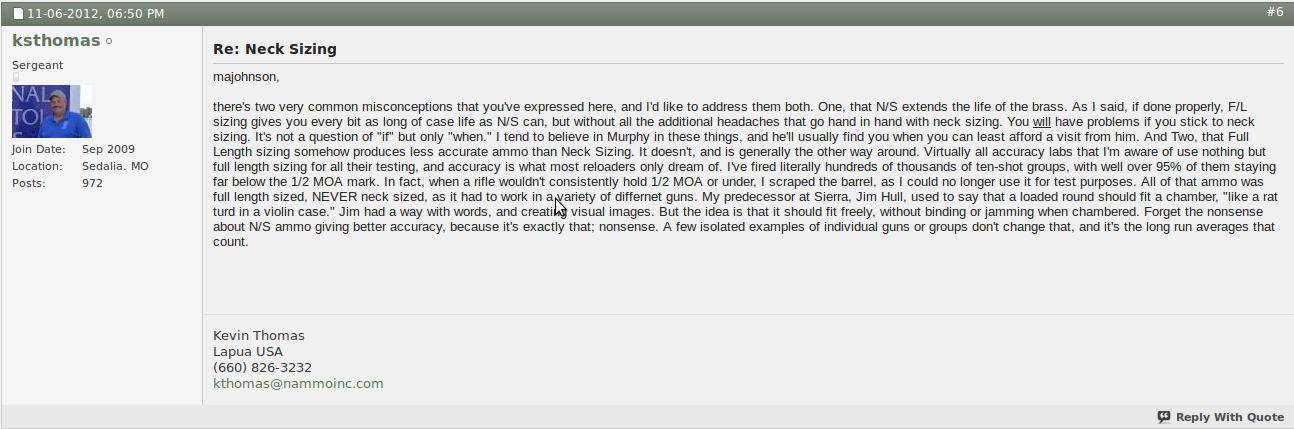
Below is Kevin Thomas who worked in the Sierra ballistic test lab and now shoots for Lapua USA.

Y3IiYL5.jpg


Below is German Salazar who shot with the late Jim Hull and coined the phrase "The cartridge should fit the chamber like a rat turd in a violin case".

Mr. Salazar explains below the benefits of full length resizing and having clearance around the case body and the rear of the case.

Reloading: Partial Neck Sizing
by German A. Salazar
http://riflemansjournal.########.com/2010/06/reloading-partial-neck-sizing.html

"Now the last scenario, a full-length sized case in which the neck is also fully sized. There is clearance at the neck and in the body of the case, the closest fit anywhere is the bullet in the throat. If the neck to bullet concentricity is good (although it needn't be perfect), then the bullet will find good alignment in the throat and the case body and neck will have minimal influence. Let's not forget that the base of the case is supported by the bolt face or the extractor to a certain degree as well; this is yet another influence on alignment. As you can see, there are several points from base to bullet that can have an effect. My procedure is to minimize the influence of those that I can control, namely the case body and neck, and let the alignment be dictated by the fit of the bullet in the throat and to some extent by the bolt's support of the base. Barring a seriously out of square case head, I don't think the bolt can have a negative effect on alignment, only a slightly positive effect from minimizing "case droop" in the chamber. Given that a resized case will usually have a maximum of 0.001" diametrical clearance at the web, this isn't much of a factor anyway."


In simple terms from above the ejector is pushing the base of the case away from the bolt face. The case body and neck are not touching the chamber walls and the only part of the case touching the chamber is the case shoulder. And the bullet is self centering in the chambers throat without the case body having any steering effect on the bullet.

And a neck sized only case will be the opposite of the full length resized case and have a greater steering effect on the bullet. Meaning if the case is warped the bullet will not be aligned with the axis of the bore.

Bottom line, if you go to AccurateShooter.com or Benchrest Central you will see the vast majority of shooters are full length resizing.

"BUT" the best part of reloading is the person pulling the press handle decides how to do it. And I have seen too many warped cases and believe in the rat turd in the violin case method.

 
Last edited:
Back
Top Bottom