









































Is there any advantage to buying a fixed magnification scope in today's market?

Snoochers

Member
EE Expired
Rating - 0%
0   0   0
Location
Toronto
Years ago variable magnification came at a huge cost. A fixed scope with all the same features as a variable one (minus magnification of course!) would be much cheaper. In other words, you'd get a lot more out of a 500$ fixed scope compared to a 500$ variable scope.

Things look different today. It looks like variable magnification has become the new standard. Indeed, I'm seeing that many producers don't even sell fixed magnification scopes anymore!

Is there any advantage to buying a fixed magnification scope in today's market? Has the variable magnification "premium" disappeared over the years?

I'd love to buy a superb fixed magnification scope (3-6x in that range) if it was superior to a similarly priced variable scope. Point me in the right direction!

EDIT: In terms of use, I am thinking hunting between 50-300 yards.
 
Last edited:
Yeah I know there's nothing wrong with fixed power, I'm just wondering if they are any cheaper or if they are made better compared to variable scopes. My brief research suggests they might not be any cheaper anymore, but am looking for other thoughts. I'm thinking of hunting around 50-300 yards, so a good 4 or 6x would do me fine. But if a 3-9x costs the same, no reason to not go for that.
 
Yeah I know there's nothing wrong with fixed power, I'm just wondering if they are any cheaper or if they are made better compared to variable scopes. My brief research suggests they might not be any cheaper anymore, but am looking for other thoughts. I'm thinking of hunting around 50-300 yards, so a good 4 or 6x would do me fine. But if a 3-9x costs the same, no reason to not go for that.

Price being equal I would expect a fixed would be slightly more durable (less parts) and may perform slightly better. Potentially more compact/lighter.
 
Nothing wrong with a good fixed power scope. I've got a few Leupold's and a Weaver. The thinking that a fixed power of the same cost as a variable will be a better scope it, I think, sound. It only stands t reason.
 
Yes it does sound to reason, but I'd be interested in finding some evidence of this! I am looking on the Leupold site for example and the fixed power scopes don't seem better in other regards.
 
I wouldn't be surprised if the vast majority of shooters leave their variable scopes on the highest power 90% of the time. So, yes, fixed power scopes have definite advantages. They are generally cheaper than equivalent variable power scopes. Also, they don't need a parallax adjustment. The downside is that nowadays it's a little harder to find good fixed power modern scopes.
 
Yes I am finding trouble finding myself. I keep saying the argument "they are generally cheaper" but haven't found that yet! Do you know of a maker that makes both fixed and variable in the same materials?
 
Fixed power scopes tend to have a larger exit pupil than a dialed up to equivalent power variable, and as such are typically brighter, also the glass always seems better on fixed scopes - which is hard to quantify.
 
I think there are "physical" advantages to a fix power. As in, less lenses, less moving parts, less chances of something going wrong...

But as far as an economy, I doubt it.
- They sell less fix power
- So fix power does not benefit from the economy of scale, available to variable power.

Buying used, you "might" get a better deal, as they are not as popular as variable power.
 
Fixed power scopes tend to have a larger exit pupil than a dialed up to equivalent power variable, and as such are typically brighter, also the glass always seems better on fixed scopes - which is hard to quantify.
This would be true only if the fixed-power scope had a larger objective lens, which is not usually the case. In fact, it will usually be the opposite--the variable having the larger objective lens. As just one example, the Leupold fixed 4x33 scope has an exit pupil of 8.25 mm., whereas the new Leupold 3-9x40 VX-Freedom scope (or, for that matter, any 3-9x40) has an exit pupil of 10.0 mm. when set at 4 power.

One advantage of a fixed-power scope over a variable is size/weight, although the difference may be pretty small. To use a Leupold example again, the fixed 4x33 weighs a scant 9.3 oz. and is 10.5" long, whereas the 2.5-8x36 variable weighs 11.4 oz. and is 11.4" long. These differences are pretty trivial. Another advantage of a fixed-power scope is that there are fewer parts and lenses, and nothing moving around inside the scope. As a result, they are, in general, less susceptible to breakage or interior damage from impacts. However, well-made variables seldom fail except from severe impacts (which would likely also put a fixed-power out of action).

For general hunting purposes, in my opinion, the greatest shortcoming of a fixed-power scope like a 4X is the narrower-than-desirable field of view. The Leupold 4x33 provides only a 24-ft. FOV at 100 yards, which could be problematic when hunting in cover--this as opposed to 37.5-ft for the 2.5-8x36 set at 2.5 power. If we consider a fixed 6-power scope like the larger Leupold 6x42, the situation is much worse--only 17.3-ft. at 100 yards. The Leupold 6x42 costs the same as the Leupold 2.5-8x36, but there's just no comparison, when placed alongside the 2.5-8x36, in effectiveness in any hunting situation.

You'd think that the smaller number of lenses in a fixed-power scope should allow it to provide a clearer and brighter image than provided by a variable, but any difference in this respect is very very small. The one place where a fixed-power scope makes good sense is in target and BR shooting. I have fixed Leupold BR-36s and a Leupold 45x45, and they're just fine when shooting from the bench. However, if hunting is in the picture, a decent variable has it all over any fixed-power scope--wide FOV at low power and better magnification at high power.
 
Last edited:

i have quite a few fixed 6x. my favorite scope for a hunting rifle. none are cheap but are light weight and work for me.
 
Lower fixed power scopes are lighter and more compact than variables. The Leupold 2.5x Ultralight (6.5 oz) and 4x Compact or FX-I (7.5 oz) are good examples. I just changed out the Leupold 1.5-5x on my main hunting rifle back to the 4x Compact. The rifle has a handier and lighter feel with this scope plus it has a 2.5 MOA dot reticle which works as a range finder. I went with the 2.5x Ultralight on my 30-06. I have a Leupold 2.5x Scout scope (7.5 oz) on my 358 BLR.

I don't feel disadvantaged with a low fixed power scope for longer range shots. I nailed an Elk at 400+ meters using the 4x Compact so it can be done. Also I don't really play with the magnification settings on a variable scope when hunting. I just set it at about mid point and leave it there.

I suppose severity would differ depending on scope quality but POI could wander with changes in magnification settings on a variable.

Leupold used to make a fixed 6x AO, a nice hunter/bench rest scope.

27480158008_89e7a1884e_b.jpg

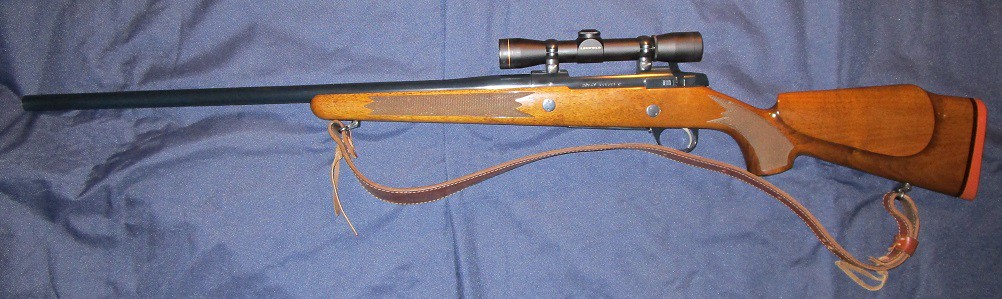
.458 Lott custom Sako AV with Leupold FX-I 4x28mm

40799160082_4b66f050d5_b.jpg

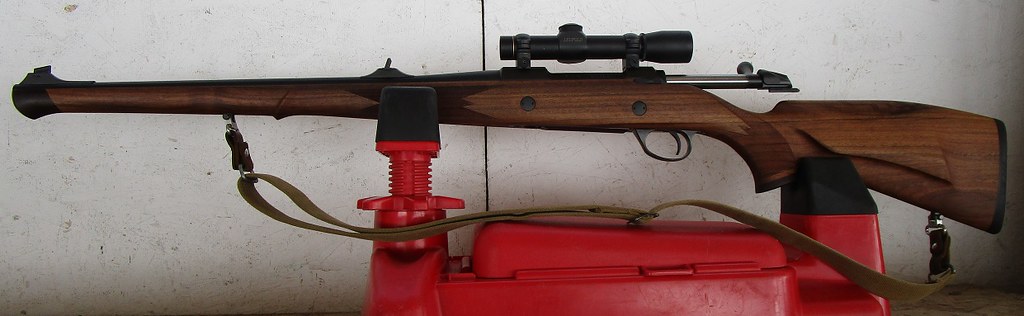
.30-06 Sako 85 Bavarian Carbine with Leupold FX-II Ultralight 2.5x20mm

35335923611_b5946d7fdb_b.jpg

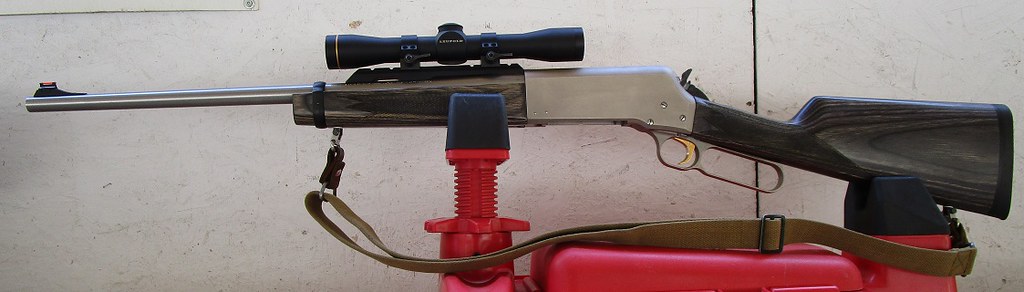
.358 Winchester Browning BLR Lightweight '81 Stainless Laminate Takedown with Leupold FX-II Scout IER 2.5x28mm
 
Last edited:

Fixed power scopes tend to have a larger exit pupil than a dialed up to equivalent power variable, and as such are typically brighter, also the glass always seems better on fixed scopes - which is hard to quantify.

Fixed power have fewer lenses then variable power. So everything being equal, a fixed should be brighter and clearer then a variable power scope.
 
I was given a Husqvarna 270 with a fixed Leupold 6-power scope on it.

The deer I shot at 15 metres never knew it was too high powered for close up and neither did the one at 40 yards.

I've lost track of the number of black bears I've shot with my 300 WM with a 4-power Leupold plus a deer, a moose and two elk.
 
Back
Top Bottom