I've just started reloading 9mm on a new Dillon XL650, and run into an issue. Not with the Dillon, but with brass and my case gauge.
As a bit of background, I've been reloading for over 5 years, mostly .308Win on a single stage (hundreds of rounds), over a thousand rounds of .45ACP on a Lee Turret, some .357 Magnum and a few other, but until now I've not bothered to reload any 9mm because I could always find it online for cheap enough. Now that I got a good deal on a XL650, I figured it was time to start doing some 9mm in volume for the coming summer match season. I'm not an expert reloader by any stretch, but I do have at least some idea of the process.
I also have two Shockbottle case gauges - one in .45ACP and one in 9mm. When I reloaded the .45, they all fell easily into the gauge, no issues, and have all worked flawlessly in my various .45's so far.
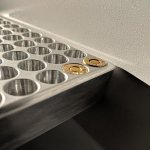
Today I tried my first run of 10 rounds of 9mm, mostly just to see if I had the Dillon set up properly. Out of the 10 rounds, 3 did not fit well into the case gauge - they protruded slightly, as in the following pic, which shows a "good" one next to a "bad" one:
Profile view:
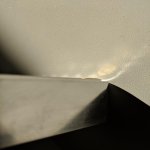
I checked my resizing die, my expander die, and the final crimper die, and they all seemed set properly, so I looked more closely at what was blocking the perfect fit.
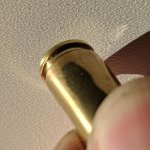
It seemed to be a dent from an extractor, on the rim, that made the rim a bit out of round and slightly protruding in that one spot. On the unaffected cases, the dent was not there, or much fainter. To check for sure, I tried placing the cases in the gauge upside down (or right side up, depending on your perspective - basically, rim end first, bullet up). For the "good fit" ones, the case rim dropped into the gauge holes easily (not all the way in, of course, because the "chamber" of the case gauge is tapered a bit like the round itself, but the whole rim dropped into the top part of the hole). With the "bad fit" rounds, the rim end wouldn't go easily into the top of the gauge hole, it was binding.
Here is my attempt at a photo of the dented rim, which seems to be causing the problem:
When I try the rounds in my barrel (plunk test) they all seem to fit properly, because the rim never makes contact with anything, except presumably some of the area around the breech face, which on my two 9mm pistols seems to have reasonably generous clearances. This also tells me that the rest of the case is properly sized, so it's not an issue with my dies, I believe, unless someone else with more wisdom knows something I'm missing. I don't think resizing dies are supposed to resize/straighten the rim?
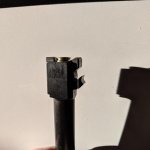
"bad" round fits:
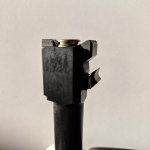
"good" round fits the same:
I haven't had a chance to actually take them to the range and try them in the guns, since we still have a decent amount of snow up here, but I hope to try them in the next few weeks.
Has anyone else had any experience with this sort of issue, where the rounds don't fit the case gauge but seem to fit the barrel?
If it was only one or two rounds out of a hundred, I'd just set them aside in a practice pile, but if it's going to be anywhere like 30% of my rounds, that starts getting more annoying.
I guess I'm just wondering if anyone has come across this particular situation with these Shockbottle case gauges, and what the solutions may be, other than reloading 1000 rounds to get 700 "competition" rounds and 300 practice ones.
Or maybe that's the yield percentage I should expect when looking for good, well-functioning rounds for competition use?
I know, the problem isn't with the case gauge, it's with my fired brass , but I have no easy way to sort them before they're run through the Dillon (because they're not resized until then, and may not fit the case gauge for that reason alone).
I never had this issue with the .45ACP I reloaded, and using the .45 Shockbottle gauge. Of course, different guns, different extractors, different brass etc., I know...
Anybody have a way of measuring rim diameter/concentricity on 1000's of fired 9mm brass quickly and easily?
I guess the solution I'll probably take, is just pull aside all the non-fitting rounds, and then plunk test each of them in the barrel. But the whole reason for getting the 100 round case gauge was to avoid having to do that.
OK, I guess this is less of a question, and more of an expression of my annoyance that the gods of Fired Brass are conspiring to make using my new Dillon XL650 just a little more work
As a bit of background, I've been reloading for over 5 years, mostly .308Win on a single stage (hundreds of rounds), over a thousand rounds of .45ACP on a Lee Turret, some .357 Magnum and a few other, but until now I've not bothered to reload any 9mm because I could always find it online for cheap enough. Now that I got a good deal on a XL650, I figured it was time to start doing some 9mm in volume for the coming summer match season. I'm not an expert reloader by any stretch, but I do have at least some idea of the process.
I also have two Shockbottle case gauges - one in .45ACP and one in 9mm. When I reloaded the .45, they all fell easily into the gauge, no issues, and have all worked flawlessly in my various .45's so far.
Today I tried my first run of 10 rounds of 9mm, mostly just to see if I had the Dillon set up properly. Out of the 10 rounds, 3 did not fit well into the case gauge - they protruded slightly, as in the following pic, which shows a "good" one next to a "bad" one:
Profile view:
I checked my resizing die, my expander die, and the final crimper die, and they all seemed set properly, so I looked more closely at what was blocking the perfect fit.
It seemed to be a dent from an extractor, on the rim, that made the rim a bit out of round and slightly protruding in that one spot. On the unaffected cases, the dent was not there, or much fainter. To check for sure, I tried placing the cases in the gauge upside down (or right side up, depending on your perspective - basically, rim end first, bullet up). For the "good fit" ones, the case rim dropped into the gauge holes easily (not all the way in, of course, because the "chamber" of the case gauge is tapered a bit like the round itself, but the whole rim dropped into the top part of the hole). With the "bad fit" rounds, the rim end wouldn't go easily into the top of the gauge hole, it was binding.
Here is my attempt at a photo of the dented rim, which seems to be causing the problem:
When I try the rounds in my barrel (plunk test) they all seem to fit properly, because the rim never makes contact with anything, except presumably some of the area around the breech face, which on my two 9mm pistols seems to have reasonably generous clearances. This also tells me that the rest of the case is properly sized, so it's not an issue with my dies, I believe, unless someone else with more wisdom knows something I'm missing. I don't think resizing dies are supposed to resize/straighten the rim?
"bad" round fits:
"good" round fits the same:
I haven't had a chance to actually take them to the range and try them in the guns, since we still have a decent amount of snow up here, but I hope to try them in the next few weeks.
Has anyone else had any experience with this sort of issue, where the rounds don't fit the case gauge but seem to fit the barrel?
If it was only one or two rounds out of a hundred, I'd just set them aside in a practice pile, but if it's going to be anywhere like 30% of my rounds, that starts getting more annoying.
I guess I'm just wondering if anyone has come across this particular situation with these Shockbottle case gauges, and what the solutions may be, other than reloading 1000 rounds to get 700 "competition" rounds and 300 practice ones.
Or maybe that's the yield percentage I should expect when looking for good, well-functioning rounds for competition use?
I know, the problem isn't with the case gauge, it's with my fired brass
, but I have no easy way to sort them before they're run through the Dillon (because they're not resized until then, and may not fit the case gauge for that reason alone).I never had this issue with the .45ACP I reloaded, and using the .45 Shockbottle gauge. Of course, different guns, different extractors, different brass etc., I know...
Anybody have a way of measuring rim diameter/concentricity on 1000's of fired 9mm brass quickly and easily?
I guess the solution I'll probably take, is just pull aside all the non-fitting rounds, and then plunk test each of them in the barrel. But the whole reason for getting the 100 round case gauge was to avoid having to do that.
OK, I guess this is less of a question, and more of an expression of my annoyance that the gods of Fired Brass are conspiring to make using my new Dillon XL650 just a little more work