












































You are using an out of date browser. It may not display this or other websites correctly.
You should upgrade or use an alternative browser.
You should upgrade or use an alternative browser.
Using a Lee Classic Loader to reload for use in a Lever Action?
- Thread starter TinCanoe
- Start date


If the loader is the gizmo I think it is, it necks size only. A lever action tends to stretch brass and requires the brass to be full length sized.
By the cheap Lee single press and a set of dies. That will make perfect ammo.
By the cheap Lee single press and a set of dies. That will make perfect ammo.

If the loader is the gizmo I think it is, it necks size only. A lever action tends to stretch brass and requires the brass to be full length sized.
By the cheap Lee single press and a set of dies. That will make perfect ammo.
Bingo. They neck size only.


- Location
- Calgary, AB.
If the loader is the gizmo I think it is, it necks size only. A lever action tends to stretch brass and requires the brass to be full length sized.
By the cheap Lee single press and a set of dies. That will make perfect ammo.
This^
And for the record, I bought the $40 set of LEE dies from Cabelas and they work very well on my Rock Chucker.

Hey guys,
I am thinking of purchasing a Lee Classic Loader to reload for use in my 30-30 Lever Action rifle.
I see there is a ‘warning’ from manufacturer not for use in Lever Action.
WHY?
If you use a Lee Loader it only neck sizes the case and after a few reloads the cases will stick in the chamber and you will have extraction problems.
On a bolt action lifting the bolt is called primary extraction, the bolt rotates and moves slightly to the rear. This breaks the fired case free from the chamber walls and allows you to pull the bolt straight back and eject the case. "BUT" even with a bolt action when you have hard bolt lift its time to full length resize the case.
On a semi-auto the full length resized body of the case should be .003 to .005 smaller in diameter than its fired diameter. This allows the case to "spring back" from the chamber walls and extract reliably.
On a 30-30 Winchester lever action the bolt does not rotate and only moves straight back. Meaning this type rifles action does not have the extraction force to extract a neck sized case reliably. Each time you fire a neck sized case it conforms more and more to chamber dimensions and eventually it will stick and bind in the chamber.
When I got out of the military in 1973 I bought a Remington 760 pump action and a Lee loader. The second time I loaded the cases and fired them they stuck in the chamber and would not eject until the cases cooled off.
Lesson learned, some times it doesn't pay to be a cheap bastard and the next day I bought a RCBS Rockchucker press and a set of full length dies.

Last edited:
More and more I am reading that full-sizing (every time) is preferable to neck-sizing, in all circumstances, even precision shooting. There may be a slight caveat that this assumes you have appropriately dimensioned full-sized dies for your rifle's chamber.
More and more I am reading that full-sizing (every time) is preferable to neck-sizing, in all circumstances, even precision shooting. There may be a slight caveat that this assumes you have appropriately dimensioned full-sized dies for your rifle's chamber.
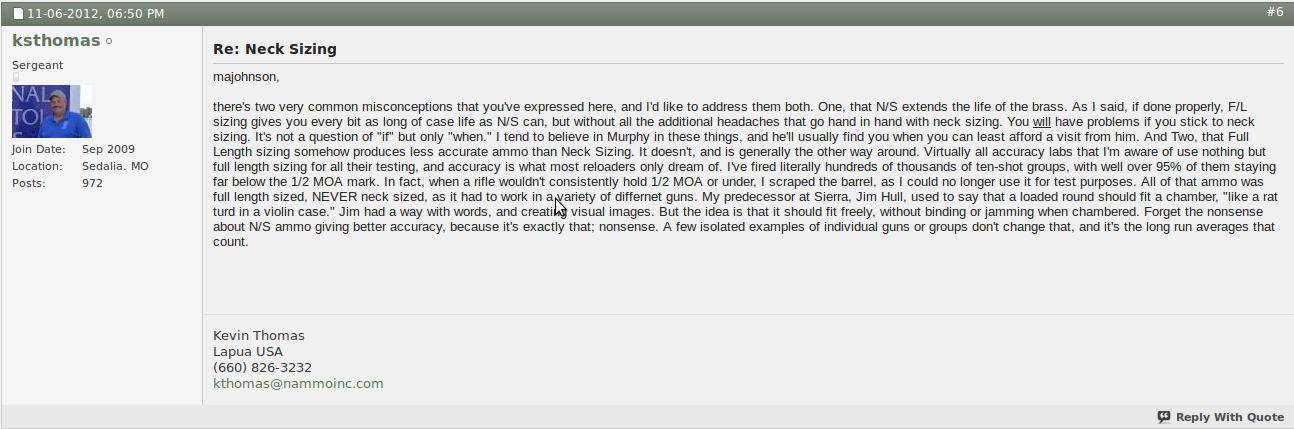
Below are Kevin Thomas and Eric Cortina of Team Lapua USA. Please note that Kevin Thomas worked in the Sierra Ballistic Test lab before shooting for Lapua.
Full length resizing, "The cartridge should fit the chamber "like a rat turd in a violin case".
Meaning a full length resized case body does not touch the chamber walls and only the case shoulder contacts the chamber. The case is supported by the bolt face in the rear and by the bullet in the throat. If a case does not have uniform wall thickness it will expand more on the thin side of the case. This causes the case to warp and become egg shaped and the base of the case will not be 90 degrees to the axis of the bore. Bottom line, a neck sized case has more effect on bullet alignment in the throat and the axis of the bore.
Below German Salazar explains the benefits of full length resizing vs partial full length resizing or neck sizing.
Reloading: Partial Neck Sizing
by German A. Salazar
http://riflemansjournal.########.com/2010/06/reloading-partial-neck-sizing.html
"Now the last scenario, a full-length sized case in which the neck is also fully sized. There is clearance at the neck and in the body of the case, the closest fit anywhere is the bullet in the throat. If the neck to bullet concentricity is good (although it needn't be perfect), then the bullet will find good alignment in the throat and the case body and neck will have minimal influence. Let's not forget that the base of the case is supported by the bolt face or the extractor to a certain degree as well; this is yet another influence on alignment. As you can see, there are several points from base to bullet that can have an effect. My procedure is to minimize the influence of those that I can control, namely the case body and neck, and let the alignment be dictated by the fit of the bullet in the throat and to some extent by the bolt's support of the base. Barring a seriously out of square case head, I don't think the bolt can have a negative effect on alignment, only a slightly positive effect from minimizing "case droop" in the chamber. Given that a resized case will usually have a maximum of 0.001" diametrical clearance at the web, this isn't much of a factor anyway."
Below are Kevin Thomas and Eric Cortina of Team Lapua USA.......
Below German Salazar explains the benefits of full length resizing vs partial full length resizing or neck sizing.
Thanks for the references! Kevin indicated one of the reasons for f/s was due to the requirement for rounds to chamber in a variety of firearms. That was a little misleading to the main point of his own argument and may confuse folks because although that may have been the case, that is not the point. The main point is that one would still (always) want to f/s even if using cases previously fired in the same gun.
Thanks for the references! Kevin indicated one of the reasons for f/s was due to the requirement for rounds to chamber in a variety of firearms. That was a little misleading to the main point of his own argument and may confuse folks because although that may have been the case, that is not the point. The main point is that one would still (always) want to f/s even if using cases previously fired in the same gun.
The ammunition in the Sierra test lab was full length resized because it was fired in a variety of different rifles.
Meaning the ammunition had to fit in any rifle chamber just like new ammunition and you do not neck size for a variety of rifles if you want the case to fit in the chamber.
This is why the resizing dies instructions tell you to contact the shell holder and turn the die in 1/8 to a 1/4 turn more so the ammunition will fit in any chamber.
You make the ammunition a custom fit in "YOUR" chamber with minimum shoulder bump .001 to .002. "BUT" this same ammunition may not chamber in another rifle.
Full length resizing, "The cartridge should fit the chamber "like a rat turd in a violin case". I see no confusion in what Kevin Thomas said.
... I see no confusion in what Kevin Thomas said.
That is good. What I was attempting to point out was that some folks may hang their hat on that single statement about f/s their ammo when handloading for a variety of firearms as being an important factor. Although true, they should f/s regardless. I know folks who only f/s their handloads if they will be used in multiple firearms as a result of statements like that, because folks misinterpret in the way they read and digest information...despite the "rat turd in the violin case" comment.

Many moons ago, I reloaded for my Canadian Centennials (matched rifle and carbine) in 30-30 with a Lee Classic Loader. The odd time a round would be a bit tough to chamber. While the Classic would be okay, a proper press and dies would be better. I full length size pretty much everything now. I am not worried about 1000 yd. 1" groups nor super duper high velocity loads, so full length works fine. I apply Lee case lube with my fingers, making sure a wee bit gets in the case mouth. I started off back in the day using that gawd awful sticky crap and rolling the cases in it. I wasn't long ditching that stuff!
... I am not worried about 1000 yd. 1" groups nor super duper high velocity loads, so full length works fine...
If you read up some, you will likely find that even the long range shooters are full length sizing. The point I was making, which Big Ed kindly provided references to, is that neck sizing is not necessary or even helpful for any reason. As you mentioned, the Lee Classic Loader only performs a n/s, for (hopefully) obvious reasons, but that is out of necessity of the tool.
If you read up some, you will likely find that even the long range shooters are full length sizing. The point I was making, which Big Ed kindly provided references to, is that neck sizing is not necessary or even helpful for any reason. As you mentioned, the Lee Classic Loader only performs a n/s, for (hopefully) obvious reasons, but that is out of necessity of the tool.
Just a lighthearted way for me to say that I am not what might be called a "good shot". I have "read up some". I have been reloading for nearly 50 years, and have fired more than a few of my own reloads. My post was simply to state my experience.
...My post was simply to state my experience.
oh, oops...sorry for the misinterpretation...(tail between legs)...me being lighthearted back





















