300 Win Mag modified ladder test?

Icefire

CGN frequent flyer
Rating - 100%
42   0   0
HI,

Looking to work up a load for my Cadex with 208gr ELD Match and H1000.

Previous owner gave me a load but it didn't group that well at 100M.

Hodgdon data say to use 71.7 to 78.0C of H1000. I'm not shooting 1000 rounds to test! Does most only test 2 grain less than max at every .2gr step?

Looking to do a 10 rounds per weight, shooting by alterning by weight/target instead of shooting all 10 of one weight than switch.

Also, previous owner gave me the Ogive lenght, since it can varry pretty much, how do you work a load when you have 2 variable?
 
Last edited:
.2gr increments is excessively small for that much case capacity. I use .2gr for 223 sized cases, .3gr for 308 sized and .5gr for 338 sized cases. For the 300WM, I'd go .4gr or .5gr increments.

10 rounds at each charge isn't a ladder test. Load two rounds at each charge, I'd start at around 74gr. Shoot low to high then high to low at 300+ meters, all on one big paper target. Use the same point of aim for all rounds.

Seat the bullets just short of the lands if you can, or magazine length if you can't.
 
My version of a ladder test (243 Win) was 14 to 16 rounds in .2 gr increments. Three subsequent rounds showed nearly identical velocities and grouped in close proximity.
That particular velocity was identified by a friend with Quickload as coinciding with a favourable harmonic node for my barrel length.
It was that simple.
 
Here's what I did to work up a load in my .300 win mag if you're interested; I shoot 208 ELD-Ms as well but I use Vihta Vuori N560 and get great results.

My gun is a Tikka T3 rebarreled with a Lothar Walther 32" Super Palma 10" twist running a SAAMI chamber and throat. Even with MDT's 3.56" metal mags, my action limits me to 3.426" COL so I have to jump the bullets at least 90 thou. I look for one or more accuracy nodes that corresponds with charge weight(s) and load / test those afterwards.

Basically I pick a charge weight range and load test rounds in increments of .2 gr from the starting charge to what I conclude might be a max / upper end charge.

Example: 70.1 70.3 70.5 70.7 70.9 71.1 71.3 71.5

I try to load at least 3 rounds per charge weight; more is better and you'll see why in a pic below.

Example: 3 x 70.1, 3 x 70.3 etc etc

I then pick a decent distance (at least 400m if I can) to set up a large poster board with a decent aiming mark. Maintaining the same point of aim and exercising excellent principles of marksmanship throughout is critical for this. I don't worry about the wind but calm and bright conditions are ideal. If you have a spotting scope and a buddy to keep track of where shots go, you can plot where your rounds went and when. I tend to use different colours of permanent marker and colour the tips of my bullets to represent corresponding charge weights. The marker on the bullet transmits to cardboard and poster board quite well if you're shooting alone and need feedback for where your rounds went. I also have a wireless camera system to record shots as a backup.

I shoot the test rounds in following order:

Lowest to Highest - checking for pressure signs as I go and stopping at what my gun / handloads hint at as being upper end.

Highest to Lowest

Lowest to Highest

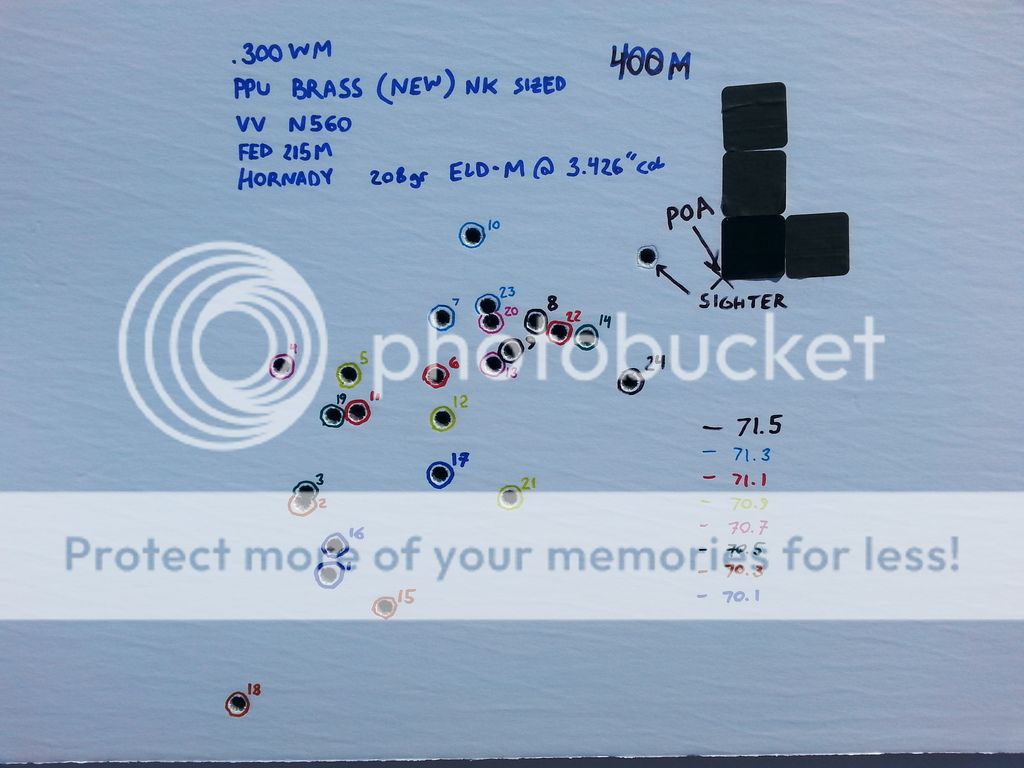
Once that's done, you could have something that resembles this:

20180429_120435_zpsnz7wnfha.jpg


If you look at shots 1-8, you'd think that shots 2 and 3 are an accuracy node or that 4,5 and 6 show good potential because there is very little vertical dispersion. I got away from shooting 1 charge ladder because there is always the potential for shooter error to skew results. Thus, I shoot at least 3 charge ladders at the same point of aim and it gives me more useful data on what my loads / gun can perform like.

With that in mind, 71.3gr is what I settled on in this case.

I then load at least 10 rds of each charge weight that may be an accuracy node and shoot them for a group at at least 400m over chronograph / magnetospeed to collect velocity data. In my case, my load gave me and SD of 7.5 and AVG velocity of 3035; not too shabby. I don't have a pic handy but 10 rds at 400m gave me about 2 1/4" group center to center (roughly 1/2 MOA.)

I basically combined some ideas from OCW and other ladder test methods and use this one a lot because it minimizes the rounds I need to fire while maximizing the data I can collect to better decide on a good load based on what my goal is (ie low SDs and an as little vertical dispersion as possible while staying at least sub MOA but potential for sub-sub MOA.)

Now if you have to start low and want to work up towards a much higher max / upper end, I basically do the same thing but in separate sessions (starting at the lowest end of course.)

Example: 70.1 - 71.5 one day and then 71.7 - 73.1 another day

Try to keep the weather consistent / timeframe narrow; don't shoot these tests months apart or one on a cold day and one on a warm day.

As mentioned above, you could space out your charge increments depending on your particular case volume. One thing to keep in mind is that there is always the possibility of narrow accuracy nodes and larger charge increments could mask / hide these. No combination of powder / components / barrels will 100% perform predictably and/or consistently. I also will suggest that as you get closer to max / possible upper end to narrow your charge jumps to avoid catastrophic surprises (increments of .2gr instead of .5gr etc.)

Hope this helps.

 
Last edited:
So only accuracy first, no chrony?
a bit risky to get yer no?

If you are using a Labradar or Shooting Chrony , you totally could get your velocities while shooting this and get even more data at the same time.

I do it this way because I only have access to a magnetospeed. While my gun's POI doesn't seem to shift with it mounted, I don't want to risk changing the barrel harmonics so that's why I look for results on paper first.

Getting velocities afterwards can also tell you if your potential final load is temp sensitive as the barrel warms up. I usually try to shoot ladder tests / groups using an F Class rate of fire (about 1 rd every 45 seconds.) Not too slow but you don't want to fry eggs on your barrel either.
 
Here's what I did to work up a load in my .300 win mag if you're interested; I shoot 208 ELD-Ms as well but I use Vihta Vuori N560 and get great results.

My gun is a Tikka T3 rebarreled with a Lothar Walther 32" Super Palma 10" twist running a SAAMI chamber and throat. Even with MDT's 3.56" metal mags, my action limits me to 3.426" COL so I have to jump the bullets at least 90 thou. I look for one or more accuracy nodes that corresponds with charge weight(s) and load / test those afterwards.

Basically I pick a charge weight range and load test rounds in increments of .2 gr from the starting charge to what I conclude might be a max / upper end charge.

Example: 70.1 70.3 70.5 70.7 70.9 71.1 71.3 71.5

I try to load at least 3 rounds per charge weight; more is better and you'll see why in a pic below.

Example: 3 x 70.1, 3 x 70.3 etc etc

I then pick a decent distance (at least 400m if I can) to set up a large poster board with a decent aiming mark. Maintaining the same point of aim and exercising excellent principles of marksmanship throughout is critical for this. I don't worry about the wind but calm and bright conditions are ideal. If you have a spotting scope and a buddy to keep track of where shots go, you can plot where your rounds went and when. I tend to use different colours of permanent marker and colour the tips of my bullets to represent corresponding charge weights. The marker on the bullet transmits to cardboard and poster board quite well if you're shooting alone and need feedback for where your rounds went. I also have a wireless camera system to record shots as a backup.

I shoot the test rounds in following order:

Lowest to Highest - checking for pressure signs as I go and stopping at what my gun / handloads hint at as being upper end.

Highest to Lowest

Lowest to Highest

Once that's done, you could have something that resembles this:

20180429_120435_zpsnz7wnfha.jpg


If you look at shots 1-8, you'd think that shots 2 and 3 are an accuracy node or that 4,5 and 6 show good potential because there is very little vertical dispersion. I got away from shooting 1 charge ladder because there is always the potential for shooter error to skew results. Thus, I shoot at least 3 charge ladders at the same point of aim and it gives me more useful data on what my loads / gun can perform like.

With that in mind, 71.3gr is what I settled on in this case.

I then load at least 10 rds of each charge weight that may be an accuracy node and shoot them for a group at at least 400m over chronograph / magnetospeed to collect velocity data. In my case, my load gave me and SD of 7.5 and AVG velocity of 3035; not too shabby. I don't have a pic handy but 10 rds at 400m gave me about 2 1/4" group center to center (roughly 1/2 MOA.)

I basically combined some ideas from OCW and other ladder test methods and use this one a lot because it minimizes the rounds I need to fire while maximizing the data I can collect to better decide on a good load based on what my goal is (ie low SDs and an as little vertical dispersion as possible while staying at least sub MOA but potential for sub-sub MOA.)

Now if you have to start low and want to work up towards a much higher max / upper end, I basically do the same thing but in separate sessions (starting at the lowest end of course.)

Example: 70.1 - 71.5 one day and then 71.7 - 73.1 another day

Try to keep the weather consistent / timeframe narrow; don't shoot these tests months apart or one on a cold day and one on a warm day.

As mentioned above, you could space out your charge increments depending on your particular case volume. One thing to keep in mind is that there is always the possibility of narrow accuracy nodes and larger charge increments could mask / hide these. No combination of powder / components / barrels will 100% perform predictably and/or consistently. I also will suggest that as you get closer to max / possible upper end to narrow your charge jumps to avoid catastrophic surprises (increments of .2gr instead of .5gr etc.)

Hope this helps.

How do you keep track of all those holes?
 
How do you keep track of all those holes?

Color your bullets, use a video camera, or a spotting scope.

Ladder test is the only way to go. Also groups at 100 yards don’t mean anything. I’ve seen great groups at 100 turn to complete crap at distance. Also seen meh groups at 100 turn half minute or less at distance.
 
I’m loading 110 round seated to mag lenght (2.890 ogive), 5rnds of eqch in .3gr step from 71.7 to 78.0.

When I find nodes, I’ll do 10 rnds .1gr step over and under the nodes.

Pics to come
 
Curious how much velocity change you see in a 300wm with 0.2gr charge weight steps?

Quickload predicts it's not much (anywhere from 6-15 fps jumps depending on what numbers you plug in for case capacity / temp / seating depth of bullet etc. To be honest, the small increments are more for finding narrow accuracy nodes on paper. I suspect my choice of barrel length combined with playing with slower powders like IMR 7828 or IMR 7977 Enduron makes finding really tight nodes harder.

One day when I rebarrel my .300wm, I'm gonna go to a more "factory" length of 26-27" in a heavier contour and see what results I get. Until then, the Lothar Walther spaghetti noodle seems to shoot Hornady's 208 and 225 ELD Ms quite well.
 
Back
Top Bottom