Battle of Ridgeway (Fenian Raids) - 152 Anniversary today!!

cigar_man

CGN frequent flyer
GunNutz
Rating - 100%
107   0   0
Location
Ontari Ari Oh
Canada's Forgotten Boys of the Fenian Raids.

Cantom and myself met at the Battle of Ridgeway park at 07:00 for the 152nd Anniversary.

"Decoration Day"

To the best of all accounts, the troops started to march up Ridge Road at around 7:30 hrs.

We followed their route at the exact same timings today.

One hundred and fifty two years ago today the battle also fell on a Saturday.

Thanks Tom, it was an Honour for us both to share the moment.

Kind of sad though at the end, two guys showed up to empty the parks garbage cans, we informed them of what today was.

The lad paused for a moment, said that's cool and carried on.

I left a picture of John McHaffie who was a Battle of Ridgeway participant with the 13th Battalion of Infantry (Hamilton) and took some pics with his Canada General Service Medal for the Fenian Raids.

Rest in Peace Gentlemen, you have done your Duty for Canada.

vlPouGIh.jpg


XE8AvKrh.jpg


DqYt49Vh.jpg


'Thats all Folks", we where the only ones in attendance for this Cherished Day of Memory!
 
Last edited:
Shame that the Queens Own Rifles from Toronto did not do anything this year.

They did back in 2010 (see below)

Back in the day (late 70s early 80s) the QOR had a very active program of recreation and participation but the budget was cut by the Ontario Government
as was their role as honor guard in front of the Ontario Legislature and the LG's office at Queens Park. The goverment was providing funding for the 9-5 ceremonial
guard posts (1 infront beside the main entrance and 1 at the west side at the bottom of the steps to the LG quarters) but it was pulled for budget reasons. It was
a big hit with the tourists from June to the end of August when it was operated using students trained by the QOR with the 1866 uniforms and kit as part of a summer
program for student employment.

Probably not politically correct in Toronto to have ceremonial guards with muskets and bayonets standing around anymore.

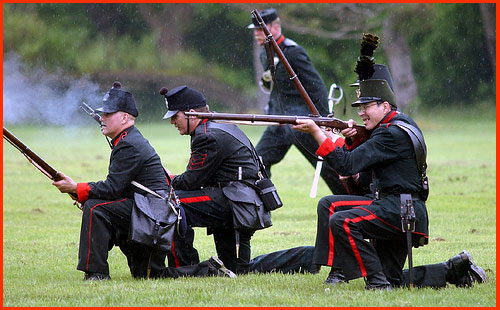
A large part of the driving force for the 1866 recreations is now Major Simondson from the QOR. (That is him when he was a Captain behind the QOR riflemen skirmishing in the below picture)

The picture is not from 2010 but earlier. I am not in that picture but that was lot of fun. We had the Parker Hale Enfield repros and kit.

Was really proud to stand guard at Queens Park.

Those were different days for sure.....

qor-firing.jpg


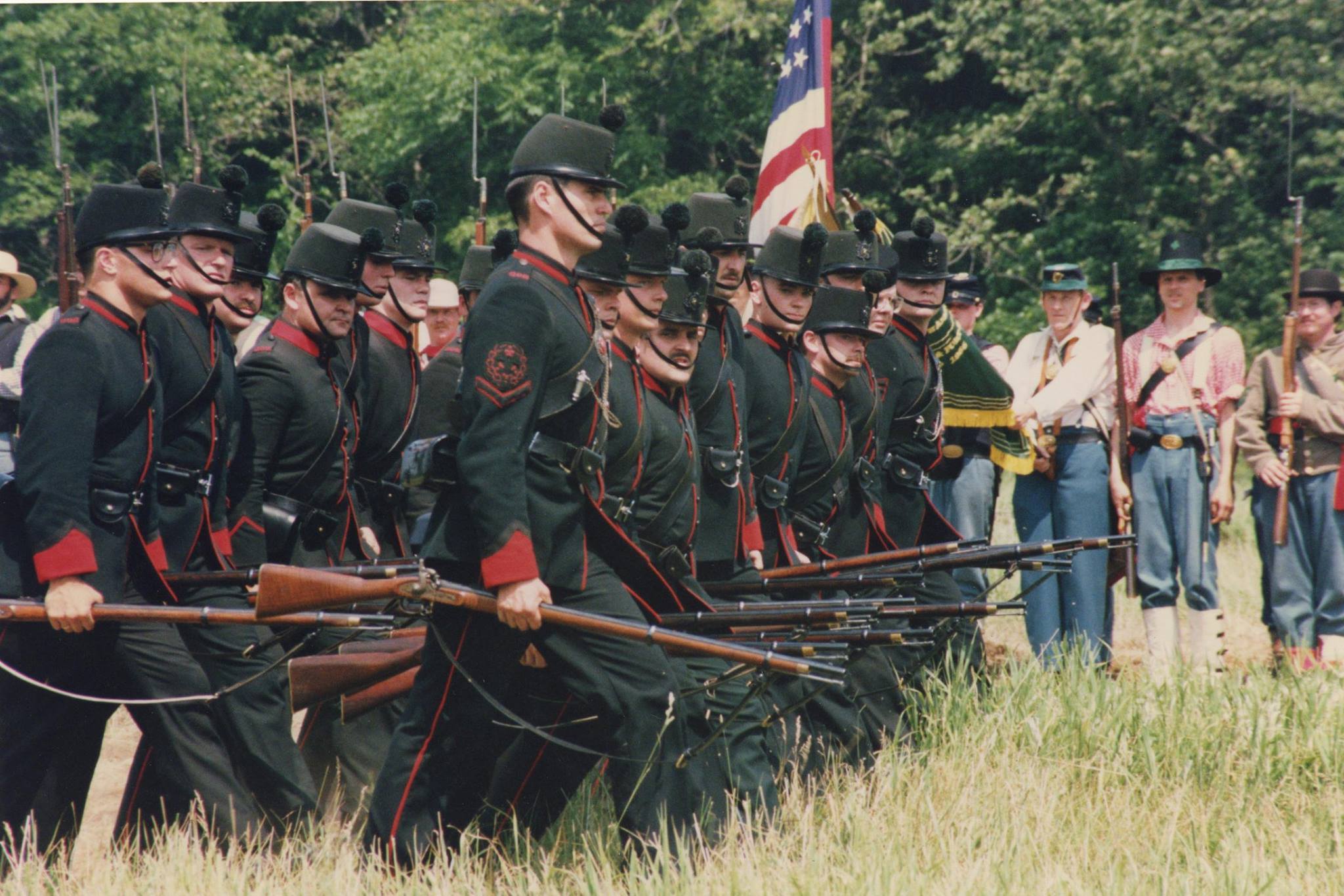
Back in 2010 there was a creation and celebration the the LG and Royal Hamilton Light Infantry and Queens own Rifles units representing the Canadians and volunteers as Fenians at the battle.

http://rhli.ca/ceremonialguard/parades/12june2010Ridgeway.html
 
Last edited:
Well done to bring the history to our attention. Visited the site last year in late May and it was a sober reminder of the trials we went through establishing our place in the world as a sovereign nation not to be taken lightly.
 
Pretty damn cool!

One of my distant ancestors was awarded the Fenian Raid 1866 medal, which I have.

Pte J. Brady, 3rd V.V.R.

Pte James Brady went on to become a Mines Engineer in British Columbia, and I am a little unclear exactly where he fits into the Family Tree, though I do clearly recall that he was referred to as "the mercenary" by one of my great Aunts. So I would presume he had a bit of an unsettled life for at least some of his younger years.

V.V.R was Victoria (Victoria's?) Volunteer Rifles, formed out of mostly members of a Tennis Club in Montreal at the time.
 
I did the first guard at Casa Loma. I heard the Queens Park guard was pulled because they refused to hire female students as it was not historically correct to have women in the army back in the 1860's
 
Last edited:
Had another great time at the Battle of Stoney Creek. This year entrance is free. Several dozen pioneers vendors. Beer/Ale tent. 2 houses that were there during the battle. And Yank, Brit, Local Militia and Native Warrior Reenactors!
 
Canadian Militia was issued several rimfire firearms during the Fenian Raid period (Starr, Peadoby and Spencer Models). These Models were used until the British Government was able to supply the Snider Rifles. The Red Sashes in the Missisquois Bay area bought at their own expense several Ballard rifles and used them at the battle of Eccles Hill in Frelighsburg in 1870.
 
Last edited:
"Decoration Day" June 2nd 1890

We will remember them” is a call heard at many military memorial ceremonies and parades, but it was only in 1931 that Ottawa passed an act permanently fixing Canada’s national military memorial day to the anniversary of Armistice Day, Nov. 11, 1918, marking the end of the Great War. The day was named Remembrance Day.

The same act moved Thanksgiving to October from its traditional November date, still adhered to by our American neighbours.

The 1931 Armistice Remembrance Day Act became an inauspicious memorial to those who died in what was called at the time “the war to end all wars.”

As the poet W.H. Auden wrote, the 1930s were “a low dishonest decade” in which “clever hopes expired.”

The decade ushered in the Second World War, which was infinitely more savage and apocalyptic than the first.

It was appropriate to commemorate those killed in that futile First World War with symbolic artificial paper poppies under tombstone-cold grey skies of November.

But for 30 years before, Canadians had a different memorial called Decoration Day in which we commemorated our war dead with the laying of real flowers, not in the hopeless gloom of November but in the warm light and optimism of late spring or in summer, often on the weekend closest to June 2, the anniversary of Canada's forgotten first modern battle, the Battle of Ridgeway in 1866.

On Decoration Day, Canadians gathered at war monuments, tended to soldiers’ graves after the ravages of winter and “decorated” them with flowers, wreaths and garlands, prayed that their sacrifices were not in vain and that we had come to be worthy of them.

Veterans were showered in flowers as they passed, escorted by phalanxes of children.

It was a popular communion of young and old with the souls of our fallen soldiers in a celebration of hope, life and rebirth. We remembered and we remembered well.

Sadly, politics trumped memory.

Decoration Day began as a protest in 1890 by forgotten veterans who had fought in the Battle of Ridgeway but received no acknowledgement from the Canadian government.

Nine soldiers were killed in the battle, including three University of Toronto student volunteer riflemen plucked from their final exams the day before and thrown into combat against Irish-American Fenian insurgents who had invaded Canada across the Niagara River near Fort Erie.

The Ridgeway Nine are the modern Canadian military’s first nine combat casualties, but the boys killed that day were quickly forgotten by the bungling politicians in Ottawa who had sent them to their deaths, as were another 22 soldiers who later died from wounds and disease contracted on service during the Fenian Raids that summer in 1866.

By 1890, frustrated with being forgotten for nearly 25 years, the surviving middle-aged veterans protested on the June 2 anniversary of Ridgeway by laying flowers and wreaths at the Canadian Volunteers Monument near Queen’s Park, Toronto’s oldest standing public monument. The event became Decoration Day, an annual tradition that endured until 1930 and is still commemorated today in some communities in the Niagara-Welland-Fort Erie region where the 1866 battle was fought.

Decoration Day eventually included Canadian soldiers killed in the Northwest Rebellion of 1885, and the South African War (Boer War) of 1899-1902, and the even the Great War, whose casualties were commemorated in June before there was any armistice in November of 1918.

When Remembrance Day was established in 1931, with only a few surviving Fenian Raid veterans remaining to remind Ottawa of its historical bungling, the embarrassing memory of our first fallen soldiers was purged from our national heritage and from the Remembrance Day commemoration. Today, they’re not even listed in our National Books of Remembrance, and few in Canada have even heard of the Battle of Ridgeway.

Until recently, Canada’s Veterans Affairs website used to state that Remembrance Day only “commemorates Canadians who died in service to Canada from the South African War to current missions.” Now, some Veterans Affairs web pages have begun to purge the South African War casualties, proclaiming that, on Remembrance Day, “we honour those who fought for Canada in the First World War (1914-1918), the Second World War (1939-1945), and the Korean War (1950-1953), as well as those who have served since then.” This is a further erosion of our historical memory of sacrifices that should never be forgotten no matter how long ago they might have been made.

With the recent death of the last surviving veteran of the First World War, tomorrow may see the memory of those sacrifices thoughtlessly deleted from our national heritage. And the day after tomorrow, our Second World War and Korean War fallen may be as easily forgotten, and it will be left to us to explain to our children what Nov. 11 used to signify and why we fought those wars.

Remembrance must be forever. Veterans Affairs needs to permanently restore the memory of all our forgotten soldiers who fell in service for Canada, not just the more recent ones but beginning with our very first who we used to commemorate during Decoration Day, starting with the Ridgeway Nine.

Let’s all take one more day to remember, that warm sunny one in June. Let’s revive Decoration Day and place a living flower on a soldier’s grave, tend to it tenderly, embrace a veteran and thank them for those better summers of our liberty and prosperity that define this great nation we call Canada. One more day is surely not asking too much to acknowledge entire lives given. Let’s remain true to our promise, “We will remember them.”

Peter Vronsky

 
Canadian Militia was issued several rimfire firearms during the Fenian Raid period (Starr, Peadoby and Spencer Models). These Models were used until the British Government was able to supply the Snider Rifles. The Red Sashes in the Missisquois Bay area bought at their own expense several Ballard rifles and used them at the battle of Eccles Hill in Frelighsburg in 1870.

Yup, I had an ancestor that fought there. The Fenians, supposedly all hardened Union Army veterans of the Civil War, travelled to the border by railroad, then detrained a short distance from Eccles Hill. The story is that because they had had nothing to eat on the way from NYC but some almost completely salted salt pork, they were all nearly dead from thirst and immediately most of the horde swarmed the banks of the Mississquoi River and began gulping down river water, some of them scooping it up in their boots and pouring it into their mouths. Must have been fairly comical.

The Canadians from the area had been alerted by US Customs officials (or at least so the US claims) and were ready in concealed positions in the trees at the top of Eccles Hill, which is just across the border. The Fenians came up to the hill using a small dirt road that used to be there (it was removed in the 1970s to improve security for the 1976 Olympics in Montreal). They were wheeling a small artillery piece with them and getting ready to conquer but as soon as they started up the hill towards the militia they met with a volley from the Canadians, one of them falling down dead. It was a completely open field in those days and the Fenians immediately fled it and, leaving behind their dead man and the artillery piece, which the Canadians took possession of. It now forms part of the official monument at the battle site (which itself is rather badly neglected by the QC government, both because the whole area had been English speaking at the time, and no doubt because the monument is in English only, since it was we Anglais that erected it and it was done pre-bilingualism).

The militia were particularly ready and militant in 1870 because the Fenians had been there a few years before, on that occasion they had successfully occupied a few farms where they milled around for a day or more, stealing washing off the clothes lines and things like that (there's a story about a Fenian running around in a woman's dress). They also took a Union Jack back with them and used it to raise money for their cause in New York City. Then they returned and made their second raid, obviously expecting the same easy pickings. They did not come back a third time.

fenian.18_0.jpg


0._Captured_Fenian_Cannon_Eccles_Hill_Miguel_Tremblay_Wikipedia.jpg
 
Last edited:
Back
Top Bottom