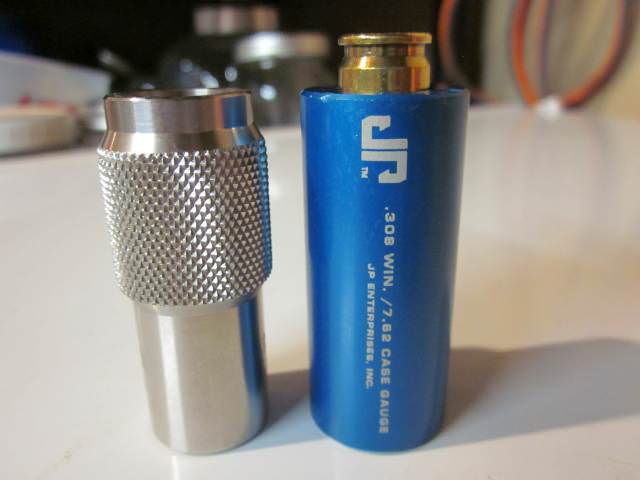
Below are two .308 drop in gauges, a Dillon and a JP Enterprise case gauge.
In the Dillon gauge below is a "fired" 7.62x51 Lake City case and is one of the longest fired cases from a half a coffee can of 03 dated fired Lake City 7.62 cases. These fired cases varied .006 in headspace length to show you variations in military chamber headspace. And what you are fighting against when resizing once fired military 7.62 cases and the brass spring back after sizing. Meaning the resized case wants to spring back to its fired size after sizing and grows and springs back after sizing.
You normally do not have this problem with cases fired in "your" rifle because the case was fire formed to "your" chamber and springs back smaller than "your" chamber. But with once fired brass and range pickup brass there is no guaranty that a full length resized case will fit in "your" chamber. And this is where a small base die comes into play, because the small base die will push the case shoulder back .002 to .003 "more" than a standard die. "BUT" even with my RCBS .308 small base die I'm getting .003 variance in shoulder location after sizing because of brass spring back from the military chambers. (maching gun fired brass)
Below is the same fired case in the JP Enterprise gauge that is a smaller diameter than the Dillon gauge. And after sizing if the case drops all the way into the JP Enterprise gauge between the headspace slot it will fit in any chamber. Meaning the JP Enterprise gauge is closer to minimum SAAMI dimensions in diameter and headspace length.
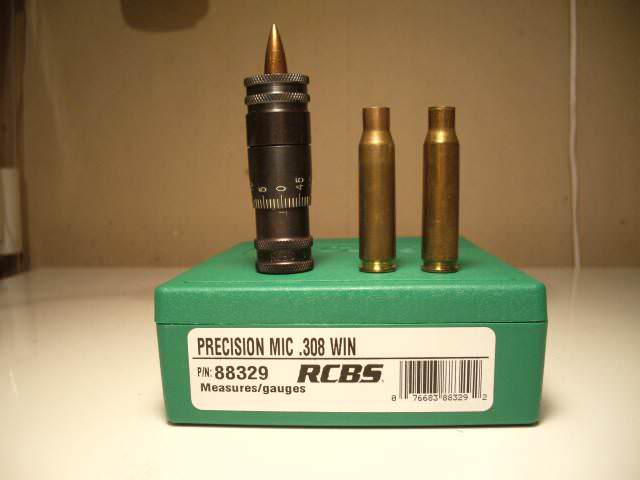
Below is my .308 RCBS Precision Mic and if I put a .308 GO gauge into the gauge it measures two marks to the right of zero. (-.002) And when I place the fired Lake City case above in this gauge it measures +.010 or .012 longer than the GO gauge. This means the chamber this case was fired in was .003 longer than a commercial .308 Field gauge, which is .009 longer than the GO gauge. And why you have problems pushing the case shoulder back to fit in your .308 rifle. The distance between the .308 GO and NO-GO is .003 and the field gauge is .009 longer than the GO gauge. Meaning a used worn .308 rifle is allowed .006 wear past the NO-GO gauge.
NOTE, I only have one Precision Mic above and prefer the Hornady cartridge case headspace gauge because it will measure any normal caliber case and is cheaper than the RCBS Precision Mic.
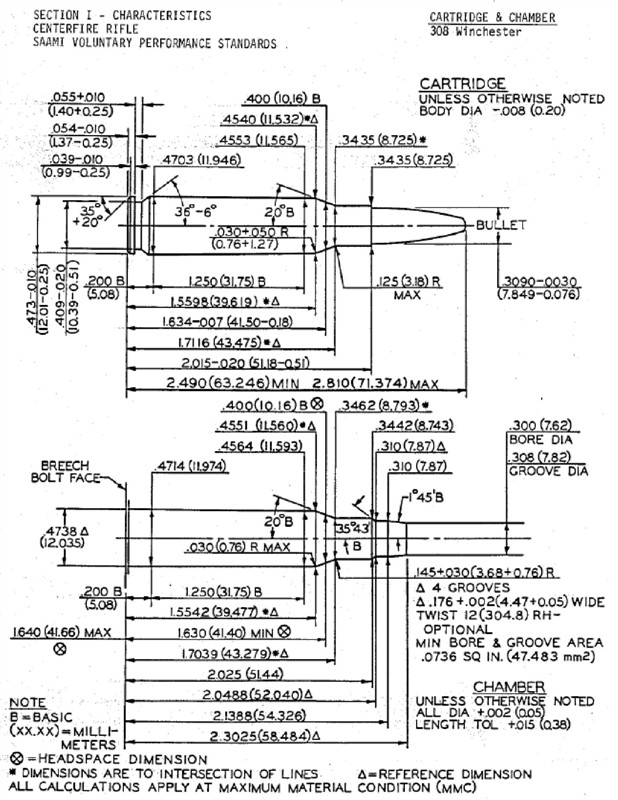
Below headspace gauges explained, if you look at a SAAMI cartridge and chamber drawing it lists headspace as min and max with .010 in between.
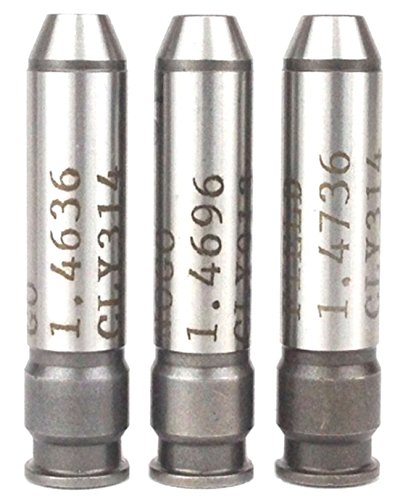
Pacific Tool and Gauge offers three lengths of headspace gauges per rifle caliber. In order from the shortest to longest, they are: GO, NO-GO, and FIELD:
1. GO: Corresponds to the minimum chamber dimensions. If a rifle closes on a GO gauge, the chamber will accept ammunition that is made to SAAMI’s maximum specifications. The GO gauge is essential for checking a newly-reamed chamber in order to ensure a tight, accurate and safe chamber that will accept SAAMI maximum ammo. Although the GO gauge is necessary for a gunsmith or armorer, it usually has fewer applications for the collector or surplus firearms purchaser.
2. NO-GO: Corresponds to the maximum headspace Forster recommends for gunsmiths chambering new, bolt action rifles. This is NOT a SAAMI-maximum measurement. If a rifle closes on a NO-GO gauge, it may still be within SAAMI specifications or it may have excessive headspace. To determine if there is excessive headspace, the chamber should then be checked with a FIELD gauge. The NO-GO gauge is a valuable tool for checking a newly-reamed chamber in order to ensure a tight and accurate chamber.
3. FIELD: Corresponds to the longest safe headspace. If a rifle closes on a FIELD gauge, its chamber is dangerously close to, or longer than, SAAMI’s specified maximum chamber size. If chamber headspace is excessive, the gun should be taken out of service until it has been inspected and repaired by a competent gunsmith. FIELD gauges are slightly shorter than the SAAMI maximum in order to give a small safety margin.
Below in the .308 chamber drawing at the circled X marks you will see 1.630 as min and 1.640 max headspace and .010 between.
Below you can see how much longer military 7.62 NATO headspace gauges are than commercial .308 headspace limits. And why the resized cases spring back longer than "your" chamber and chamber hard or not at all.