












































You are using an out of date browser. It may not display this or other websites correctly.
You should upgrade or use an alternative browser.
You should upgrade or use an alternative browser.
Quick load
- Thread starter Slimbo
- Start date


You also need the case capacity in H2O and a chronograph to give you actual velocity. Then you change the burn rate in Quickload until the two velocities match.
When the velocities match Quickload will give you the approximate chamber pressure for a workup load. Meaning chamber pressure and velocity estimates for the incremental increase in loads.
In another forum someone asked the same question for a 280 ackley and someone posted the Quickload data. But the data was wrong because the case capacity used was less than the standard .280 Rem.
I have Quickload but I would never give out any data because the people asking for Quickload data do not give out enough information to give accurate data.
Example the default case capacity in Quickload for the .223/5.56 is 28.0 grains of H2O. And my cases have a capacity of 30.6 and this creates a 6,000 psi difference in chamber pressure.
When the velocities match Quickload will give you the approximate chamber pressure for a workup load. Meaning chamber pressure and velocity estimates for the incremental increase in loads.
In another forum someone asked the same question for a 280 ackley and someone posted the Quickload data. But the data was wrong because the case capacity used was less than the standard .280 Rem.
I have Quickload but I would never give out any data because the people asking for Quickload data do not give out enough information to give accurate data.
Example the default case capacity in Quickload for the .223/5.56 is 28.0 grains of H2O. And my cases have a capacity of 30.6 and this creates a 6,000 psi difference in chamber pressure.

Anybody mind running a quick quick load for me?
280 ackley
160 accubond
RL22
24” barrel
3.280 OAL
Thanks!
how far off the lands?
There is obviously more to this program than I was aware of. I was just looking for a table like you’ve posted in that big thread about the 6.5CM vs the 260, so that I can compare the numbers to my manuals. I’m away from the reloading bench right now and can’t remember the distance to the lands but I could get that in the next few days.

From what I can recall, distance from the lands doesn't matter in QL. What matters is if you are jammed into the lands which is unlikely for most hunting loads. It increases the start pressure and QL can account for this IIRC.
distance off the lands does matter, as it will effect start pressure. Subtract 145psi for every .005" off the lands (+7200psi over bullets baseline start pressure)
Here's a generic prediction based on a .050" jump to lands. Case capacity may be more or less than your brass
Here's a generic prediction based on a .050" jump to lands. Case capacity may be more or less than your brass
Code:
Cartridge          : .280 Ack Imp
Bullet             : .284, 160, Nosler AccuBond 54932
Useable Case Capaci: 62.904 grain H2O = 4.084 cm³
Cartridge O.A.L. L6: 3.280 inch = 83.31 mm
Barrel Length      : 24.0 inch = 609.6 mm
Powder             : Alliant Reloder-22

Predicted data by increasing and decreasing the given charge,
incremented in steps of 1.0% of nominal charge.
CAUTION: Figures exceed maximum and minimum recommended loads !

Step    Fill. Charge   Vel.  Energy   Pmax   Pmuz  Prop.Burnt B_Time
 %       %    Grains   fps   ft.lbs    psi    psi      %        ms

-10.0   89    52.20   2640    2476   45123  10857     95.6    1.291
-09.0   90    52.78   2668    2529   46372  10985     96.0    1.277
-08.0   91    53.36   2696    2582   47664  11110     96.3    1.264
-07.0   92    53.94   2724    2635   48998  11232     96.7    1.250
-06.0   93    54.52   2751    2690   50376  11351     97.0    1.237
-05.0   94    55.10   2779    2744   51803  11467     97.4    1.224
-04.0   95    55.68   2807    2800   53277  11580     97.7    1.211  ! Near Maximum !
-03.0   96    56.26   2835    2856   54800  11689     97.9    1.198  ! Near Maximum !
-02.0   97    56.84   2863    2913   56378  11795     98.2    1.185  ! Near Maximum !
-01.0   98    57.42   2891    2970   58005  11897     98.5    1.172  ! Near Maximum !
+00.0   99    58.00   2919    3028   59680  11996     98.7    1.159  ! Near Maximum !
+01.0  100    58.58   2947    3086   61407  12090     98.9    1.147  !DANGEROUS LOAD-DO NOT USE!
+02.0  101    59.16   2975    3145   63187  12181     99.1    1.134  !DANGEROUS LOAD-DO NOT USE!
+03.0  102    59.74   3004    3205   65022  12267     99.3    1.122  !DANGEROUS LOAD-DO NOT USE!
+04.0  103    60.32   3032    3265   66915  12349     99.5    1.109  !DANGEROUS LOAD-DO NOT USE!
+05.0  104    60.90   3060    3326   68868  12426     99.6    1.097  !DANGEROUS LOAD-DO NOT USE!

Results caused by ± 10% powder lot-to-lot burning rate variation using nominal charge
Data for burning rate increased by 10% relative to nominal value:
+Ba     99    58.00   3054    3314   70649  11695    100.0    1.095  !DANGEROUS LOAD-DO NOT USE!
Data for burning rate decreased by 10% relative to nominal value:
-Ba 99 58.00 2739 2666 49002 11650 93.0 1.239For sure it will matter on the load. QL has no inputs for primer, but adjusting the burn rate once you chrony the load will take care of that. It's 145psi per .005" off the lands, so 1450 psi for .050"
I use Rem 9.5M magnum and F210M standard primers in my 280AI, but not interchangeably.
I use Rem 9.5M magnum and F210M standard primers in my 280AI, but not interchangeably.
Using QL defaults with no tweaks. Check against data above. Tell me there's no difference. Garbage in, garbage out
Code:
Cartridge          : .280 Ack Imp
Bullet             : .284, 160, Nosler AccuBond 54932
Useable Case Capaci: 63.864 grain H2O = 4.147 cm³
Cartridge O.A.L. L6: 3.340 inch = 84.84 mm
Barrel Length      : 24.0 inch = 609.6 mm
Powder             : Alliant Reloder-22

Predicted data by increasing and decreasing the given charge,
incremented in steps of 1.0% of nominal charge.
CAUTION: Figures exceed maximum and minimum recommended loads !

Step    Fill. Charge   Vel.  Energy   Pmax   Pmuz  Prop.Burnt B_Time
 %       %    Grains   fps   ft.lbs    psi    psi      %        ms

-10.0   93    55.08   2656    2506   42649  11272     95.9    1.389
-09.0   94    55.69   2686    2564   44122  11402     96.3    1.367
-08.0   95    56.30   2717    2623   45651  11528     96.8    1.345
-07.0   96    56.92   2748    2683   47235  11649     97.2    1.324
-06.0   97    57.53   2779    2743   48879  11766     97.6    1.303
-05.0   98    58.14   2809    2804   50583  11878     97.9    1.283
-04.0   99    58.75   2840    2866   52351  11985     98.2    1.263
-03.0  100    59.36   2871    2928   54177  12087     98.5    1.243  ! Near Maximum !
-02.0  101    59.98   2901    2991   56061  12183     98.8    1.224  ! Near Maximum !
-01.0  102    60.59   2932    3054   58010  12274     99.1    1.205  ! Near Maximum !
+00.0  103    61.20   2962    3118   60029  12359     99.3    1.187  ! Near Maximum !
+01.0  104    61.81   2993    3182   62123  12439     99.5    1.168  !DANGEROUS LOAD-DO NOT USE!
+02.0  105    62.42   3023    3247   64293  12512     99.6    1.151  !DANGEROUS LOAD-DO NOT USE!
+03.0  106    63.04   3053    3312   66544  12580     99.8    1.133  !DANGEROUS LOAD-DO NOT USE!
+04.0  107    63.65   3084    3378   68880  12641     99.9    1.116  !DANGEROUS LOAD-DO NOT USE!
+05.0  108    64.26   3114    3445   71303  12696     99.9    1.099  !DANGEROUS LOAD-DO NOT USE!

Results caused by ± 10% powder lot-to-lot burning rate variation using nominal charge
Data for burning rate increased by 10% relative to nominal value:
+Ba    103    61.20   3099    3413   72943  11941    100.0    1.095  !DANGEROUS LOAD-DO NOT USE!
Data for burning rate decreased by 10% relative to nominal value:
-Ba 103 61.20 2769 2724 47835 12110 93.9 1.308Quickload Reloading Software
Quickload Helps Assess Multiple Variables During Load Development
http://www.accurateshooter.com/gear-reviews/test-quickload-review/
"WARNING QuickLOAD is a computer simulation of centerfire cartridge performance. YOU MUST NEVER just “plug in the numbers” and use QuickLOAD’s output for a load recipe. That is foolish and dangerous. There are many reasons why the data QuickLOAD generates may not be safe in YOUR gun. Before loading live ammunition, you should always check with the powder-makers’ most recent load data. In fact, you should check multiple sources if possible, and consult with individuals who actually load for that cartridge. Sierra Bullets offers free load maps which, in general, are fairly conservative. Even when using manufacturers’ load data, start 10% low and work up. Differences in brass, primer brand, and seating depth can make huge differences in pressure. Always reload conservatively and always double- and triple-check QuickLOAD’s output against reliable load data supplied by the powder-makers".
I have Quickload and I still make workup loads by averaging the suggested start loads from several reloading manuals. And as I work up I look for the point the primers become flush with the base of the case. At this point the chamber pressure is high enough to make the brass stretch to meet the bolt face.
In another forum someone gave out Quickload data based on the Nosler case capacity. And Nosler gives the case capacity from the base of the bullet and Quickload wants the case capacity filled to the case mouth.
Bottom line, you are better off looking in several reloading manuals than asking for Quickload information in reloading forums. Quickload requires tweaking from its default settings to even get approximate data. And Quickload just gives you computer generated guesstimates even after tweaking the settings. Just look at how the load data varies in the the different reloading manuals. There are simply to many variations in firearms and reloading components for Quickload to output the approximate information without a chronograph, correct case capacity, etc.
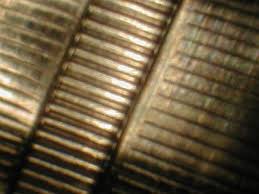
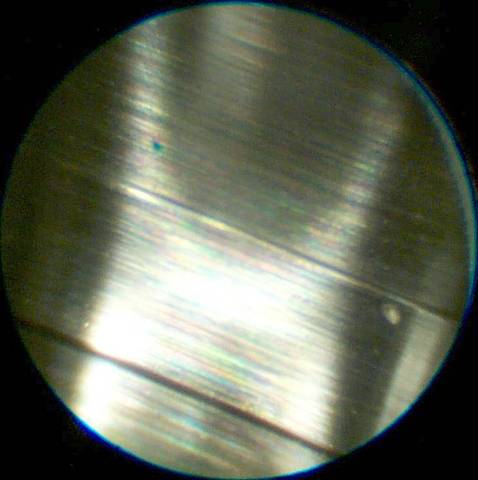
Below is a example of variations in rifle bores, besides bore diameter and this is just "one" of many differences in firearms that Quickload doesn't know, and why it needs tweaked.
Below a bore scope photo of a new Savage button rifled bore.
Below a bore scope photo of a custom hand lapped barrel.
Another example, the throat in my Savage ,223 is longer than the throats in my AR15 rifles. So it can be loaded slightly warmer than published load data with the bullets seated longer.
Quickload Helps Assess Multiple Variables During Load Development
http://www.accurateshooter.com/gear-reviews/test-quickload-review/
"WARNING QuickLOAD is a computer simulation of centerfire cartridge performance. YOU MUST NEVER just “plug in the numbers” and use QuickLOAD’s output for a load recipe. That is foolish and dangerous. There are many reasons why the data QuickLOAD generates may not be safe in YOUR gun. Before loading live ammunition, you should always check with the powder-makers’ most recent load data. In fact, you should check multiple sources if possible, and consult with individuals who actually load for that cartridge. Sierra Bullets offers free load maps which, in general, are fairly conservative. Even when using manufacturers’ load data, start 10% low and work up. Differences in brass, primer brand, and seating depth can make huge differences in pressure. Always reload conservatively and always double- and triple-check QuickLOAD’s output against reliable load data supplied by the powder-makers".
I have Quickload and I still make workup loads by averaging the suggested start loads from several reloading manuals. And as I work up I look for the point the primers become flush with the base of the case. At this point the chamber pressure is high enough to make the brass stretch to meet the bolt face.
In another forum someone gave out Quickload data based on the Nosler case capacity. And Nosler gives the case capacity from the base of the bullet and Quickload wants the case capacity filled to the case mouth.
Bottom line, you are better off looking in several reloading manuals than asking for Quickload information in reloading forums. Quickload requires tweaking from its default settings to even get approximate data. And Quickload just gives you computer generated guesstimates even after tweaking the settings. Just look at how the load data varies in the the different reloading manuals. There are simply to many variations in firearms and reloading components for Quickload to output the approximate information without a chronograph, correct case capacity, etc.
Below is a example of variations in rifle bores, besides bore diameter and this is just "one" of many differences in firearms that Quickload doesn't know, and why it needs tweaked.
Below a bore scope photo of a new Savage button rifled bore.
Below a bore scope photo of a custom hand lapped barrel.
Another example, the throat in my Savage ,223 is longer than the throats in my AR15 rifles. So it can be loaded slightly warmer than published load data with the bullets seated longer.
Last edited:
I've measured brass capacity from four different 280 Ackleys. All Nosler brass, h20 capacity has ranged from 73.4grs to 74.7grs. Hornady brass could be different. Fireformed 280, 270 or 30-06 brass could be significantly different.
My lot # of 160AB are 1.402" long and weigh 159.9grs. This will change from lot to lot. This does make a difference
My 160gr AB load is at 3.392" OAL, .024" off lands. A Kimber 84L with a 3.28" OAL and potentially a longer jump to lands, does make a difference
Adjusting weighting factor from QL default of 0.5 to 0.42 (courtesy of Pierre van der Walt) does make a difference
Powder temperature does matter
Burn rate (Ba) changes as chamber pressure changes. Ba will climb as pressures approx 65k psi. At 50k psi the Ba will be lower. Its advised to not adjust Ba more than 5% to match chrony results, and this is where having accurate info on the other inputs of the program make a difference
There is lots of good information out there on how to tune QL to acheive best results. Like any data source, it's always wise to start low and work up slowly with your rifle, your components, to find your load. A chronograph or even better, a doppler radar, is a must have
My lot # of 160AB are 1.402" long and weigh 159.9grs. This will change from lot to lot. This does make a difference
My 160gr AB load is at 3.392" OAL, .024" off lands. A Kimber 84L with a 3.28" OAL and potentially a longer jump to lands, does make a difference
Adjusting weighting factor from QL default of 0.5 to 0.42 (courtesy of Pierre van der Walt) does make a difference
Powder temperature does matter
Burn rate (Ba) changes as chamber pressure changes. Ba will climb as pressures approx 65k psi. At 50k psi the Ba will be lower. Its advised to not adjust Ba more than 5% to match chrony results, and this is where having accurate info on the other inputs of the program make a difference
There is lots of good information out there on how to tune QL to acheive best results. Like any data source, it's always wise to start low and work up slowly with your rifle, your components, to find your load. A chronograph or even better, a doppler radar, is a must have
Garbage in, garbage out
Its all mostly garbage until its calibrated for his load, gun and conditions.


When I first got Quickload I did not have a chronograph, and inputting the powder charges from reloading manuals was way off.
Then I measured my case capacity and the loads got a little closer to the manuals.
When I got the chronograph and adjusted the burn rate in Quickload the output was a lot closer to the manuals, but could vary 100 to 200 fps
Bottom line with a chronograph your chamber pressure readings will give you a better idea of maximum pressure. And without a chronograph the powder charges velocity and chamber pressure output will be far off the manuals.
Bottom line, Quickload is not a miracle software program and needs accurate input tweaking to give out accurate guesstimates.
Then I measured my case capacity and the loads got a little closer to the manuals.
When I got the chronograph and adjusted the burn rate in Quickload the output was a lot closer to the manuals, but could vary 100 to 200 fps
Bottom line with a chronograph your chamber pressure readings will give you a better idea of maximum pressure. And without a chronograph the powder charges velocity and chamber pressure output will be far off the manuals.
Bottom line, Quickload is not a miracle software program and needs accurate input tweaking to give out accurate guesstimates.





















