Trimming and neck turning pilot clearance

tomapleleafss

CGN Regular
Rating - 100%
59   0   0
Location
Southeast SK
Looking for opinions from people that outside neck turn and trim their brass. I have 1X fired brass (6.5 mm) and now I want to trim up the brass and then turn the outside necks. Problem I got is that if I resize my brass the neck is somewhat tight on the pilots (pilots are about .001" bigger). But with the fired brass there is a bit of play (brass is .005" bigger). Does anyone trim or outside neck turn with fired brass?
(I don't have any bigger bushings to just bring it down a bit. I don't have an expander die either).
 
Is your pilot a forster for neck turning?
Myselft in 308, using lee collet neck sizing and forster neck turning,
Had to turn forster pilot in 1000 grit sandpaper to make it fit the resized necks properly

Edit : on my forster sticker there is a reminder
Always size before neck turning
 
Is your pilot a forster for neck turning?
Myselft in 308, using lee collet neck sizing and forster neck turning,
Had to turn forster pilot in 1000 grit sandpaper to make it fit the resized necks properly

Edit : on my forster sticker there is a reminder
Always size before neck turning

Yep I have the Forster setup for trimming and neck turning, then Redding Type S FL die for resizing. Never thought of sanding the pilot down. Only need to take a thousandth or two off. I would prefer not to buy an expander die or bigger bushings.
 
This was the solution to my problem, and hope it solves yours.
Purchased an extra unmodified pilot for safekeeping, if ever a future die should require factory spec pilot.
 
Looking for opinions from people that outside neck turn and trim their brass. I have 1X fired brass (6.5 mm) and now I want to trim up the brass and then turn the outside necks. Problem I got is that if I resize my brass the neck is somewhat tight on the pilots (pilots are about .001" bigger). But with the fired brass there is a bit of play (brass is .005" bigger). Does anyone trim or outside neck turn with fired brass?
(I don't have any bigger bushings to just bring it down a bit. I don't have an expander die either).

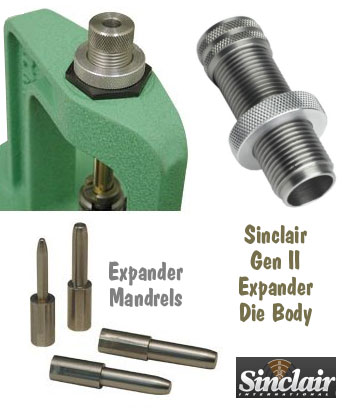
I just received two .308 Win expanders for my Sinclair expander die, they are .307 and .306. The .306 is the neck turning mandrel.

You want the neck to be snug fit on the mandrel but spin freely. You will run into variation in neck thickness and hardness and deal with brass spring back after sizing.

Meaning the case should not slide off the mandrel if tilted and also not be hard to rotate the case. If the case neck is a little loose I will use a 30 wt oil or Hornady Unique case lube on the mandrel to take up the slop. The more expensive expander dies have mandrels in .001 incroments for fine tuning. If you have a factory rifle I would just skim the necks and only clean up 50% to 75% of the necks. (IF NEEDED) And a simple Redding neck thickness gauge will tell you if you even need to turn the necks.

I'm prepping 300 Lake City 7.62 cases and the necks on average have less than .001 neck thickness variations and are not worth turning for a factory rifle.

Practice on some range pickup brass first to get the hang of it and do not remove more brass than needed.

Also remember Redding tells you if you do not neck turn then just use a bushing .004 smaller than a loaded round and use the expander that come with their dies.

I have messed up more case necks by neck turning and removing too much brass, so go slow and careful. And if your necks do not have excessive thickness variations then just don't bother turning them.

At accurateshooter.com many competitive shooters use Lapua brass and just load and shoot and don't even think about neck turning.
 
I have debated on even bothering with neck turning. I don't use the super expensive brass. I stick to Hornady, and have some Federal given to me by a buddy (from factory ammo). If I never purchased the neck turner already I wouldn't be having this conversation. But I got it so I was going to try to use it. I have turned a few and like bigedp51 I only tried to take off as little as possible.
 
So I have decided to try and sand the mandrel down. I started with 600 grit sandpaper, didn't really get anywhere. Moved on to 120 grit emery cloth and didn't really get anywhere. Had another roll of emery cloth, doesn't have grit size but seems a tad rougher than the 120 and still don't seem to be anywhere. I have the Forster power adapter so I am using the drill to turn it. In about a half hour of sanding I think I may have gotten a 0.0005" off. For those that have done it, do I need special emery cloth? Is the steel on the mandrel that hard? Or do I just need to keep doing what I am doing.
 
Like rick357 said, you need the expender die for the pilot size.

Why turn the teck if you are gonna have a loose fitting pilot? your runout will be worst
 
you want to full length size, the problem with the bushing in a redding die is that it only sizes 1/3 of the neck, this means the remaining neck is large and instead of ending up with 11 though neck thickness at the bas of the neck you could be down to 5 depending on how big your chamber is, if your not going to do it right you are just pissing uphill
 
Like rick357 said, you need the expender die for the pilot size.

Why turn the teck if you are gonna have a loose fitting pilot? your runout will be worst

Just to be clear, my runout is avg 0.5 thou, with the occasional 1 thou.
The pilot is not loose fitting, you go very gradually at it.
Took hours to get it right, with 1000 grit sandpaper and a little at a time...

I didn't like the idea of sizing neck, expander, resize neck once more.
In my books the less the brass is manipulated the better.
The Lee collet die produces zero runout, and is dirt cheap.
 
So I have decided to try and sand the mandrel down. I started with 600 grit sandpaper, didn't really get anywhere. Moved on to 120 grit emery cloth and didn't really get anywhere. Had another roll of emery cloth, doesn't have grit size but seems a tad rougher than the 120 and still don't seem to be anywhere. I have the Forster power adapter so I am using the drill to turn it. In about a half hour of sanding I think I may have gotten a 0.0005" off. For those that have done it, do I need special emery cloth? Is the steel on the mandrel that hard? Or do I just need to keep doing what I am doing.

1000 grit and patience was key here, change sandpaper regularly so it gets it's bite back.
Forster on a power drill adaptor, put the drill on high speed, and just gave 'er.
I wouldn't dare go grittier than 800, this is fine tuning afterall, as previously mentioned the slightest loose fitting will produce more runout than it solves.

Oh and edit : This task goes hand in hand with a boombox and some liquor, as patience is key here.
 
you want to full length size, the problem with the bushing in a redding die is that it only sizes 1/3 of the neck, this means the remaining neck is large and instead of ending up with 11 though neck thickness at the bas of the neck you could be down to 5 depending on how big your chamber is, if your not going to do it right you are just pissing uphill

It depend how much you bump and how it's set-up. In my 300 WM I size 40% but in the 6.5CM, it's more 60%. Bushing die are made for neck turning. If you don't you need to keep the expender button.
 
you want to full length size, the problem with the bushing in a redding die is that it only sizes 1/3 of the neck, this means the remaining neck is large and instead of ending up with 11 though neck thickness at the bas of the neck you could be down to 5 depending on how big your chamber is, if your not going to do it right you are just pissing uphill

In my experience with the Redding neck die, this simply is not true. If you set it up to do so, the Redding die will allow neck sizing right down to the shoulder. A lot of people just don't take the time or go through the effort to understand how to set their dies up properly. As well, a lot of people don't want to size the entire neck and this die allows them to select exactly how much of it they size.

I use the Forster neck die shoulder bump at most stages of the reloading cycle however. The only time I use the Redding neck die is right after turning the shoulder on the third reload of the brass.

I also have the Lee neck collet die and use it on new brass until it has been fired at least twice to fully fireform it to the chamber of my rifle and I use the Lee die as part of the process I go through to perform the neck turning. If a person isn't going to go through the steps to do neck turning properly or wants a quick and elegant solution without worrying about neck thickness variations, the Lee neck collet is the die to use.
 
Just to be clear, my runout is avg 0.5 thou, with the occasional 1 thou.
The pilot is not loose fitting, you go very gradually at it.
Took hours to get it right, with 1000 grit sandpaper and a little at a time...

I didn't like the idea of sizing neck, expander, resize neck once more.
In my books the less the brass is manipulated the better.
The Lee collet die produces zero runout, and is dirt cheap.

Normally you neck turn once, and if you do it right, the brass is not overworked. you'll need to bump the shoulder anyway one day.

Running a sandpaper on the pilot on a drill will polish it probably unequal. Might be a fraction of a thousand but it defeat the purpose of neck turning.
 
Normally you neck turn once, and if you do it right, the brass is not overworked. you'll need to bump the shoulder anyway one day.

Running a sandpaper on the pilot on a drill will polish it probably unequal. Might be a fraction of a thousand but it defeat the purpose of neck turning.

I bump the shoulders every firing, with my redding body die.
Also run the brass in the neck turner every firing, only takes a minor amount out, but brass keeps flowing up as you shoot and resize, insures uniformity from firing to firing.
If my method would induce runout, I must of been a lucky one, as I have avg 0.5 thou runout, with the occasional 1 thou and occasional absolute zero.

Another detail, I didn't turn my pilot down all that much, not even 1 thou.
maybe 5/8s of a thou.

I agree, if the difference is major, sanding down let's say 2 thou in diameter with sandpaper is a scary thing to do.
 
Normally you neck turn once, and if you do it right, the brass is not overworked. you'll need to bump the shoulder anyway one day.

Running a sandpaper on the pilot on a drill will polish it probably unequal. Might be a fraction of a thousand but it defeat the purpose of neck turning.

I would tend to agree with you on this. Fine to do something like this as a test bed to see if a smaller mandrel will work, but better to get something machined to the proper tolerances. Still, in the short term, hand finishing using a drill press and sandpaper can work if done slowly and carefully.

As to shoulder bumping, since I normally use the Forster neck size shoulder bump die, I end up bumping the shoulder almost every time I reload. I only bump it a maximum of 1 thou and usually only half that, just enough that I can close the bolt without effort. I normally full length without neck re-size every third or fourth reload with the Redding full length die, again bumping the shoulder only about 1.5 thou. For some reason I have a tough time refining the amount of shoulder bump with it. It is either 1.5 thou or none. One of these days I'll take it out and clean the threads to see if I can't get it set better - at least that is what I say each time I use it.

And, getting back to the OP's original question, I would highly recommend the Lee collet neck die to do the necks. You will also need a full length die at regular intervals to resize the body and bump the shoulder, and I would recommend the Redding full length without neck sizing die. Forget neck turning and neck sizing with bushings unless you are willing to go to the trouble of getting the equipment and doing all the necessary steps.
 
In my post #6 I stated I received two new .308 Win expanders for my for my Sinclair expander die. One was .307 and is the normal size for expander in a sizing die and the other expander is .306 and for neck turning.

Meaning this gives you about .0005 clearance around the circumference of the neck turning mandrel. Normally a turning mandrel is .001 smaller than your dies expander and when you lube the turning mandrel you will have less clearance.

So again you resize the case and your dies expander is .001 than bullet diameter. After sizing the neck springs back smaller depending on how hard the neck is. Then you turn the neck on a expander mandrel .001 smaller than the resizing dies expander and .002 smaller than bullet diameter.

If you have to sand down the mandrel to fit in the case neck you have the wrong size turning mandrel or the dies expander is too small.

If you polish your resizing dies expander and reduce its diameter it may be a tight fit on the turning mandrel, or not fit at all.

I have a Hornady neck turning tool and the turning mandrels are .002 smaller than bullet diameter. "BUT" sometimes I have to use my Sinclair expander die with a expander .001 larger just before turning to let the case turn freely.

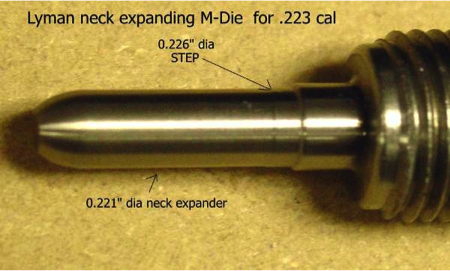
Below if I used my Lyman type "M" expander on my .223 cases the case necks will not fit on my turning mandrel. The .223 bullet diameter is .224 and the turning mandrel is .222 and the expander below is .001 "smaller" than the turning mandrel.

ohIUcpd.png


And sometimes I need to use my Sinclair expander die with the correct size expander to insure the case neck fits on the turning mandrel. You die can have a resizing die expander on the small side and be dealing with brass spring back.

sinclairexpander350.jpg


Neck-Turning Basics
http://www.accurateshooter.com/technical-articles/neck-turning-basics/
 
If you have to sand down the mandrel to fit in the case neck you have the wrong size turning mandrel or the dies expander is too small.


Not sure about this. Yes you are right in a way, in another way some reload equipment is not always compatible with one another, and you have to tweak it.
Forster, in 308, only offer a mandrel that is 2.5 thou smaller than bullet diameter from what I have seen.
Lee collet neck die, sets your neck 3 thou smaller than bullet diameter.

So by forsters dimensions you should be running 2.5 thou neck tension, by Lee's neck collet dimensions you are running a 3 thou neck tension.
By sanding my forster mandrel 1/2 thou, with 1000 grit sandpaper, mandrel still on the turning station, over a few hours, I don't think my half thou shaving would have negative impact.
On top of this, since I have stuck to 1000 grit and have not gone grittier, it's mirror like and will not stick.

If I am consistenly at 0.5 thou runout, and have 3 thou neck tension, what can be wrong with that?
 
K&M sells turning mandrels in .001 increments but the less costly turning mandrels average .002 smaller than bullet diameter. And the average expander in your sizing die is .001 smaller than bullet diameter.

I also polished my dies expanders smaller for more bullet grip, "BUT" when I turn the necks I use my Sinclair expander die and expand the case necks .001 larger than my turning mandrel.

Below Forster turning mandrels are .002 to .0025 smaller than bullet diameter. "BUT" again Sinclair only sells two diameter expanders and for the .308 they have .307 and .306. Meaning the .307 is for expanding the necks after sizing and the .306 for turning the necks. And my Hornady neck turning mandrel is .306 also.

So again you do not need to sand your turning mandrel you just need to expand your necks .001 larger than your turning mandrel. And this is why Sinclair and the other companies have two diameter expander mandrels for neck turning each caliber. They are marked as a expander mandrel or turning mandril and the small of the two is for turning. Or the smaller of the two can be used for more bullet grip.

Forster Pilots for Hand Held Outside Neck Turner
https://www.forsterproducts.com/product/pilots-for-hand-held-outside-neck-turner/

"Dedicated Pilots are sold separately, .002″ to .0025″ smaller than the bullet diameter."

Sinclair expander die?
http://forum.accurateshooter.com/threads/sinclair-expander-die.1853314/

Example below, I could not use the Lyman type "M" expander that is .003 smaller than bullet diameter on a turning mandrel .002 smaller than bullet diameter. So I would use my Sinclair .223 expander on the case necks and turn the necks on a .222 mandrel.

Bottom line, get the correct size expander .001 larger than your turning mandrel and you do not need to sand the mandrel down.

ohIUcpd.png


If I am consistenly at 0.5 thou runout, and have 3 thou neck tension, what can be wrong with that?

Many competitive shooters use more neck tension and smaller expanders with up to .004 neck tension. "BUT" you still need to expand the case neck .001 larger than the turning mandrel.
 
Last edited:
Back
Top Bottom