












































You are using an out of date browser. It may not display this or other websites correctly.
You should upgrade or use an alternative browser.
You should upgrade or use an alternative browser.
Idea for volume .223 precision loads
- Thread starter MartyK2500
- Start date

Its my understanding that reloaders with a progressive press use the Lyman type "M" expander for less neck runout and more bullet grip for precision loads with their AR15 rifles.
And they bump the case mouth onto the .226 step to very slightly expand the case mouth to improve straight inline bullet seating. And then give the case mouth a slight taper crimp to steamline the case mouth for feeding.
You would have to exparament with your Forster dies vs the Lyman expander with its .003 bullet grip and your accuracy.
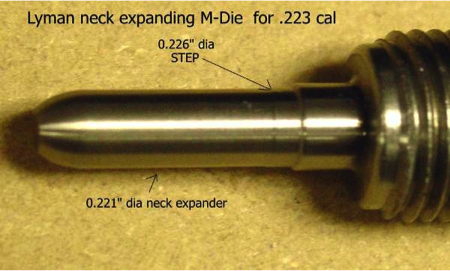
And they bump the case mouth onto the .226 step to very slightly expand the case mouth to improve straight inline bullet seating. And then give the case mouth a slight taper crimp to steamline the case mouth for feeding.
You would have to exparament with your Forster dies vs the Lyman expander with its .003 bullet grip and your accuracy.
Its my understanding that reloaders with a progressive press use the Lyman type "M" expander for less neck runout and more bullet grip for precision loads with their AR15 rifles.
And they bump the case mouth onto the .226 step to very slightly expand the case mouth to improve straight inline bullet seating. And then give the case mouth a slight taper crimp to steamline the case mouth for feeding.
You would have to exparament with your Forster dies vs the Lyman expander with its .003 bullet grip and your accuracy.
Thanks, another die idea to read on.
The way i can see it, if i FLS in big batches with a good amount of lube just sprayed everywhere in the batch, i could then dry tumble
The lot of resized brass to get the lube off, and this little expander would get my necks back to propper size opening after a tumbler may kink them.

well there goes your "precision" out the window...
So you're saying that neck-sized brass always produces more accurate ammunition than full-length sized? Let's just say that's not widely accepted as a fact. A better approach is careful F/L Sizing that only bumps the shoulder back about 0.002", which you'd have to do after a few firings with neck-sized brass anyways. Provides for longer case life over F/L sizing, and ammunition that will always chamber easily in the rifle in which it was originally fired.
Last edited:
I never neck resized without pushing back the shoulders anyways.
If I’m to neck size i use a body die, which pushes back the shoulders 2 thous on my bolter.
Using a FLS here would achieve close to the same thing, I’d do it in one step instead of two.
It is my perceived knowledge (don’t have anything on hand to back this), that cheap FLS dies induce runout.
But that a premium FLS die (ie forster benchrest) has very little negative effects on runout.
This is auto ammo anyways not expecting sub 1/2 moa accuracy like my bolt gun.
I will invest in a 20” HBAR IBI barrel after all, so simply sub-moa would be nice to achieve.
If I’m to neck size i use a body die, which pushes back the shoulders 2 thous on my bolter.
Using a FLS here would achieve close to the same thing, I’d do it in one step instead of two.
It is my perceived knowledge (don’t have anything on hand to back this), that cheap FLS dies induce runout.
But that a premium FLS die (ie forster benchrest) has very little negative effects on runout.
This is auto ammo anyways not expecting sub 1/2 moa accuracy like my bolt gun.
I will invest in a 20” HBAR IBI barrel after all, so simply sub-moa would be nice to achieve.
FirearmsEnthusiast
CGN frequent flyer
- Location
- Kingston, ON
I would prep the brass, size it and seat the primer before turning to the Dillon.
I would feed the Dillon primed brass.
I would prefer a 650 with a case feeder, but a 550 will work if you are only loading a 1000 or so per sitting.
The Dillon will dispense ball powder perfectly (plus or minus a tenth, with most being bang on.) A fine grained extruded powder will also work very well - like RL15 or N140.
I do exactly this - deprime, tumble, full length re-size, quick de-lube tumble, trim, prime. Then I pour 100+ cases into my Dillon 650 case feeder, and use the Dillon as the powder measure and bullet seater. Works great!
Doesn’t save all of the labour, but re-sizing is pretty quick on my Forester Co-Ax, and I have a Giraud trimmer which is amazing.
The trick is to have large “batch sizes” to the time invested in press change-over and Giraud change-over (pretty quick to begin with) is minimized.
Can i ask why you wouldn't trim on dillon using dillon power trimmer and also not prime on dillon?
Varget doesn't like dillon powder hoppers so i will get a powder through die, FX120 on table right beside with auto throw and auto trickler should do a quick job of it.
Varget doesn't like dillon powder hoppers so i will get a powder through die, FX120 on table right beside with auto throw and auto trickler should do a quick job of it.
You shouldn't have any issues getting the results you seek with the setup you describe. I have been able to get sub-moa results using a 550 and with the following process.
Processing on mark7/1050
-Decap and touch up necks with a dillon size die backed out quite a bit
-swage
-rt1200 trim/size
-RCBS small base size
-Lyman M die takes the burr off the inside of the neck
Wet tumble in cement mixer to remove lube and clean primer pockets
Loading on a 550
-Prime / M die to touch up necks from tumbling
-powder with dillon powder drop(using TAC ball powder, testing shows charge weights vary maximum of +/- 0.15gr
-seat 77gr SMK with dillon seater die
-Very light crimp with Lee FCD
This ammo in a 18" AR(Faxxon Gunner barrel) and 6x optic shoots sub MOA constantly when benched. Typical is 1.5" at 200yds, sometimes better.
In a attempt to make better ammo than this, possibly for a rifle with a better barrel and a 10/12x optic I'm in the process of making the following changes:
-Replace dillon 550 toolhead with widden floating tool head
-Replace RCBS size die with Mighty Armory Sizing Die
-Using a powder thru die, FX120i/Auto-throw/Auto-trickler, and Varget loaded with 0.02gr variance
-Redding Competition seater die
-Might try some berger 80/80.5gr bullets
-Might play with no crimp
Processing on mark7/1050
-Decap and touch up necks with a dillon size die backed out quite a bit
-swage
-rt1200 trim/size
-RCBS small base size
-Lyman M die takes the burr off the inside of the neck
Wet tumble in cement mixer to remove lube and clean primer pockets
Loading on a 550
-Prime / M die to touch up necks from tumbling
-powder with dillon powder drop(using TAC ball powder, testing shows charge weights vary maximum of +/- 0.15gr
-seat 77gr SMK with dillon seater die
-Very light crimp with Lee FCD
This ammo in a 18" AR(Faxxon Gunner barrel) and 6x optic shoots sub MOA constantly when benched. Typical is 1.5" at 200yds, sometimes better.
In a attempt to make better ammo than this, possibly for a rifle with a better barrel and a 10/12x optic I'm in the process of making the following changes:
-Replace dillon 550 toolhead with widden floating tool head
-Replace RCBS size die with Mighty Armory Sizing Die
-Using a powder thru die, FX120i/Auto-throw/Auto-trickler, and Varget loaded with 0.02gr variance
-Redding Competition seater die
-Might try some berger 80/80.5gr bullets
-Might play with no crimp
You shouldn't have any issues getting the results you seek with the setup you describe. I have been able to get sub-moa results using a 550 and with the following process.
Processing on mark7/1050
-Decap and touch up necks with a dillon size die backed out quite a bit
-swage
-rt1200 trim/size
-RCBS small base size
-Lyman M die takes the burr off the inside of the neck
Wet tumble in cement mixer to remove lube and clean primer pockets
Loading on a 550
-Prime / M die to touch up necks from tumbling
-powder with dillon powder drop(using TAC ball powder, testing shows charge weights vary maximum of +/- 0.15gr
-seat 77gr SMK with dillon seater die
-Very light crimp with Lee FCD
This ammo in a 18" AR(Faxxon Gunner barrel) and 6x optic shoots sub MOA constantly when benched. Typical is 1.5" at 200yds, sometimes better.
In a attempt to make better ammo than this, possibly for a rifle with a better barrel and a 10/12x optic I'm in the process of making the following changes:
-Replace dillon 550 toolhead with widden floating tool head
-Replace RCBS size die with Mighty Armory Sizing Die
-Using a powder thru die, FX120i/Auto-throw/Auto-trickler, and Varget loaded with 0.02gr variance
-Redding Competition seater die
-Might try some berger 80/80.5gr bullets
-Might play with no crimp
Very detailed reply thanks!
Yes this is the way I am going, and you have given me inspiration on what to use.
You got me thinking, I may get 2x 650 toolheads (without a powder funnel they are cheap anyways).
Process them in 2 passes.
First pass would be brass processing
Tumble
Second pass would be neck touch up, powder/prime/seat/light crimp if needed
Very detailed reply thanks!
Yes this is the way I am going, and you have given me inspiration on what to use.
You got me thinking, I may get 2x 650 toolheads (without a powder funnel they are cheap anyways).
Process them in 2 passes.
First pass would be brass processing
Tumble
Second pass would be neck touch up, powder/prime/seat/light crimp if needed
IMO this would be the only way to go, when I had just the 550 I had one toolhead for processing and one for loading.
If your going to get another one I would look hard at getting a floating head for the loading one.
Also I should note the 0.15gr variance with the dillon powder drop and TAC is the max I've seen. Most charges are within 0.4-.06gr, if you find the process is taking too long with the FX120 this might be worth trying.
I plan on doing some comparisons.
With that said... their are other considerations that might make a stick powder like Varget a better choice such as temp stability, etc, that would probably only show up in long term extensive testing which I don't have the patience or time for haha.
I plan on doing some comparisons.
With that said... their are other considerations that might make a stick powder like Varget a better choice such as temp stability, etc, that would probably only show up in long term extensive testing which I don't have the patience or time for haha.
Exactly, I wont have time to test differences extensively, but, powdering is quick enough with auto throw auto trickler.
On my bolter I regularly take teezers and either substract/add 1 kernel of varget to be dead on.
On this one I will tolerate the minor under/over throws of 1-2 kernels.
In 2018 my experience with varget made me buy a few 8lb jugs.
The labradar was with me every single session, and have data from 40F all the way to 100F, how insensitive that powder is is mind boggling.
I wouldn't even want to mess with anything else now.
On my bolter I regularly take teezers and either substract/add 1 kernel of varget to be dead on.
On this one I will tolerate the minor under/over throws of 1-2 kernels.
In 2018 my experience with varget made me buy a few 8lb jugs.
The labradar was with me every single session, and have data from 40F all the way to 100F, how insensitive that powder is is mind boggling.
I wouldn't even want to mess with anything else now.
I never neck resized without pushing back the shoulders anyways.
If I’m to neck size i use a body die, which pushes back the shoulders 2 thous on my bolter.
Using a FLS here would achieve close to the same thing, I’d do it in one step instead of two.
It is my perceived knowledge (don’t have anything on hand to back this), that cheap FLS dies induce runout.
But that a premium FLS die (ie forster benchrest) has very little negative effects on runout.
This is auto ammo anyways not expecting sub 1/2 moa accuracy like my bolt gun.
I will invest in a 20” HBAR IBI barrel after all, so simply sub-moa would be nice to achieve.
MartyK2500
The biggest cause of case neck runout happens when the expander is locked down off center. And I must add it has nothing do with how much the die costs or "cheap dies".
Below is a cutaway of a Lee resizing die and it has a ridged mounted expander clamped firmly in place with the clamping collet. If you clean up the threads and remove any metal chips in the collet and die my Lee dies average .002 or less neck runout. And with my Forster sizing dies I might if I'm lucky get .001 or less neck runout. I measure the case neck thickness variations and after sizing I check the case on a runout gauge and try to get no more than .001 more than the neck thickness variations. Meaning trying to get the inside of the case neck as centered as possible on unturned case necks. NOTE, the US Military considers match grade ammunition to have .003 or less bullet runout. So in the field under normal hunting conditions you would be fine with the .003 or a little more runout. I can tell you if your standing on your hind legs shooting at a running deer runout doesn't mean anything.
So it is how well a expander is centered in the die and case neck thickness variations that causes neck runout. And bullet runout can also happen during seating if anything allows the bullet to tilt in the seating process.It is my perceived knowledge (don’t have anything on hand to back this), that cheap FLS dies induce runout.
But that a premium FLS die (ie forster benchrest) has very little negative effects on runout.
And if you do not have a runout gauge and a neck thickness gauge a simple Lee die with its ridged mounted expander will make more concentric cases than a Redding die with a off center expander.

Below I added a modified Forster expander and spindle assembly to a Redding full length .243 die. And this greatly reduces case neck runout because of the high mounted floating expander. "AND" also not dragging the longer Redding expander through the case neck with its increased friction. I also added a rubber o-ring under the expanders lock ring to allow the expander to float and self center.
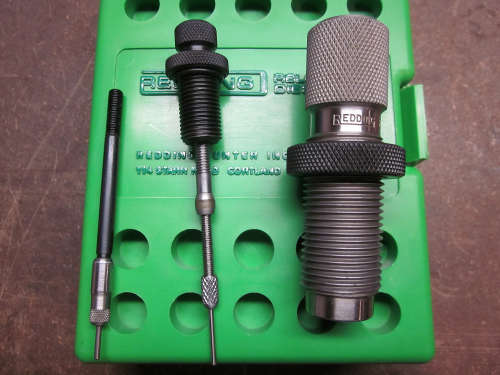
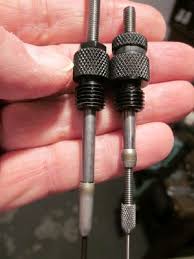
Below I added Forster expander and spindle assemblies to all my older RCBS dies. And greatly reduced the chances of the expander causing neck runout.
You can take any type or make full length die and remove the expander and size the case and then use a expander die and make very concentric cases. This is why I posted the Lyman expander die for the AR15 type rifles. It will make very concentric cases plus give you .003 bullet grip that many competitive shooters use even in bolt action rifles. I just read not long ago that David Tubb was using .004 bullet grip in his 1000 yard matches.
Now resizing lube and having to remove it, and there is a solution for this and its called Hornady One Shot........and I can hear the groaning in the background.
I was about to size some Lake City 5.56 cases with my home made lanolin and alcohol mix and saw a almost full can of One Shot on the shelf. I remembered the stuck and hard to size cases and asked myself what I was doing wrong. So I read the entire directions (again) on the can and saw it tells you to clean your dies to remove any old case lube. Then after cleaning you spray the inside of the die with One Shot and let it dry. And this was the step I didn't do the first time and why I had problems.
Bottom line, if you don't mind spending a little more for the Hornady One Shot it does not need to be removed. Because it is a "dry film" lubricant and I sized 250 Lake City case without a single problem. No tumbling after sizing, no lube buildup on the case shoulders and very easy sizing. I'm still a cheap bastard but the time saved was amazing, you spray the cases at a 45 degree angle so the spray gets inside the case necks. And the One Shot is very slick and what impressed me the most was how expander glided through the inside of the necks with so little friction. And the best part is you do not need to remove the dry film from the case after sizing. Meaning no wiping or tumbling after sizing and speeding up the loading process.
My 2 cents on speeding up the process with a progressive press............and using cheap dies.


davide montini
CGN frequent flyer
- Location
- sudbury, ontario
Nice read bigjed51.....
I seen a bunch of videos on you tube ....demonstration the 45 degree spray with one shot and another with a towel .....also with about 7..8 little sponges in the hopper ...block the hole let turn for 5..7 minutes....then proceed to load or process
....eh what ever works for you ...giver er
Cheers to all
I seen a bunch of videos on you tube ....demonstration the 45 degree spray with one shot and another with a towel .....also with about 7..8 little sponges in the hopper ...block the hole let turn for 5..7 minutes....then proceed to load or process
....eh what ever works for you ...giver er
Cheers to all
MartyK2500
The biggest cause of case neck runout happens when the expander is locked down off center. And I must add it has nothing do with how much the die costs or "cheap dies".
Below is a cutaway of a Lee resizing die and it has a ridged mounted expander clamped firmly in place with the clamping collet. If you clean up the threads and remove any metal chips in the collet and die my Lee dies average .002 or less neck runout. And with my Forster sizing dies I might if I'm lucky get .001 or less neck runout. I measure the case neck thickness variations and after sizing I check the case on a runout gauge and try to get no more than .001 more than the neck thickness variations. Meaning trying to get the inside of the case neck as centered as possible on unturned case necks. NOTE, the US Military considers match grade ammunition to have .003 or less bullet runout. So in the field under normal hunting conditions you would be fine with the .003 or a little more runout. I can tell you if your standing on your hind legs shooting at a running deer runout doesn't mean anything.
So it is how well a expander is centered in the die and case neck thickness variations that causes neck runout. And bullet runout can also happen during seating if anything allows the bullet to tilt in the seating process.It is my perceived knowledge (don’t have anything on hand to back this), that cheap FLS dies induce runout.
But that a premium FLS die (ie forster benchrest) has very little negative effects on runout.
And if you do not have a runout gauge and a neck thickness gauge a simple Lee die with its ridged mounted expander will make more concentric cases than a Redding die with a off center expander.
Below I added a modified Forster expander and spindle assembly to a Redding full length .243 die. And this greatly reduces case neck runout because of the high mounted floating expander. "AND" also not dragging the longer Redding expander through the case neck with its increased friction. I also added a rubber o-ring under the expanders lock ring to allow the expander to float and self center.
Below I added Forster expander and spindle assemblies to all my older RCBS dies. And greatly reduced the chances of the expander causing neck runout.
You can take any type or make full length die and remove the expander and size the case and then use a expander die and make very concentric cases. This is why I posted the Lyman expander die for the AR15 type rifles. It will make very concentric cases plus give you .003 bullet grip that many competitive shooters use even in bolt action rifles. I just read not long ago that David Tubb was using .004 bullet grip in his 1000 yard matches.
Now resizing lube and having to remove it, and there is a solution for this and its called Hornady One Shot........and I can hear the groaning in the background.
I was about to size some Lake City 5.56 cases with my home made lanolin and alcohol mix and saw a almost full can of One Shot on the shelf. I remembered the stuck and hard to size cases and asked myself what I was doing wrong. So I read the entire directions (again) on the can and saw it tells you to clean your dies to remove any old case lube. Then after cleaning you spray the inside of the die with One Shot and let it dry. And this was the step I didn't do the first time and why I had problems.
Bottom line, if you don't mind spending a little more for the Hornady One Shot it does not need to be removed. Because it is a "dry film" lubricant and I sized 250 Lake City case without a single problem. No tumbling after sizing, no lube buildup on the case shoulders and very easy sizing. I'm still a cheap bastard but the time saved was amazing, you spray the cases at a 45 degree angle so the spray gets inside the case necks. And the One Shot is very slick and what impressed me the most was how expander glided through the inside of the necks with so little friction. And the best part is you do not need to remove the dry film from the case after sizing. Meaning no wiping or tumbling after sizing and speeding up the loading process.
My 2 cents on speeding up the process with a progressive press............and using cheap dies.
Very informative post Big Ed!
This thread is guiding me differently than i was expecting, glad i made it and gpt these replies.





















