Question about rifle dies vs pistol dies

brandon6976

CGN Regular
Rating - 100%
74   0   1
Location
Toronto area
Hello all, I reload for pistol and still consider myself relatively new. When I load for pistol I get the following with all the die sets I've bought;
- Sizer = So this sizes the brass and with the Hornady (Which is what I use) has the zip spindle which kicks out the old primer
- case mouth expander = Just puts a small flare at the case mouth so the new bullet can sit at the top of the case
- Seater die = seats and crimps the new round, they seem to all be adjustable in 2 ways, the two ways being crimp & seating depth

I'd like to get into rifle reloading however don't want to dive head first into the shallow end without understanding what I need to do. For me I shoot 223, I'm hoping to load 223 for my bolt action and target shooting. When I look at different die sets I see for example the Lee die set is a 3 die set (example link) it's three dies are ;
- Full Length Sizing Die = Same as idea as pistol I assume with the addition it'll push down the shoulder to the right size
- Easy Adjust Dead Length Bullet Seating Die = Is this the same as the case mouth expander in pistol to flare the case mouth?
- Factory Crimp Die = it appears to be the same idea as pistol where it seats the bullet and crimps it ?

I reload today using a Hornady AP L&L press so I've tended to get the Hornady dies (though I understand I don't need to). When I look at say the match (or even their custom) die set it's a 2 die set (example link)
- Full-length sizing die = Much like pistol or the lee it appears to be
- Bullet seater die = I'd imagine this seats it and crimps it ? So is it like the pistol where it adjusts in both ways where tuning it adjusts the crimp and depth ?

I'm hoping if anyone has any advice or tips for someone like me diving into it (even if you can direct me to a good youtube video or web page)? My understanding is that the big difference is obviously that with something such as 223 having a shoulder the resizing die is really pushing the shoulder back to ensure it's right length after fire forming. I guess it looks like to me there is no seating die with Hornady, is this because the sizing die opens it up slightly or something?

I've tried to watch some video's online but just not sure why Lee would have the 3 die that's similar to pistol but Hornady seems to be 2 die sets for most of their rifle?
 
You are smart to ask.

Rifle is similar to pistol, except that usually you don't flare the case mouth. So you could load bottle necked cartridges with just two dies.

But it is standard practice to use a champfer tool to take the inside sharp edge of a case mouth off so it does not scrape the bullet on seating. This only has to be done the first time.

Straight walled rifle cases (like 45-70) are loaded like large pistol cases. If you load lead bullets it any rifle case, some mouth flare is a real good idea. I use the expander button of the next size up deprimer rod to touch the case mouth and open it a bit. Tonight I was expanding some 303 case mouths with a 338 die. A 8mm would have worked, too.

Bottle necked rifle case need to be lubed before sizing.

If you are sizing a few cases, the case lube technique does not matter very much. If you have a bucket or two of brass to size, there is a fast efficient way to lube the cases. I lube 100 or so cases (rifle) at a time. Takes about 30 seconds.

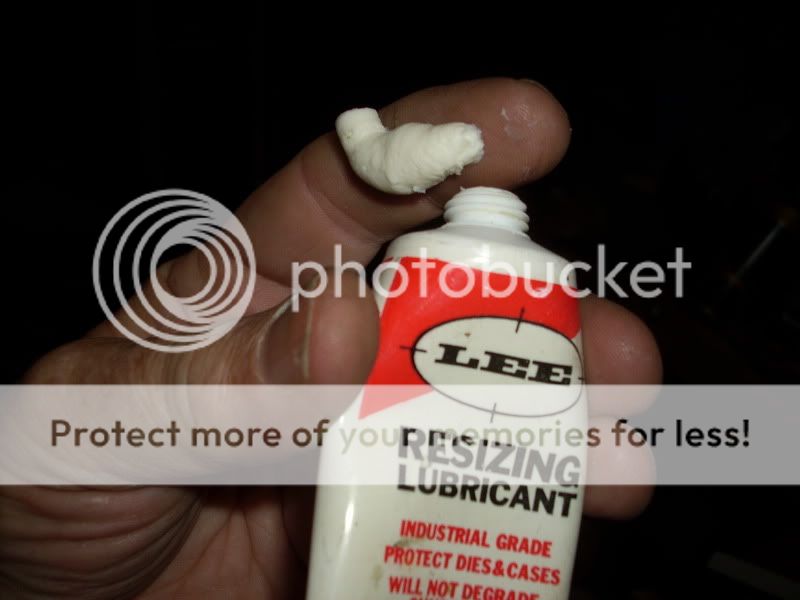
I use Lee case lube. It is a water soluble cream that is easy to clean off.

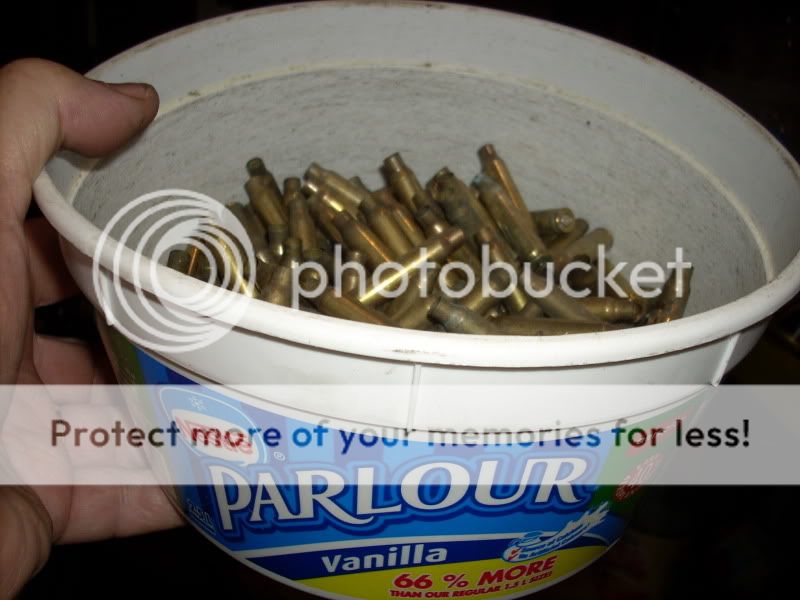
Dump brass in a plastic pail that has a lid.

lubebrass1.jpg


Then take a 1" worm of lube and smear it around the top inside wall of the pail.

lubebrass.jpg


Put lid on and swirl and shake for 15 seconds. This will lube all the cases and deposit a tiny dab on the case mouth, to lube the expander button.

 
A basic standard reloading die set for a rifle cartridge consists of two dies - a full length sizing die and a bullet seating die. There are variations of each, but that is what most of us start with. After you lube a previously fired case, you push the case into the die where the body gets squished down in diameter, the neck gets squished down more and the shoulder may or may not be pushed back - depends on your fired case's dimensions and how you set up the sizing die in the press. At the top of the stroke, the neck is smaller than wanted, and the primer has been removed. When you withdraw the case, the neck is pulled over the expander button on the de-priming rod, resulting in identical I.D. for all cases regardless of neck thickness. Now you check for overall length of the case, trim as required, chamfer the inner and outer corners of the case neck, re-prime the case and load it with powder. Some will re-prime on the press as part of the sequence of sizing. Switch to the bullet seating die, put your case in the shell holder and hold a bullet on top while moving the case up into the die. It seats the bullet. Seating die body is adjusted as per instructions; with many brands, you can set up the seating die to either roll crimp or not roll crimp. The seating stem is adjusted to get the C.O.A.L. that you desire. The Lee Factory Crimp Die is for crimping the mouth of the case against a bullet that does not have a cannular groove engraved at the case mouth location. In 40+ years of reloading for 308, 243, 30-06, 338 Win Mag, 9.3x62, etc., I have never experienced the need to crimp a jacketed bullet. When I loaded cast bullets in 45-70, I always roll crimped into the crimp groove on the bullet, regardless of charge.
 
You are smart to ask.

Rifle is similar to pistol, except that usually you don't flare the case mouth. So you could load bottle necked cartridges with just two dies.

But it is standard practice to use a champfer tool to take the inside sharp edge of a case mouth off so it does not scrape the bullet on seating. This only has to be done the first time.

Straight walled rifle cases (like 45-70) are loaded like large pistol cases. If you load lead bullets it any rifle case, some mouth flare is a real good idea. I use the expander button of the next size up deprimer rod to touch the case mouth and open it a bit. Tonight I was expanding some 303 case mouths with a 338 die. A 8mm would have worked, too.

Bottle necked rifle case need to be lubed before sizing.

If you are sizing a few cases, the case lube technique does not matter very much. If you have a bucket or two of brass to size, there is a fast efficient way to lube the cases. I lube 100 or so cases (rifle) at a time. Takes about 30 seconds.

I use Lee case lube. It is a water soluble cream that is easy to clean off.

Dump brass in a plastic pail that has a lid.

lubebrass1.jpg


Then take a 1" worm of lube and smear it around the top inside wall of the pail.

lubebrass.jpg


Put lid on and swirl and shake for 15 seconds. This will lube all the cases and deposit a tiny dab on the case mouth, to lube the expander button.


Ok I am stealing that lube trick starting now and wish I'd seen this earlier as I just did a pile of .223 brass one at a time last night.

Thanks for posting it.

Also, just to add for the OP, it is a good idea to chamfer after trimming as well.
 
thanks guys, so to just to echo back if I hear correctly, the 2 die is common because you're typically not going to use something that expands the case mouth.

Is it fair to assume that the resizer will leave the brass in a condition that (for example with a 223) the case mouth is going to be just right in terms of size I can drop a FMJ bullet onto it and it'll be ready for crimp/seating? I don't have any 223 dies yet but I went to the basement with some fired brass and put a bullet onto it and it slips right into the case (pass the neck and into where the powder would be), so I'm guessing that for example with 223 the bullet is .224 so the resizer/expander button would leave the case mouth say at .223 and the press would seat it with the force of the press?

I have watched a bunch of video's and I understand the lube, trim and chamfering. For me I was mostly confused around what is happening with the loss of a die (as a pistol guy it all seemed very logical and with rifles there is a die missing haha).
 
Basic large and small tools for both. About the only thing different is inside/outside chamfer, and being anal about brass length and coal. Pistol is more a bulk loading process, while rifle is precision.

yep completely agree, I reload pistol and some pistol calibers for lever rifles (45 colt and 38/357) but that's mostly just close up targets and having fun. I've seen how guys get anal in terms of case length, playing with the COAL and sorting brass so the weight, length and brand of brass matches to keep inside volume equal. It's something i want to get into for my bolt actions and I enjoy target shooting.
 
You are defining the reason for the chamfering on the inside corner of the neck. I think in the Richard Lee manual, he discusses the need / desire for .002" "stretch" when you seat the bullet. When you measure the ID of the neck, fresh out of the sizing die, it will be a couple thou smaller than your bullet. When you seat that bullet, that little chamfer that you make on the inside shoulder of the neck lets the bullet ease into and stretch the neck a bit, giving you the neck tension in a jacketed rifle cartridge that serves the same purpose as a crimp on a cast bullet.
 
You are defining the reason for the chamfering on the inside corner of the neck. I think in the Richard Lee manual, he discusses the need / desire for .002" "stretch" when you seat the bullet. When you measure the ID of the neck, fresh out of the sizing die, it will be a couple thou smaller than your bullet. When you seat that bullet, that little chamfer that you make on the inside shoulder of the neck lets the bullet ease into and stretch the neck a bit, giving you the neck tension in a jacketed rifle cartridge that serves the same purpose as a crimp on a cast bullet.

ahh alright makes sense. Thanks very much! Helps my simple brain to understand how it all works and helps me understand :)
 
You won't need a crimp on ammo destined for a single loaded bolt action rifle. The exceptions to that might be for something that has heavy recoil and is mag-feed, a tube feed rifle does need crimping as a rule because of how it stores ammunition. A stack type magazine rifle may or may not need crimping depending on how much recoil you have.
I single feed my target rifles, have never used the crimp feature on my seating dies.
You'll want to lube the inside of the case neck, I use a Q-tip with several drops of the RCBS case lube on it. Like Ganderite, I use the Lee case lube for the cartridge body, but I simply smear a thin film on each case with my fingertips. I lube the straight part of the case walls and the outside of the neck this way, I try to avoid getting lube on the shoulder of the case.
You don't need a lot to do the job!
New cases should be sized, and measured too IMO. I also chamfer and de-burr new cases, even good stuff like Lapua. The square mouth edge on new brass doesn't help when you are seating bullets.
For bullet choices, boat tail styles are easier to deal with. The tapered base will sit neatly in the case mouth waiting to be seated. Flat base bullets are a little harder to balance. Most handgun bullets are flat base, part of the reason for the flaring die.
 
thanks guys, so to just to echo back if I hear correctly, the 2 die is common because you're typically not going to use something that expands the case mouth.

Is it fair to assume that the resizer will leave the brass in a condition that (for example with a 223) the case mouth is going to be just right in terms of size I can drop a FMJ bullet onto it and it'll be ready for crimp/seating? I don't have any 223 dies yet but I went to the basement with some fired brass and put a bullet onto it and it slips right into the case (pass the neck and into where the powder would be), so I'm guessing that for example with 223 the bullet is .224 so the resizer/expander button would leave the case mouth say at .223 and the press would seat it with the force of the press?

I have watched a bunch of video's and I understand the lube, trim and chamfering. For me I was mostly confused around what is happening with the loss of a die (as a pistol guy it all seemed very logical and with rifles there is a die missing haha).

Yes. The sizer sizes the neck down more than the required amount and then on the other stroke, the expander expands the neck to the correct size to be tight on the bullet. This is the stroke that stretches brass, so some lube inside neck is good. In the video I show that the mass lube process leaves a little lube on the case mouth that gets taken into the neck, so the inside of the necks are lubed, too.

The seater die will seat the bullet. If you screw the die in a bit, it will also crimp. Crimping is a pain unless all the cases are the same length (or unless you use a Lee factory Crimp die, which does not rely upon case length)

In 223 there is not enough recoil or bullet weight to require crimping, so you are better off not doing it. Screw the seater die down onto a loaded round until you feel the die hit the case mouth, then back it out a half turn and lock. This prevents any crimping action.

The only exception to needing a crimp is if you are loading a mild load of ball powder. This will be difficult to ignite and a crimped case will help build ignition pressure.
 
Also as someone that does mostly pistol and very little rifle myself.... we are spoiled with hardly ever trimming. You will need to trim your case length on necked rifle cartridges, you'll be measuring always, and trimming often. We get spoiled with our pistol cases, I hardly ever bother measuring cases because they stay so consistent... I just measure OAL on my pistol ammo and call it done. That's not the case with necked rifle ammo, it stretches and gets over length
 
Back
Top Bottom