Powder coated 45 ACP not fully chambering

I've had lots of situations in tight chambered firearms, that won't chamber that last little bit with powder coating.
The first bit of the ogive is now larger and resizing doesn't touch it.
The NOE sizing system has a unit with which you can size the nose portion a bit. I haven't had good luck with it.
Some bullet designs are worse than others for this problem.

I have a 6 cavity Lee 230 gr. RN mould which I bought to make pin shoot loads. It throws excellent quality bullets which I PC. They looked great. The first match I took them to was a disaster. I had used my Lee Factory Crimp Die to finish size and crimp the rounds and they all dropped nicely into a 45 ACP cartridge gauge so I thought I was good to go. In two matches I got off two shots (the first one in each match). The second round jammed in the chamber both times.

Previously I had been using Berry's 230 gr. RNCP bullets and they had worked fine. It turns out that the Lee 45 RN bullet has a very short ogive so when I seated them to the same depth as the Berry bullets which have a longer ogive it turned out that the short Lee ogive was jamming into the rifling before the case was fully chambered. When I 'plunk' tested the rounds in the barrel of my Kimber Stainless II Target none of them fully chambered. I now have to seat the bullets considerably deeper into the case so the ogive doesn't make contact with the rifling before the round is fully chambered. As deeper seating raises chamber pressure I also had to decrease the load somewhat to compensate.

Someone earlier commented that the best way to check the ammo is to use the barrel, not a gauge as chambers vary from gun to gun and that is good advice. It's the best way to guarantee that the rounds will actually chamber in a specific gun.
 
The OP has confirmed that his rounds plunk and spin, that's why I gave up on my "OAL's too long" campaign which I started with post #3. I really hope the OP knows that a plunk and spin test can only be done with the barrel, not a gauge.
 
Just wondering why you would need to PC .45 acp due to the low velocity. Isn't the only benefit to reduce leading at high velocity? I can understand PCing hot 45 Colt or 45-70 for sure but 45 acp seems like a wasted effort.
 
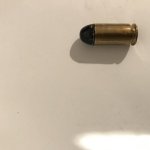
9E7B2AB9-892D-4124-98F1-76926675CECF.jpgI didn’t have much time tonight, to try and load a few more with more of a bell.
But I have noticed something on the cartridges.
Hard to explain, I’ll post a pic and try and explain.

The bullet drops off ( has a ridge ) about a centimetre from the case).
I scraped the powder coating away ,from where the bullet has the ridge.

And yes,I know how to do a plunk test, with the barrel.
 

Attachments

  • 9E7B2AB9-892D-4124-98F1-76926675CECF.jpg
    9E7B2AB9-892D-4124-98F1-76926675CECF.jpg
    22 KB · Views: 63
That's what we're telling you, the PC's getting rolled up at the case mouth. You're not flaring enough and or your combo seat/crimp die isn't setup properly. First try seating without any crimp whatsoever and see if the PC still rolls up on you. If it does then it's probably flare related.
 
Last edited:
Just wondering why you would need to PC .45 acp due to the low velocity. Isn't the only benefit to reduce leading at high velocity? I can understand PCing hot 45 Colt or 45-70 for sure but 45 acp seems like a wasted effort.

Actually PC was first tried as an alternative to conventional lube to alleviate the "lube smoke" in indoor ranges , lots of shooters use PC just for the "cleaner air" aspect of shooting thousands of rounds indoors and the "added" advantage of alleviating leading at higher velocities was an "afterthought" that worked quite well for a lot of us.
 
Brianma65

Your last photo is a little fuzzy but it looks like the seater plug is causing the raised ring in your powder coating just above the case mouth.

1. Polish the mouth edge of the seater plug it might be biting into the powder coating and deforming it.

2. Seat and crimp in two separate operations and this will not push the powder coat around the case mouth.

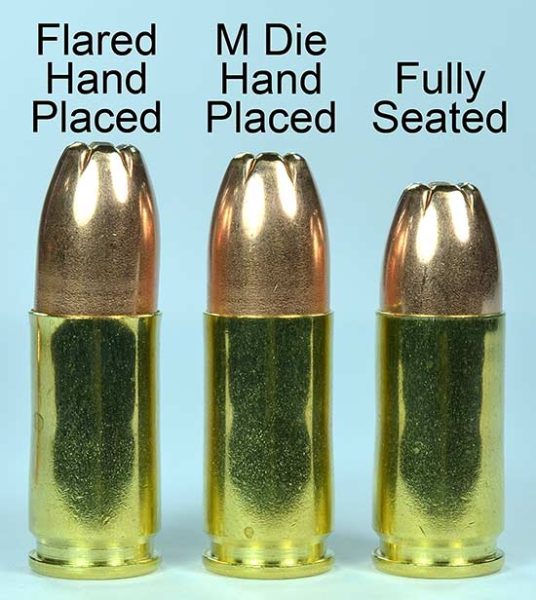
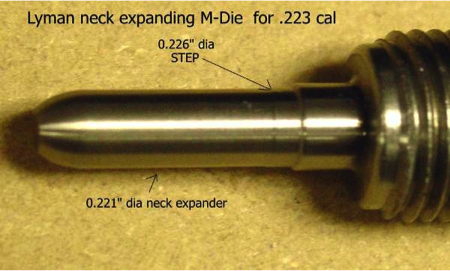
I prefer using a Lyman type "M" expander because it opens the case mouth to just above bullet diameter and allows the bullet to be pushed "straight" into the case with just your fingers.

vwgkeH3.jpg


Below normally with the type "M" expander the case mouth is only bumped onto step "B" of the expander. And if the bullet is larger than section "B" you can bell the case mouth at step "C".

Dmxwtu2.jpg


Below a type "M" expander for a .223 rifle, after bumping the case mouth onto the .226 section and after brass spring back the case mouth is approximately .001 larger than the bullet.

The type "M" expander stretches the case mouth less and extends case life before you start to get case mouth cracks.

ohIUcpd.png


Bottom line, my guess is your crimps and seater plug are plowing up the powder coating and causing your problem.
 
Actually PC was first tried as an alternative to conventional lube to alleviate the "lube smoke" in indoor ranges , lots of shooters use PC just for the "cleaner air" aspect of shooting thousands of rounds indoors and the "added" advantage of alleviating leading at higher velocities was an "afterthought" that worked quite well for a lot of us.
This. We did a visual comparison test firing the same bullets with the same powder charge out of the same gun. Half the bullets were PCd and half were conventionally lubed. The decrease in smoke generated using the PC'd bullets was significant.
 
I have some .225 g LRN PC cartridges that I recently made, and Somme of them will not completely chamber.
I have to push the slide the lay 1/8 of an inch.
And a few of them ,I can not manually close the slide on,are difficult to extract.

I ran all the bullets trough a .45 acp resizer die , before loading.

Is it possible, that my new Spring field RO 1911, has a tight chamber?

Did the bullets work before you PCed?

PC bullets fit differently than non-PC bullets. The nose or ogive changes dimensions when you PC, growing by a 2-3 thousandths or more and sizing doesn't touch the ogive. You may need to seat the PC bullet deeper than the non-PC bullet.
 
Update.
I made 5 dummy rounds, no crimp, they would not pass the plunk test.
Put a slight crimp on all 5 , they now pass the plunk test, but didn’t spin, easily like my factory FMJ.

All five rounds functioned perfect in the handgun,

So, I guess I need a lee crimp die?

Just made 5 more at 1.190 and they now pass both the plunk and spin test.
But only with a good crimp.
No crimp = no go .
 
Last edited:
Did the bullets work before you PCed?

PC bullets fit differently than non-PC bullets. The nose or ogive changes dimensions when you PC, growing by a 2-3 thousandths or more and sizing doesn't touch the ogive. You may need to seat the PC bullet deeper than the non-PC bullet.
Never tryed them non PC.
I’ve been seating them at 1.200 , gonna try them at 1.190
 
Actually PC was first tried as an alternative to conventional lube to alleviate the "lube smoke" in indoor ranges , lots of shooters use PC just for the "cleaner air" aspect of shooting thousands of rounds indoors and the "added" advantage of alleviating leading at higher velocities was an "afterthought" that worked quite well for a lot of us.

I see, makes sense. Thanks.
 
Back
Top Bottom