To what degree are you prepping your brass?

TrevorF

CGN frequent flyer
Rating - 100%
55   0   0
Location
Northern NB
A little back ground. I've got a remington 700 with a trigger tech trigger and a .308 krieger barrel in a chassis. I don't compete but I do want the highest level of precision possible.

Currently I use Winchester brass. I start off by FL resizing, trimming to 2.005, deburring the flash holes, uniforming the primer pockets then lightly turning the necks to remove the high side only.

Once the cases are fire formed I use a Lee collet die. Recently I discovered that Sinclair also makes a flash hole uniforming tool that I plan on purchasing.

Is there anything else I should be doing? FL bushing die? Competition seater die? COL or OAL guage?

Basically if there's something out there, product or process that has been proven to absolutely improve accuracy I want to do it.

Thanks,
Trevor
 
Everybody is different. New brass I do the primer flash holes, and Lee collet neck size and trim to length if they are long enough. Once fire formed, I tumble clean, anneal after every shot, use a Redding body die for a 0.002" bump, and trim to length, and size with a Lee collet die. Seat with a Redding mic die. Seating depth is a huge deal so you should get something to measure your base to ogive. ( Ignore the COL once they fit in your mag.) I use the Hornady measuring tools for that.
 
What are you currently seeing for group sizes with a minimum 5 shot group? Just to clarify, you are shooting a 308win right? I found components like bullet and powder have a bigger effect than brass prep on precision and accuracy. That said, a comparator is a must so you can verify you are only bumping the shoulder .002-.003 when it comes time to full length size, which you will have to eventually do.
When I am shooting 1 hole groups in the .3-.4" range, I first clean the brass in green corn media in a Lyman turbo 1200 tumbler until the cases are shiny. I even use a piece of scotch brite pad to clean the fouling off the outside case neck before I put them into the corn media. Then I am bumping the case shoulder with a Redding body die, then depriming and sizing the case neck with a lee collet neck sizing die. Then I trim to length, clean primer pocket somewhat, and chamfer. I very lightly chamfer just to make sure there are no burrs on the case mouth. Every 3rd firing, I anneal the cases before putting into the green corn media and tumbling.
I have never deburred flash holes or trimmed outside or inside case necks. Unless you are shooting in the .1-.2" range, you probably wont notice any difference.
 
I have pretty much always just full length sized the brass for the first loading in my hunting rifles, and neck sized for 3-4 firings after that. I True primer pockets, and check flash holes, cleaning if required. Checked over all length of brass, trimming if required, chamfering and deburring case mouths and then loading to the manuals stated COAL's. This has worked well and has provided many different loads for different cartridges and rifles from 1/4 to 1 MOA over the years. Since the standard I have set for myself and my hunting rifles is 1 MOA, these are good for me. I also do not hunt long range and am limited to 500 yards at our range, and have only ever taken one animal beyond 450 yards in 35 years, so am not concerned with the accuracy being to the same level as those competing in benchrest.
I am not that good of a rifleman, as I shake like a leaf in a high wind on a good day. I spend more time working on my shooting form, trigger control, and each year time in overcoming my "flinch" I developed with a hard-kicking, magna-ported rifle in 300 Win Mag when i was 21. Mostly my flinch is from the noise of the rifle and wearing ear plugs and muffs definitely helps. But it takes a minimum of 200 rounds each year to return to the point where I do not blink when the rifle fires. And I refuse to own a muzzle braked rifle. If I cannot learn to shoot a larger caliber or cartridge without a brake, then I won't own it. (my top end cartridge comfort level is my 416 Taylor)
I do now have the concentricity tools and neck turning tools to be able to go that next level, but have not done so yet, as I have been tied up in competitive archery the last ten years and have mainly been staying to my regular practice. I also have the modified cases and comparators and measuring devices from Hornady, mentioned above, and have checked my bullets' and chamber ogive distances on a few rifles now for working on seating depth. Still need the measuring tool for lever/pump/semi actions.
Also, in going to that next level, I would be weight sorting brass and bullets to ensure minimal variances in those variables.
I would also move to using higher end brass exclusively, if I were getting competitive. But for now, I do use once fired factory ammo brass from Federal and Winchester, as well as new brass from Winchester, Federal, Hornady, Nosler, Norma and Lapua for making my hunting loads, depending on cartridge and availability, as I load for several cartridges, for both bolt actions and lever actions. These have all worked well for me over the years.
 
Everybody is different. New brass I do the primer flash holes, and Lee collet neck size and trim to length if they are long enough. Once fire formed, I tumble clean, anneal after every shot, use a Redding body die for a 0.002" bump, and trim to length, and size with a Lee collet die. Seat with a Redding mic die. Seating depth is a huge deal so you should get something to measure your base to ogive. ( Ignore the COL once they fit in your mag.) I use the Hornady measuring tools for that.

Right now I'm just sticking with 2.8" OAL. I'll get the hornady tool, then what, .002" off the rifling?
 
Right now I'm just sticking with 2.8" OAL. I'll get the hornady tool, then what, .002" off the rifling?

Your gun will tell you that. Anywhere from into the lands, to .2" off the rifling may work best. Respectfully, it sounds like you have some reading and testing to do.
 
Oh boy... Here is the can of worms... ;)

Generally speaking (no numbers), I'd like to mention a few more things that may effect the consistency, sometimes they counteract each other, but not always. Speaking strictly about internal ballistics.

Don't underestimate run-out, OAL (with bullet comparator), seating depth and neck tension.

You may want to invest in a good tool to check run-out. I use Sinclair Concentricity Gauge. Run-out may be introduced by brass (neck thickness), dies (both sizing and seating) and press. Forster Co-Ax press makes life easier. ;)

Neck tension and/or seating depth essentially regulate the initial pressure forcing bullet to move, this in turn changes the burn rate of the powder and pressure curve until the bullet leaves the barrel - hence the velocity. If you place the bullet closer to the forcing cone and minimize the jump, the neck tension becomes less important as the forcing pressure is defined mostly by interaction of the barrel with soon-to-be-deformed bullet. If the bullet is over/under-sized or not concentric with the barrel (run-out or not seating straight), the effort to push it through the forcing cone will vary, changing the pressure. You may be very accurate with the powder charge, but forcing pressure variation might make if look like you are off by a grain or 2.

I believe that most of the brass prep and loading routines attempt to eliminate variations of pressure curve from round to round and the number of variables is huge, most of them reloaders can't control anyway - like bullet/jacket material or exact bullet profile, powder kernels size and shape, amount of priming compound, etc. Pick the parameters, ask Why and How they effect the internal ballistics and make them work in your favor.

The rambling above is not an absolute and final solution but my personal point of view based on some experience, rather simplified. :)

Good luck!

s>
 
Right now I'm just sticking with 2.8" OAL. I'll get the hornady tool, then what, .002" off the rifling?

The Hornady tools will tell you accurately how far your ogive is from the lands with your current loads. In my opinion you want to stay away from jamming in the lands. 0.002" would be way too close for me. Lots start at 0.020" off the lands with success with a bit of tweaking. The Redding body die adjusted for 0.002" shoulder bump is for consistent fitting in your rifle chamber, not to find the distance from the lands like the Hornady tool. The FL die can be adjusted to bump the case shoulder back 0.002" as well.

What do your groups look like now for size? Grab the other Hornady tool as well for checking where your lands are. If 2.8" OAL is you mag length, and or it shoots well there I would seat the bullet -0.003" shorter from there until you are happy with the results. Within 6 or so steps you will find a spot that will tighten the group right up. If your mag will allow it, and you are not jammed into the lands, you can seat longer in 0.003" steps as well. ( don't go less than one caliber size of bullet, seated into the case) Remember that after a few steps deeper in bullet seating you will have to watch for a change in pressure, especially if you are already loaded near max powder charge.
 
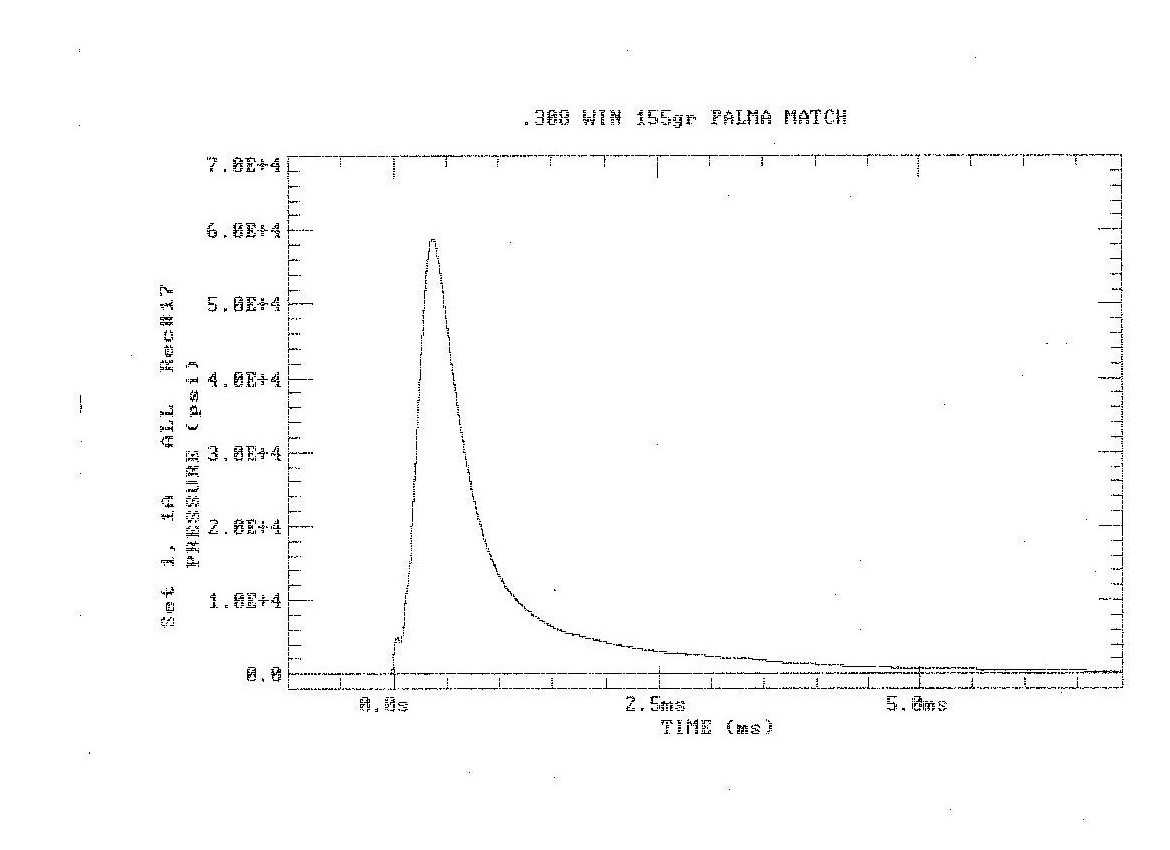
I used to have access to a very good ballistics lab. Ammo tests were always based on 20 rounds. We would record the pressure and velocity of every shot, plus record the pressure curve of each shot. See below.

I decided to investigate case prep. I used virgin (but mouth chamfered) Winchester brass and match bullets.

Test one was load and shoot.

Test 2 was deburr the flash hole and shoot.

Test 3 was uniform the primer pocket and shoot.

Test 4 was deburr and uniform and shoot.

All 4 boxes of ammo were shot and logged. The deburred brass showed a measurable improvement in ES and SD.

The primer pocket uniforming showed no change.

So all I do with new brass is chamfer the mouth, and touch the flash hole on the inside with a spinning drill bit to knock off the flash and leave a slight dimple so the decapping pin centers easily.

I now use Lapua for accuracy ammo, and it does not need flash hole deburring.

hoLCpt9.jpg
 
A little back ground. I've got a remington 700 with a trigger tech trigger and a .308 krieger barrel in a chassis. I don't compete but I do want the highest level of precision possible.

Currently I use Winchester brass. I start off by FL resizing, trimming to 2.005, deburring the flash holes, uniforming the primer pockets then lightly turning the necks to remove the high side only.

Once the cases are fire formed I use a Lee collet die. Recently I discovered that Sinclair also makes a flash hole uniforming tool that I plan on purchasing.

Is there anything else I should be doing? FL bushing die? Competition seater die? COL or OAL guage?

Basically if there's something out there, product or process that has been proven to absolutely improve accuracy I want to do it.

Thanks,
Trevor

You can improve your brass by replacing with Lapua when the Winchester is gone, no need to deburr flash holes or uniform the pockets. It'll save you the expense of the Sinclair tool.
Lapua also makes small rifle primer .308 Palma brass. I have no personal experience with it in .308, but I do use it in 6.5 Creedmoor with good results. Super consistent, well made brass.
Being able to accurately measure both cartridge base to ogive on finished rounds, and from case head to shoulder datum on brass will be beneficial to you. The Hornady comparator tool is one way to do that, or if you know a machinist who owes you a favour the tools aren't hard to make.
 
i'd say what you are already doing is good (I do the same) but to be better I'd just switch to Lapua and anneal every few firings. I got a salt annealing kit and its cheap and accurate. Will pay itself off when your brass lasts twice as long.
 
Good thread.
My thumbs are inflamed for prepping brass.. got some once fired brass at a steal of a deal.. ... buddy said , he would rather shoot then load..
I can see why at this moment in time..!
I have also moved on to using lapua brass..
Very well made.
Like GANDERLITE said in his post, I dont uniform flash holes either, but I debut and champer the inside every 3 shots.

Well back to grind I guess
 
I hate being a American in this forum and not being sure if someone in Canada wears a heavy parka to reload or if I need to covert celsius to fahrenheit. :bangHead:

Don't worry, celsius is the only metric measurement that has caught on. Food is still advertized by the pound, lumber is in inches and feet. Nobody says they're 180 cm tall or weigh 75 kilograms. Land is sold by the acre (and arpent in Kebec), houses by the square food. Shoes by the barleycorn. Beer by the pint or the half sack. Distance is measured by the hour.
 
A little back ground. I've got a remington 700 with a trigger tech trigger and a .308 krieger barrel in a chassis. I don't compete but I do want the highest level of precision possible.

Currently I use Winchester brass. I start off by FL resizing, trimming to 2.005, deburring the flash holes, uniforming the primer pockets then lightly turning the necks to remove the high side only.

Once the cases are fire formed I use a Lee collet die. Recently I discovered that Sinclair also makes a flash hole uniforming tool that I plan on purchasing.

Is there anything else I should be doing? FL bushing die? Competition seater die? COL or OAL guage?

Basically if there's something out there, product or process that has been proven to absolutely improve accuracy I want to do it.

Thanks,
Trevor

The lee collet neck die is ideal for sizing the neck. Add a Redding body die to bump the shoulder 2 thou shorter then your chamber... if you are going to run in weather, bump bit more for function.

I would neck turn to 12 or 13 thou... keep touching up the necks cause brass will flow each firing.

Depending on the bullet, the Forster seaters will do all that you need/want. If your ammo has a few thou runout, don't worry about it. Likely your ammo will develop more runout just from going to the range in the ammo box... or from the mag to the chamber.

The single biggest gain you will get in making ammo is a quality milligram scale... then tune on target at 200 to 300yds for best results.

Bedding the action in the chassis rarely hurts and mostly helps. Quality optics that let you see to a high resolution is important as are rifle supports that let you be consistent with each firing.

There is a crap ton more stuff outside of brass prep that is going to affect your results.

YMMV

Jerry
 
Back
Top Bottom