Case head cracking in 300 win mag. Need help

Chago

CGN Regular
Rating - 100%
53   0   0
Location
Ontario
Hey guys. I've been reloading for years and always stay on the safe side and load well below max. So I've never really dealt with pressure issues. Normally I'm retiring brass cause it just looks too tarnished. I have 6.5 creemoor and 308 that are on their 12th load. One thing I've literally never loaded for up until the last 18 months. Was a belted caliber. So about 1.5 years ago I got a couple 300 win mags. Love the performance of this caliber for both hunting and long range plinking. One thing I've learned is I can't neck size these as I do my other calibers. So I use a full size die. I do admittedly use the same brass in both 300 rifles.

I'm loading hornady brass which I know had a rep of being soft. With 71 grains of 7128. 212 grain eld x with CCI magnum primers. I have used this load in both rifles without any issues. I have a fierce edge and a Remington 700 total custom. The brass is on its 3rd reload. Loaded it the same way, same depth etc. Went shooting today. Shot about 30 rounds at the range. All good. Went back to the camp. A friend wanted to see the rifle, showed him. Asked if he could shoot it. Went back to our range(which is on the property). He shot 3 rounds. All 3 fired normally and accuracy was great. But I noticed 2 of the 3 brass had a near complete crack about a 1/4" above the case head on the brass body. It was almost broken all the way around.

What caused this all of a sudden? Hodgson website is saying 75 grains is considered hot, again I'm at 71. Is this a dangerously high load? Or is this a soft hornady brass problem? I still have like 20 of these rounds. Should I not fire them? All the others fired today seem fine. No signs of pressure on brass or case head.

Thanks
 
Last edited:
Learning to use a case comparator, as well as the paperclip case head identifying method would help you greatly. Every time I load for my 7mm rem mag I usually end up culling 1 or 2 pieces because I can feel the seperation with a pick.
 
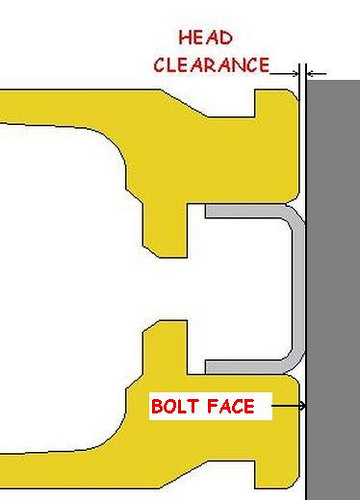
If you want your cases to last they "MUST" headspace on the case shoulder and not the belt. What happens when you full length resize with the die making hard contact with the shell holder is you push the case shoulder back too far and create too much head clearance.

Below the air space between the rear of the case and the bolt face is head clearance. And if the head clearance is excessive the case will stretch beyond its elastic limits and thin.
With a non-belted cartridge they tell you for a bolt action to bump the shoulder back .001 to .002 when sizing. With your belted case after full length resizing you can have as much as .006 to .008 head clearance. And after a few resizing the cases will split or separate because they stretch too far to contact the bolt face.

HK76WCp.jpg


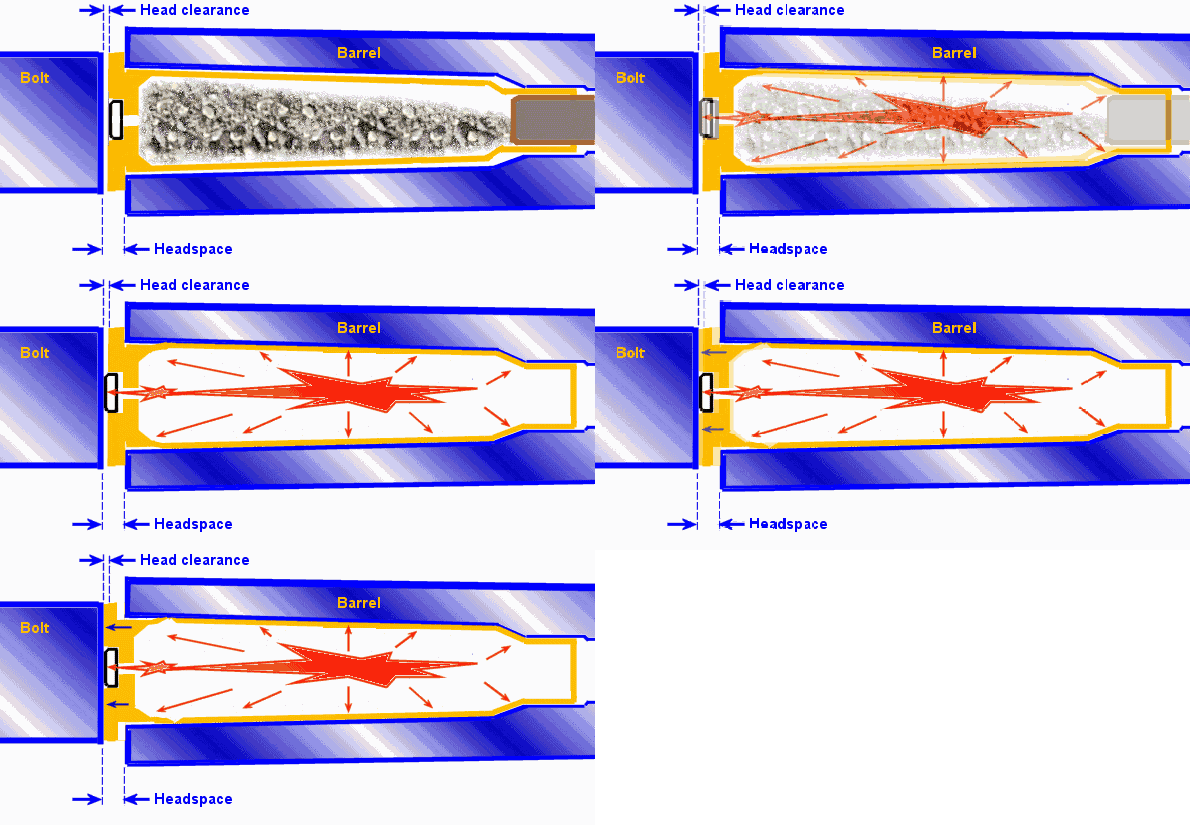
I do not have any images of a belted case so I will use the British .303 as a example. Below when you have excessive head clearance the case stretches and thins and only lasts a few reloadings.

sHgqVJR.gif


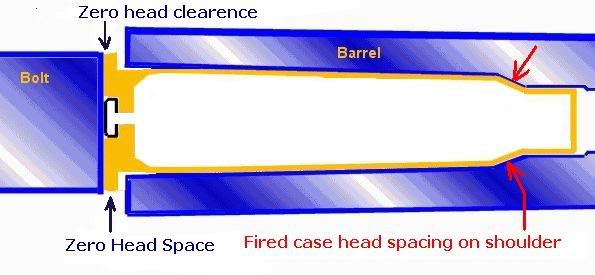
Below once the case has been fired you forget the rim or belt and let the case headspace on its shoulder. You only bump the shoulder back .001 or .002 and this amount of case stretch is within the brass cases elastic limits. Meaning the case will stretch like a rubber band and then spring back without thinning and the case will last much longer.

AQEQ9Vw.jpg


Below another example, you only need to push the case shoulder back .001 to .002 below the red dotted line. And if you push the case shoulder back further it will allow the case to stretch and thin

wm05ArY.gif


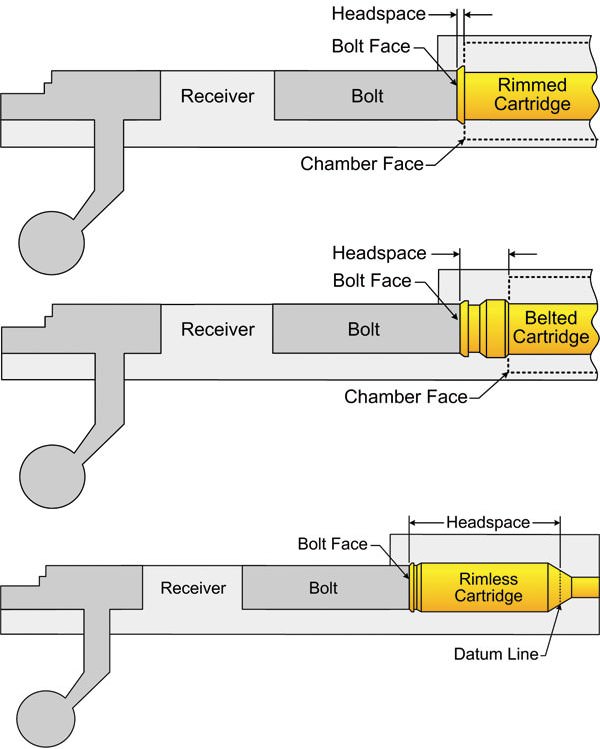
Below shows you how the different type cartridges headspace, and you can see the rimmed and belted do not headspace off the case shoulder. "BUT" the trick to make rimmed and belted cases last longer is to let them headspace off the case shoulder with minimum shoulder bump. This greatly reduces the air space or head clearance at the rear of the case and prevents the case from stretching and thinning.

3cOMj9s.jpg


I would recommend getting a Hornady cartridge case headspace gauge, you then measure a fired case and then set the resizing die up to only bump the shoulder back .001 or .002.
 
Few ways to fix this, bigedp covered the issue pretty well above.
Redding competition shell holders make it easy to dial in up to 10 thou less shoulder bump.
Adjusting your die out so it doesn't touch your shell holder, and cases still chamber easy or with a wee bit of resistance...takes some trial and error, but also works.
Neck sizing...not sure why that didn't work for you? I neck size for a few belted mags and haven't run into any problems. I check for fit after sizing, and yes after a few neck sizes (4-8 depending) they will need a bump with the FL die.
For scientific purposes, weight a few empty pieces of brass and let us know what they come out to. I picked up some Hornady 270 at the range and it was the lightest and thinnest stuff I had ever seen.
If you want some thick durable brass, PRVI is good to go.
https://www.tradeexcanada.com/content/300-winchester-magnum-brass-prvi-100
 
Last edited:

... and another important thing I didn't notice, and if it was stated, I apologize for bringing it up again, is to size for each rifle separately. In other words, brass shot in one particular rifle MUST stay with that rifle. It is the only way you can resize brass to space off the shoulder properly and consistently as per Ed's excellent explanation and instructions.
 
Wow great info. Thanks guys.

So last thing. Should I pull these last 20 bullets? Or are they safe to fire? All the other brass I have that didn't crack. Is it safe to reload those again?


Or should I just throw everything away and start clean slate.
 
There are measuring devices, like the Larry Willis's Digital Headspace Gauge, you can purchase to see how much you are actually setting back the shoulder of your brass, but you can approach the problem in an incremental fashion without acquiring expensive instruments to get the results you need. You only need .002" of clearance between the shoulder and the chamber for the round to chamber effortlessly. Begin by chambering a fired cartridge before its resized, and see if it chambers without resistance. If so, only neck sizing is required for that particular case. If there is resistance to closing the bolt, you can color the neck and shoulder of a case with a permanent marker, which provides a visual index of how much of the neck and shoulder is being resized after its run through the die. With the die set high enough above the shell holder that only the neck is being resized, incrementally turn down the resizing die until the resized brass chambers without resistance. A quarter turn at a time is probably a fine enough adjustment. Once the brass case chambers without resistance, use a wrench to tighten the lock ring so the die cannot move until all your brass is resized. Check one more piece of brass to ensure you are getting sufficient shoulder set back, then proceed with resizing the rest of your brass. If a loaded round chambers with resistance, it is then usually caused by a long seated bullet, and not due to insufficiently resized brass, unless there is a build up of brass ahead of the belt, which is another issue.
 
Belted mag brass fired at near max loads never lasts as many loadings as you would like.
You either bump the shoulder a minimum to reduce case head separation.
Then the brass loses its spring and gives you issues above the belt.
Then the primer pockets get loose.
If I can get 4-5 firings loaded near max on Winchester or Remington brass I've done pretty good.
 
Belted mag brass fired at near max loads never lasts as many loadings as you would like.
You either bump the shoulder a minimum to reduce case head separation.
Then the brass loses its spring and gives you issues above the belt.
Then the primer pockets get loose.
If I can get 4-5 firings loaded near max on Winchester or Remington brass I've done pretty good.

A bulge above the belt is not from the brass loosing spring, it the result of brass flowing towards the belt during the resizing process and can be resolved with a Larry Willis belted magnum collet die. Provided the bulge has not been allowed to become excessive, the brass can be brought back to serviceable condition with this die.

A ridge can be swaged into the primer pocket to hold loose primers tight for a few more reloads with a swage tool from Henry Remple which is used with an RCBS primer pocket swaging tool.
 

As do I. The posts pretty much have it covered.

The WHY, is because the belt is the primary headspace, the shoulder spec (SAAMI) is a bit looser than for rimless (shoulder primary headspace). Max chamber - Min ammo is about 0.020". That would be worst case. Now add in the sizer die, which may be less than ammo min and you will aggravate the issue described.

You may find that the Redding set is not enough, (+0.002" > 0.010") I'd suggest measuring first, with the Lock-N-Load gauge. I had to purchase a +0.022 shellholder for my 350 Rem Mag. (That was for the Forester die, my RCBS needed less). I had a die for 7mm Rem Mag that would not touch the shoulder, after resizing the shell was hard to chamber, I Bubba'd a shellholder for that one.

Ideally you are looking to bump the shoulder back at least 0.002". That is for target work, and you can add a few more thou set back without any issues. From my experience, 0.015" will let you have 1 reload, perhaps 2, but not any more.

Remember you are working with 3 dimensions, the FL sizing die, the rifle chamber, and initially the new brass. After the brass is fireformed, you only have control over the setting of the FL die.

I don't like the idea of backing out the die 1 turn, it is a bit imprecise and sometimes can give problems. It addresses the issue, but I prefer to control shoulder setback.

A good read is the Eric Erik Cortina article, Tubbs also has an article on shoulder setback as do others.

I don't know how I reloaded without my L-N-L gauge. I've also helped friends, showed them how it worked, pinpointed their issue, and they bought their own gauge.
 
Back
Top Bottom