












































Source of Spring Steel to make a hammer/grip spring? For Antique .32

Johnyy

CGN Ultra frequent flyer
Rating - 99.6%
245   1   0
Location
ON -
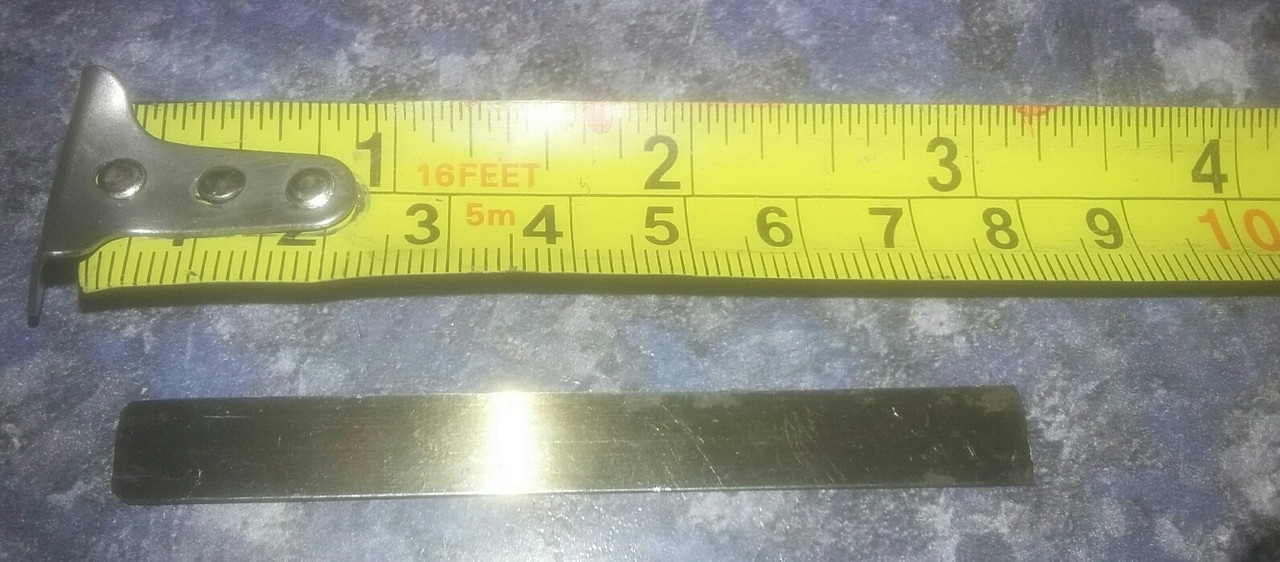
Hi, I'm hoping someone can help me with sourcing the 'proper' spring steel so I can make or buy a replacement for the spring in the grip of an Antique .32 RF. Basically, I tried good' original style ammo, & reloads with the .22 crimped on them. Either/or, If you pull the trigger hard & fast in double action, you may get one to go off, sometimes not. Rest has a light strike indication. It's approx. 3 & 1/4in. long & approx 12/32 width. Any info/source etc. to replace/buy/make one is Greatly apprenticed. I noticed a 'kit' of Spring Steel on Brownelles..is there a closer source for the small piece I'd need. Cheerz~

20190409-182807-1-resized.jpg
 
I got some at a place called Metal Supermarkets here in Edmonton. I assume there must be a metal supplier local to you somewhere that would have some different grades and thicknesses. I made some ejector springs for various SxS shotguns.
 
Antique revolver mainsprings can take a number of forms. If that piece pictured came out of your antique then it is definitely not original.

Have a look in Google images for "antique revolver mainspring" and you'll see what I mean.

While making leaf springs is not especially difficult it is most certainly a learning process, and to create a properly functioning leaf spring without the original as a guide is an art of its own.
 
I have the tools to make the job quite easy, a nice heat treating oven. I have broken some springs in the past before I had the oven. There is nothing quite as frustrating as spending several hours forging, filing and fitting a sidelock mainspring only to have it break because of an improper temper.
 
I use drill rod that I heat red hot and hammer to a bit over thickness, then grind and file the rest followed by heating red hot to bend to shape and finally heating red hot and quenching in water to harden it. Following that, I anneal to spring temper in molten lead at 720 - 740 F. I use molten lead because it gives a uniform temperature and I leave the spring in for at least 3 minutes by the clock (3 minutes is remarkably long while waiting for the clock to click over ). I make 5 or 10 mainsprings per year and almost never have them break or weaken. For a revolver mainspring, you can probably get by with 5/16" rod and for the main springs in flintlocks and percussion guns I use 3/8" rod
Almost forgot; the temperatures given in blacksmithing books have never worked for me whether I assume they are Fahrenheit or Celsius. I have also tried using automotive springs as a parent metal and the few times I have tried, it was too brittle

cheers mooncoon
 
Modern automotive springs are an alloy and I believe air harden. Really old auto springs(pre-1930s) work well. I have made a few mainsprings for falling block rifles from them that worked fine. I agree with what you say about the lead pot, works well, amazing how slow time moves during that process.
 
Hmmm, Interesting Suggestions guys. Some of it {did} go over me head! lol, Hmm, Lumber strap steel eh...be ez to get/have allot of it, backups :p But, yes. I can do a basic heat & quench..I'm going to try a couple these suggestions..if no success, I May be in touch* & try to get some help. Thnx again everyone-Cheerz!


 
I had to make a flat spring several years ago for an Italian kit gun of mine. Used mild carbon steel, and after getting the shape and taper needed, I put it in an old.coffee can and covered it with engine oil. Got the torch out and heated the can until the oil boiled then started emitting clouds.of smoke and flashes over. Let it burn itself.out and.then cool off by itself. Cleaned off.the spring and it worked like the good Lord intended.
 
Not to argue but I believe your spring stock must have had a higher carbon content than typical mild steel or 1018. Low carbon steels can not be turned into springs. The only way to harden mild steel is through case hardening. Higher carbon content steels can be through hardened then tempered to create a spring.
 
I've used a slice of a vehicle spring . anneal , grind to thickness, finish, shape then heat to critical temp(bright red) and quench in oil. then to temper back to spring consistency, I use a trick an old gunsmith told me. Put a dent in the top of an empty tin can, lay the spring in the dent and cover with motor oil. Light the oil and let it burn away and voila, a usable spring. I've done this several times and haven't had a failure yet.
 
I've used a slice of a vehicle spring . anneal , grind to thickness, finish, shape then heat to critical temp(bright red) and quench in oil. then to temper back to spring consistency, I use a trick an old gunsmith told me. Put a dent in the top of an empty tin can, lay the spring in the dent and cover with motor oil. Light the oil and let it burn away and voila, a usable spring. I've done this several times and haven't had a failure yet.

I used to draw the temper in my springs by putting them in a shallow tray sitting on 2 large finishing nails and 1/2 covered in oil. When the oil burned away the spring had gone from brittle hard to spring temper. I changed to molten lead and a high temperature thermometer, several years ago for two reasons. It was difficult to do when it is raining and perhaps more importantly, automotive oil seems to be some sort of synthetic and does not burn very well any more.

cheers mooncoon
 
I picked up some spring stock a while ago that was a heavy clockspring type spring for winding up a commercial garage door, instead of the usual coil spring type.

Looks a lot like lumber banding, but it's about 4 times as thick. A bit chewy to work with regular tooling, but not too tough to do, been using it as-is to make what I needed.

Any outfit that deals in Starrett Tools can get you sections of flat stock of known alloy that you can make a decent spring from. I'd suggest some 1095, a plain, high carbon steel, heat treat per the included instructions, to full hard, then polish it all over with wet or dry sandpaper and temper till it's a nice dark blue.
Any scratches, nicks, sharp corners, etc., are a bad thing, act as stress risers, and concentrate the stresses to that one spot, running a higher risk of breakage.

If you cannot find a suitable donor spring to make the new one out of, that would be the route I would suggest.
 
Back
Top Bottom




















