6mm Rem Split Cases

bamboo633

Member
Rating - 100%
26   0   0
Location
Manitoba
I fired 20 rounds of brand new Hornady 6mm Remington today at the range in a Browning B78. The load was 38gr of IMR3031 behind a 65gr V-max. Out of the 20 rounds every one is split similar to what is shown in the picture. Any idea what may have caused this? None of the cases are salvageable.

20190420_002652[1].jpg
 

Attachments

  • 20190420_002652[1].jpg
    20190420_002652[1].jpg
    91.8 KB · Views: 311
The necks could be work hardened, what is the neck diameter of the fired case? And how much is the neck reduced in diameter and then expanded by the expander. Meaning your die "may" be over working your brass or it may not have been annealed properly at the factory.

Are Your Sizing Dies Overworking Your Rifle Brass?
http://www.massreloading.com/dies_overworking_brass.html

Is it the same for all manufacturers of dies?
I wondered if simply changing the brand of die would fix the problem. So I purchased several manufacturers' full-length .223 resizing dies to try out. The results are shown in Table 2.

Table 2 - Inside Diameter Measurements for 5 different sizing dies
overworked_table2.jpg


You have no control over how much the neck expands when fired in your factory chamber. But Forster will hone the neck of their dies to your desired diameter.

 
Thanks for the link bigedp51, it is an interesting read and makes perfect sense when you think about it.

This was the first firing for the brass.

Here are some measurements:

Expanding ball on my Redding dies is 0.241 for both the neck and full length resizing die.

After firing:
Neck thickness = 0.011"
Outside neck diameter = 0.275"
Inside neck diameter = 0.253"

After sizing:

Neck thickness 0.011"
Outside neck diameter = 0.267"
Inside neck diameter = 0.245"
 
Remove the expander and get a sized reading again, you want to find how much the neck of the die reduces the fired diameter and then how much the neck is expanded by the expander. meaning the total the neck is being worked. "BUT" you said this was the first firing for these cases so I think it was defective brass from the factory.

In the link below the reloader had three Forster dies honed for cases with different neck thicknesses and changing bullet grip. The full length Forster dies also produce less neck runout with factory chambers.

FL Bushing Dies vs. Honed FL Dies
https://www.accurateshooter.com/technical-articles/reloading/fl-bushing-dies-vs-honed-fl-dies/

NOTE, with Remington .303 British cases and reduced loads I didn't have any split necks until the 32nd firing.

HHDfGl9.jpg
 
The neck with no expander ball installed measures 0.266". This was the first firing for the brass but I will have resized it on the first loading.

Could the brass need annealing right from the factory?
 
The neck with no expander ball installed measures 0.266". This was the first firing for the brass but I will have resized it on the first loading.

Could the brass need annealing right from the factory?
I was going to suggest annealing. Where these cases made out of another caliber or factory made. Sounds like you bought factory 6 mil brass. If improperly annealed they will split. I would try annealing a few and seeing if that fixes it. In my case forming I have come across split necks on first firing. The fix was to anneal them before resizing.
 
I have 6 mil RP cases that have been shot with 1 1/2 gr less of 3031,same bullet, over 20 times. (stopped counting after 20). Never annealed them.
I think Big Ed is right; bad brass right from the factory.
Hornady brass is usually 0.030 to 0.040 short when its brand new. This shouldn't have any negative effect, though.
 
My 6mm's all seem to split the necks just like that. Usually after the 2nd or 3rd firing though. I have thought about annealing them also. I think it is something to do with this cartridge.
 
Ruger007, are you using Hornady brass?

I am a bit concerned about this as I still have another 250 brass still in the package from the same order. I will try annealing and see if that helps. If it doesn't, I will contact Hornady and see if they can do anything. I would think it is unlikely they would help, as these are reloading components and they have no control over how they were processed but it is worth a try. I hope I am not stuck with $400 worth of defective brass.
 
Mainly Winchester and Remington brass the odd federal. The federals seem to loosen up the primers quickly even with known safe loads. Usually after 2 or 3 firings. Winchester splits necks, Remington splits them also. My dad has used a 6mm in a No1 forever. He throws out his brass after they have have been reloaded once. On more than one occasion necks have been left in the chamber.

I think it has something to do with the long necks of the cartridge. I have probably 500 new Winchester brass and 500 once fired Remington. I have been thinking of annealing them after the first load.
Just can't be bothered to buy a machine.
I have 2 6mms. A No1B and a M77V.
 
Because the splits are latitudinal as opposed to longitudinal, my thinking is tending towards the very long necks. Also, those necks are stretched to a certain extent upon resizing if not using a bushing type die, thus thinning the wall even further.
 
Because the splits are latitudinal as opposed to longitudinal, my thinking is tending towards the very long necks. Also, those necks are stretched to a certain extent upon resizing if not using a bushing type die, thus thinning the wall even further.

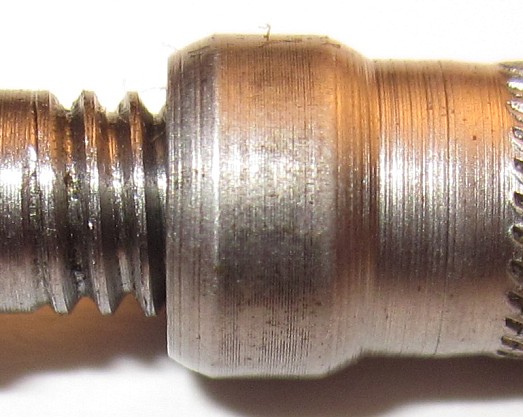
Good point Eynhallow, below is a closeup of a new RCBS expander that needs polished and as is creates a lot of drag inside the neck.

5Rqdvuh.jpg


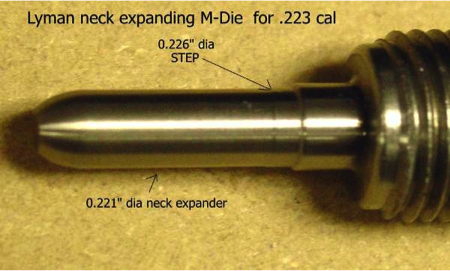
Below is a expander from a Lyman expander die and "much" smoother with far less drag. And expands the neck on the upstroke of the press ram and reduces neck runout.

ohIUcpd.png


The two things to do is polish your expanders and "lube" the inside of your case necks.
 
My 6mm's all seem to split the necks just like that. Usually after the 2nd or 3rd firing though. I have thought about annealing them also. I think it is something to do with this cartridge.

Absolutely not!!! I have owned more than a dozen 6mm Remingtons, and have used brass from many different sources over the years, and I am surprised if I do not
get a dozen or more reloads from a case without any splits. Possibly some chambers that have generous diameter throats, but that is an individual rifle issue not a 6mm Rem
issue. Regards, Dave.
 
Just to close off the thread...

I purchased a salt bath annealing system. It was like a whole different experience loading up the annealed brass tonight. The ball expander eased out of the cartridges with very little pressure. A much lighter and smoother process than the last time.

I will take the cartridges to the range tomorrow and try them. Hopefully this solves the neck splitting issue.
 
Back
Top Bottom