Bear defender 12 gauge

Modern rifle rounds (like a .30-06) are ample for most bear encounters, and are routinely used on bear hunts. But the point is to have something more rugged and compact to carry about, and that has other potential uses (like firing shot). Also, some provinces don't allow rifles in the woods above .223" calibre outside of hunting season. So shotguns would be a must!

Plus, most of these hunting rifles have scopes on them and I find it’s used in a defence situation at closer ranges, you might just see a bug patch of fur and not know where you’re shooting. I’d prefer open sights .... perhaps ghost rings for up close.
 
I concur with your assessment of slug performance, and my own gun is loaded with Brennekes, and I keep Challengers on hand if someone comes looking to bum shells. In some circumstances though, the disadvantage of the fosters is also their strength. If over penetration is a concern, a foster or even buckshot might be a better choice in that particular scenario.

Boomer, if you’re at all still monitoring this thread, it seems you have lots of experience with polar bears. I’m confident with a 12 gauge with black bears, but would a 12 gauge slug penetrate enough for big bears such as polar bears?

Whenever I watch tv shows/documentaries where someone is controlling/discouraging polar bears, I always see them using the 12 gauge and cracker shells, but if scaring them doesn’t work, will the 12 gauge suffice on those big bears?
 
I went with a cheap but wide 2 point sling, works fine.

EQDkAx7l.jpg
 
Boomer, if you’re at all still monitoring this thread, it seems you have lots of experience with polar bears. I’m confident with a 12 gauge with black bears, but would a 12 gauge slug penetrate enough for big bears such as polar bears?

Whenever I watch tv shows/documentaries where someone is controlling/discouraging polar bears, I always see them using the 12 gauge and cracker shells, but if scaring them doesn’t work, will the 12 gauge suffice on those big bears?

Most of the bears killed by DNR here are shot with run of the mill foster slugs fired from 12 ga 870 Marine Magnums. The thing to consider is that problem bears are often sub adults or bears that have a tough time making a living due to illness or injury. These are seldom trophy sized bears, although there are exceptions, particularly with cabin robbers. Even with a big bear though, you seldom have to worry about shooting the 1000 pound bear if you have a shot at the 100 pound head; in that context a foster slug is quite sufficient. My problem is a bit different than DNRs. If I have a bear problem, I'm not likely to be shooting from my truck, and I normally only carry a shotgun when I'm close enough to town that the idea of shooting a heavy rifle makes me uncomfortable, particularly if the bear is in an elevated position above me along the coast. Therefore given the possibility of a very close bear encounter while I'm on foot, I prefer original Brennekes or Challengers to fosters.

Sometimes I am really wondering ….. ????? :confused:

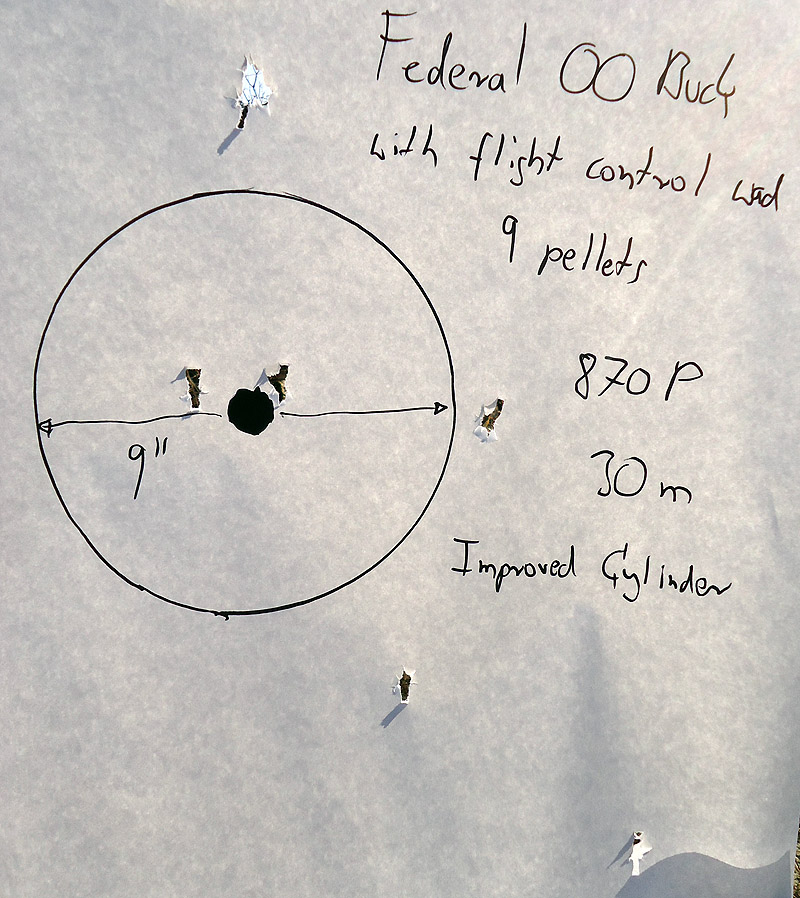
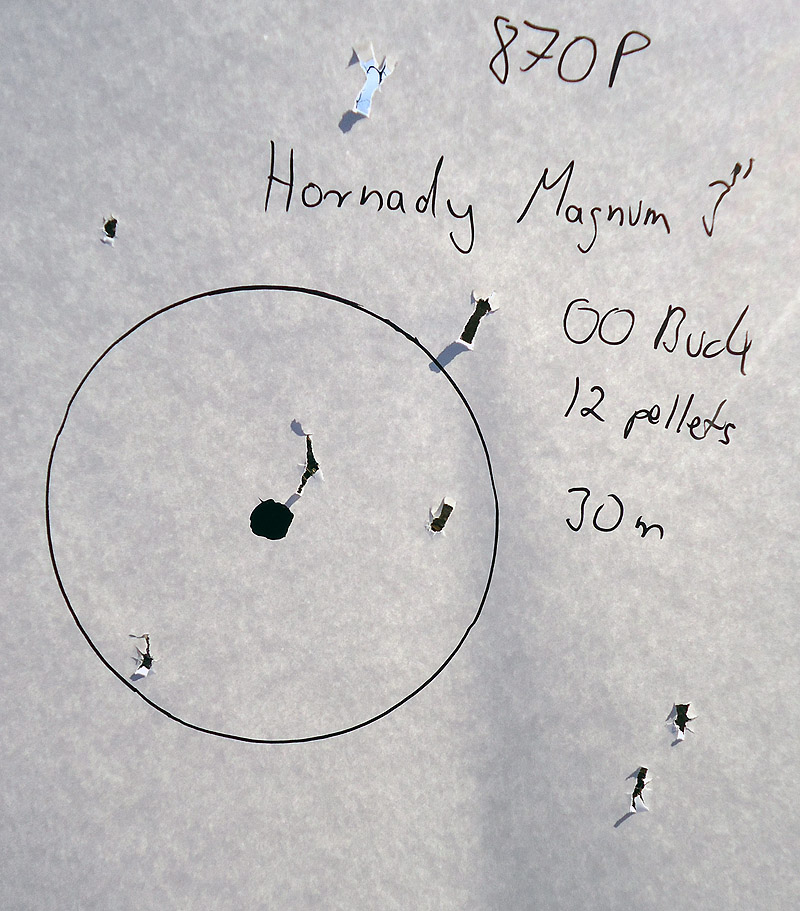
Can somebody tell me what is “devastating” about buckshot at 30 yards when shot from an Improved Cylinder ... and in the context of bear defense??

The OP bought an 870 Police and which normally comes with a fixed IC choke.

Now, the best buckshot patterns I am getting out of my 870Ps with IC choke, is with loads that use a flight control wad. Hornady makes one … and Federal makes a couple different ones.

Here are my patterns at 30 meters (9 inch pie plate). And without that wad ... the patterns are even worse ....

Federal_00Buck_30m_870P.JPG


Hornady_Mag_00Buck_30m_870P.JPG


...

And here the link to my buckshot and slug penetration tests:

Buckshot Penetration Test:
https://www.canadiangunnutz.com/forum/showthread.php/1724640-Penetration-Test-II-Buckshot

Slug Penetration Test:
https://www.canadiangunnutz.com/forum/showthread.php/1635960-Unofficial-12ga-Slug-Penetration-Comparison


So, can somebody explain to me what is “devastating” here about buckshot and in the context of bear defense??

I don’t get it …..

:confused::confused::confused:

In case of a problem in town, where over penetration might pose an unacceptable danger, I have 3" Federal Premium 00 buck in my sidesaddle. This stuff patterns well to 25 yards in my gun, and is well within the 1 inch of pattern spread per yard of range, the generalized rule of thumb for shot performance. That said, I consider 10 yards the outside limit of its usefulness for bear work in a populated area. Of the various buckshot loads I've tried, the best patterns in my gun are the Federal Premium stuff and 3" 00 Heavishot. I had great hopes for Winchester's 15 pellet 3"00 load, but to call it dismal is better than it deserves. Naturally I consider low recoil law enforcement buckshot loads unsuitable for bear work, despite its reputation for tight patterns and despite the short ranges where I would choose buckshot loads.

A note about range in defensive shooting scenarios. The bear cannot hurt you if it cannot touch you, therefore the purpose of shooting is to stop the bear's forward progression to prevent it from touching you. At ranges beyond 10 yards, there is little chance the bear can touch you, and until he breaks the 30' barrier, he hasn't committed himself to an attack. IMHO, shooting a bear beyond 20 yards is hardly justifiable unless its about to injure someone else, is wounded by a previous shot, or is about to break into an inhabited structure.

Consider the range from my gun barrel, at the bottom right of the following photo, to the bear. This is appropriate defensive shooting range, but I didn't need to shoot so I didn't. He went his way, the tourists who had ventured to close, thereby encouraging him to close the distance, had a good story to tell, and I was satisfied I had made good decisions, first to intervene and secondly by giving him an out.
 
Last edited:
Boomer you have posted lots of information ! I really would not want to shoot a bear unless I’m hunting bear . How close would I let one come in to my personal space hard to say . I would hope my nerves will remain steady though !
Leavenworth
 
Boomer you have posted lots of information ! I really would not want to shoot a bear unless I’m hunting bear . How close would I let one come in to my personal space hard to say . I would hope my nerves will remain steady though !
Leavenworth

The key to knowing whether or not you are in mortal danger from a bear is to learn their behavior. A good place to start is with the trilogy of books on bear attacks by James Gary Shelton: Bear Attacks, the deadly truth, Bear Attacks II, myths and reality, and Bear Encounter Survival Guide. Stephen Herrero has an excellent book called Bear Attacks, their causes and avoidance. The difference in behavior between a black bear and a grizzly determines how you respond to an attack; for example, you fight a black bear because black bear attacks on humans are most often predatory and playing dead works to his advantage not yours. You act submissively to a grizzly attack because the chances are that this attack is intended to drive you away, the trouble this theory is that once contact is made, the attack can become predatory. Information is power, and good decisions come from having the knowledge of how to respond to a developing situation. Just because a bear sees you doesn't mean its going to attack you, but you must be alert to his actions from that point forward, and be prepared to shoot if necessary. If however that bear has locked onto you, and his attention is not distracted by anything else going on, you have a problem, and killing that bear might be the only way of resolving it. A trick I learned with polar bears, is that if from 30 yards or so, if they stop and look at me and try to figure out what I'm all about, provided its not a female with cubs, if I run towards the bear, before he has decided what to do, he will turn tail and run away. Man, you put the run on a half ton bear like that, its a confidence booster, you just can't let that confidence get you killed. There is lots to learn and I study bears at every opportunity, and usually learn something new each time. As soon as you say that a bear will definitively do this or do that, they will prove you wrong.
 
Last edited:
The key to knowing whether or not you are in mortal danger from a bear is to learn their behavior. A good place to start is with the trilogy of books on bear attacks by James Gary Shelton: Bear Attacks, the deadly truth, Bear Attacks II, myths and reality, and Bear Encounter Survival Guide. Stephen Herrero has an excellent book called Bear Attacks, their causes and avoidance. The difference in behavior between a black bear and a grizzly determines how you respond to an attack; for example, you fight a black bear because black bear attacks on humans are most often predatory and playing dead works to his advantage not yours. You act submissively to a grizzly attack because the chances are that this attack is intended to drive you away, the trouble this theory is that once contact is made, the attack can become predatory. Information is power, and good decisions come from having the knowledge of how to respond to a developing situation. Just because a bear sees you doesn't mean its going to attack you, but you must be alert to his actions from that point forward, and be prepared to shoot if necessary. If however that bear has locked onto you, and his attention is not distracted by anything else going on, you have a problem, and killing that bear might be the only way of resolving it. A trick I learned with polar bears, is that if from 30 yards or so, if they stop and look at me and try to figure out what I'm all about, provided its not a female with cubs, if I run towards the bear, before he has decided what to do, he will turn tail and run away. Man, you put the run on a half ton bear like that, its a confidence booster, you just can't let that confidence get you killed. There is lots to learn and I study bears at every opportunity, and usually learn something new each time. As soon as you say that a bear will definitively do this or do that, they will prove you wrong.

Yikes ! Your a braver man than I if you run towards Polar Bears ! Hmmm Maybe you should change your CGN handle to " Dances With Bears " LOL ! You have experience I do not . Thanks for the information you have provided once again . Appreciated !
Leavenworth
 
On the Home Defense side of things for the 12 gauge shotgun I looked up this fella
https://www.aiptactical.com/how-to-videos.html
He makes some good points and seems to be well versed in the 870 Remington Shotgun
Let me know what you fellas think !
Leavenworth

An 870 Marine Magnum is a very popular choice of gun around here, and I take in more of those to clean than all the others combined. An 870 will provide you with years of good service and it requires little in the way of maintenance, providing its not left in the bottom of a boat, hung in a tree for months at a time, or treated like a Neanderthal's second favorite club. If the gun is wet, wipe it down, then wipe it down again with an oily rag. The only time the bore needs special attention is if less lethal ammo like cracker shells are fired in it, the propellant charge in these are sometimes corrosive, so a good cleaning in hot soapy water ASAP to remove the salts, then patch dry, run an oily patch through the bore then patch dry again. With normal use, stripping and cleaning is only really required once or twice a year. That said, the more plastic fouling and carbon that accumulates in the bore, the more difficult it is to remove.

One area where folks seem to have problems with 870s is fitting the barrel to the receiver. The ejector is riveted to the port side of the shotgun, and there is a recess in the barrel that engages it. I've seen a number of 870 ejectors broken off when some ham-fisted savage jammed the barrel into the receiver without indexing the ejector with its recess. In fairness these have all been company guns that were issued to people who probably shouldn't have had them in the first place. In no way should these failures reflect on the quality of the 870. On a similar topic, the threaded magazine cap that retains the barrel can work loose over time, particularly if it has been drilled and tapped for a sling swivel. What can happen is the sling swivel stops turning freely, then all the torque from carrying the gun slung is applied to the cap, causing it to back off. I've made a habit of checking the magazine cap for tightness every time I pick up the gun, just a I check the chamber every time I pick up the gun. If your barrel is projected down range when you shoot, chances are the magazine cap wasn't tight. The threaded ring which joins the magazine extension to the magazine, and retains the barrel on the Marine Magnum seldom comes loose since it is also held in place by the barrel/magazine band which is where the front sling swivel is located.

I don't think that an 870 Marine Magnum needs much in the way of aftermarket accessories. A nylon sling is a good idea, the stretchy cobra straps are popular here, but I prefer a simple 1.25" adjustable carry strap that I can use as a shooting aid in the hasty sling technique. A sidesaddle is a good idea, particularly if you want to carry rounds that are different that what you load in the magazine, or want to have ammo that is stored with the gun in case of an emergency. I keep a half dozen rounds of 00 buck in mine. If you like open sights, the Remington rifle sights are as good as any, but after market ghost ring and post sights are preferred by some since they are faster than either open sights or a bead. An after market follower with a male appendage which is claimed to keep the magazine spring from bunching up might be a good idea, but it might cost you a round of capacity. I'd wait to see if you needed one before you jump on it.

One of the most important actions you'll take with your gun is loading and unloading. Pick up some 12 ga snap caps, these should be weighted to duplicate the weight of live rounds, and these will allow you to practice safely at home. The first time you load rounds into the magazine, you should hold the gun upside down so you can see what's going on as you thumb rounds into the magazine. You will note that there are two shell stops, one on either side of the receiver. As the forend is pulled rearward, to its full extent to eject the round in the chamber, then moved forward enough that the elevator flips up out of the way. The shell stop on the left interrupts the subsequent round from leaving the magazine as the stop of the right releases the round that is to be chambered. When you unload the magazine, alternately depress the right shell stop, then the left to release the shell. As the bolt moves rearward, the fired shell is extracted from the chamber, and ejects from the receiver when the rim of its base hits the ejector. The forend at this point is fully rearward. As its pushed forward, the subsequent round is released form the magazine, and the elevator flips up to align it with the chamber, and the round is loaded as the bolt moves forward. All this time the trigger has been depressed. Now when your target is acquired/reacquired pressure on the the trigger is relaxed, but contact with it should not be broken, the trigger moves forward perhaps a quarter inch in order to reset, once reset, pressing it again will fire the round in the chamber.

To load the gun, hold it in the shoulder, allowing the muzzle to droop towards the ground. Index the shell with the front edge of the trigger guard, then push it home into the magazine, then repeat until the magazine is fully loaded or until you supply or shell/snap caps is in the magazine. To unload without running the shells through the chamber, assuming you have a round in the chamber, press the slide release on the port side ahead of the trigger guard to unlock the bolt, then pulling the slide fully rearward ejects the chambered shell. Anytime the slide is to be pulled rearward without first pulling the trigger, you must hold back the slide release before the forend will move. Now the slide is fully to the rear, and the subsequent round has been released from the magazine and is resting on the elevator. Roll the gun to the right with your left hand over the ejection port, and the round will drop into your hand. Now move the forend forward just enough that the elevator is in the flipped up position, and the loading port is clear of the forend. Press the shell stop on the right side of the receiver and you will hear the shell contact the shell stop on the left, now depress the shell stop on the left, and the shell drops back the loading port and falls into your hand which is ready to catch it. Practice this until you can do it in your sleep, then practice it some more.

The next technique to master is called slug select, although the term applies to putting a load in the chamber that differs from that which is loaded in the magazine. This is the technique where the tube magazine has a distinct advantage over the detachable box magazine. If you gun has a detachable box magazine, have a spare magazine loaded with your alternate loads, then simply drop the magazine on the ground and insert the alternate magazine. The technique for slug select with a tube magazine is as follows. Press the slide release, and pull the forend fully rearward. The chambered round will be ejected, and the next round in the magazine will be released onto the elevator. Roll the gun to the right so the loose rounds drops out of the gun throught the ejection port. The select round you intend to put in the chamber is now in your left hand, cup the underside of the receiver and press the shell into the gun through the ejection port, now your hand is in the perfect position to simply push forward which moves the forend forward, chambering the round. This technique is also useful for those who store the gun with the action open, so its a simple matter to drop the first round into the open loading port and close the action, at which point you can fire that round, or load the magazine. An alternate method of slug select is to carry the gun with the magazine loaded 1 round short of capacity. Simply load the select round into the magazine, cycle the action, the chambered round is ejected and the select round is chambered. My preference is to carry the gun with a full magazine and an empty chamber, but rounds may have been fired before your select round is required, so assume you're having to eject a round in order to chamber the select round. Mastering the slug select technique, is far superior to staging different shells in the magazine based on how you think a scenario will play out. The wrong shell will always be in the chamber.

You'll note that I've said nothing about the engaging or disengaging the safety. I choose not to use the safety, and carry the gun with an empty chamber, and cycle the action when until I need the gun. After the situation is resolved, I unload the chamber and return the round to the magazine. If you choose to use the safety never deviate from its use. The safety is always on, and is only disengaged when you are ready to shoot. After the situation is resolved, the safety is reengaged and only taken off again immediately prior to the next round being fired. Manipulating the safety must become part of your muscle memory, otherwise you could find yourself trying to understand why the gun doesn't fire as the bear approaches, then your realize you can't cycle the action either. That is not the situation you want to be in.

 
Last edited:
Most of the bears killed by DNR here are shot with run of the mill foster slugs fired from 12 ga 870 Marine Magnums. The thing to consider is that problem bears are often sub adults or bears that have a tough time making a living due to illness or injury. These are seldom trophy sized bears, although there are exceptions, particularly with cabin robbers. Even with a big bear though, you seldom have to worry about shooting the 1000 pound bear if you have a shot at the 100 pound head; in that context a foster slug is quite sufficient. My problem is a bit different than DNRs. If I have a bear problem, I'm not likely to be shooting from my truck, and I normally only carry a shotgun when I'm close enough to town that the idea of shooting a heavy rifle makes me uncomfortable, particularly if the bear is in an elevated position above me along the coast. Therefore given the possibility of a very close bear encounter while I'm on foot, I prefer original Brennekes or Challengers to fosters.



In case of a problem in town, where over penetration might pose an unacceptable danger, I have 3" Federal Premium 00 buck in my sidesaddle. This stuff patterns well to 25 yards in my gun, and is well within the 1 inch of pattern spread per yard of range, the generalized rule of thumb for shot performance. That said, I consider 10 yards the outside limit of its usefulness for bear work in a populated area. Of the various buckshot loads I've tried, the best patterns in my gun are the Federal Premium stuff and 3" 00 Heavishot. I had great hopes for Winchester's 15 pellet 3"00 load, but to call it dismal is better than it deserves. Naturally I consider low recoil law enforcement buckshot loads unsuitable for bear work, despite its reputation for tight patterns and despite the short ranges where I would choose buckshot loads.

A note about range in defensive shooting scenarios. The bear cannot hurt you if it cannot touch you, therefore the purpose of shooting is to stop the bear's forward progression to prevent it from touching you. At ranges beyond 10 yards, there is little chance the bear can touch you, and until he breaks the 30' barrier, he hasn't committed himself to an attack. IMHO, shooting a bear beyond 20 yards is hardly justifiable unless its about to injure someone else, is wounded by a previous shot, or is about to break into an inhabited structure.

Consider the range from my gun barrel, at the bottom right of the following photo, to the bear. This is appropriate defensive shooting range, but I didn't need to shoot so I didn't. He went his way, the tourists who had ventured to close, thereby encouraging him to close the distance, had a good story to tell, and I was satisfied I had made good decisions, first to intervene and secondly by giving him an out.


For a couple of years, I was at a range and apparently on the same schedule as a group of bear biologists who were learning or practicing their 12 gauge skills before heading up north for some live bear time. They always used 00 buck shot shells, making me think that was a good idea. Oh, and they used 870s too, just for the record.
 
For a couple of years, I was at a range and apparently on the same schedule as a group of bear biologists who were learning or practicing their 12 gauge skills before heading up north for some live bear time. They always used 00 buck shot shells, making me think that was a good idea. Oh, and they used 870s too, just for the record.

Frankly I think poorly of buckshot for bear work. IMHO I think buckshot is a niche solution best used when the over penetration potential of slugs makes their use dangerous to others, but what do I know? Given an inch of pattern spread for each yard of range, you have to shoot as well with buckshot as you would with slugs, and the slugs are going to be far more effective. Check out the bear in the photo, his brain is only the width of his snout, so the slug or shot charge must impact somewhere between the inside corners of his eyes. That's a fine shot, that I would prefer to make it with a single projectile. The results would depend greatly upon the density of the pattern, but any buckshot pellets that impacted into the snout or around his eyes do not contribute to stopping him, so you're depending on a smaller percentage of projectile weight to do the job.

Here's my gun, for my purposes the Mossberg was a better choice.
 
OO buck in camp or wherever a pass through may endanger your personnel.

Everywhere else, good quality, fresh (ie. not carried for 3 years in the field) hard cast slugs.

I agree with this.

This is exactly what I do as well but I also mostly worked solo so when I packed a shotgun I loaded it with slugs even in camp.

I haven't packed a shotgun for defense in years though.
 
Back
Top Bottom