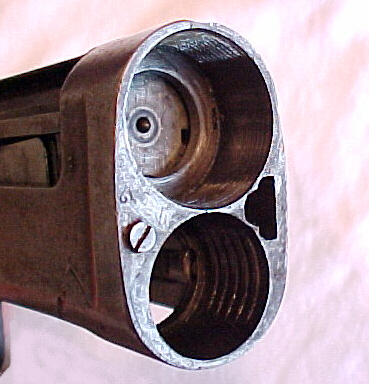
What happened to this 1897?

Rating - 100%
39   0   0
Location
Under the arch
A fellow traded me an old Winchester 1897 takedown, which I finally got apart last night.

It didn’t want to come apart, and now I see why.
TZ60yS2.jpg


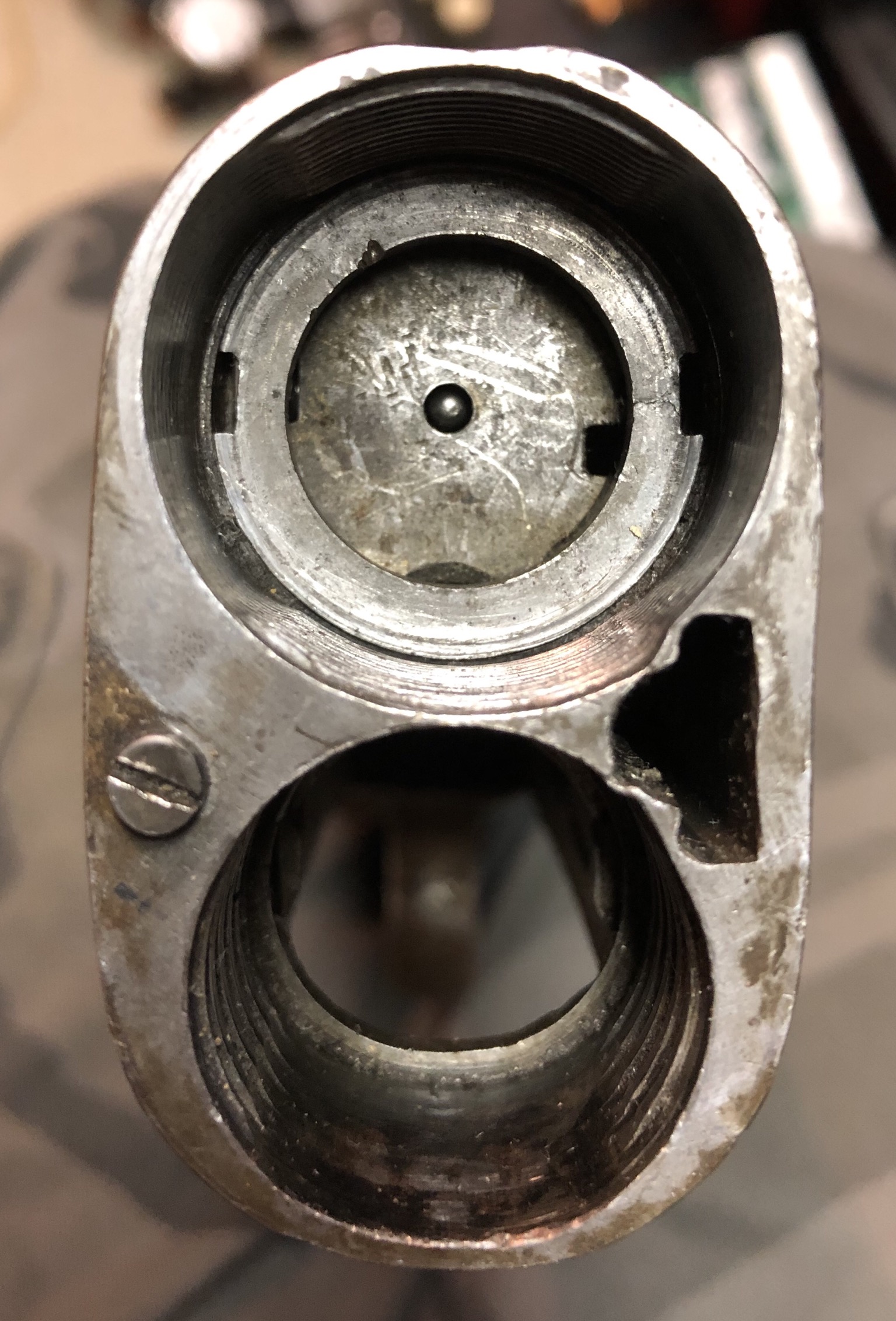
Part of the lower interrupted thread has been pushed down and into the magazine tube socket.

It is only the end of the thread that is affected.
PDVm8Iw.jpg


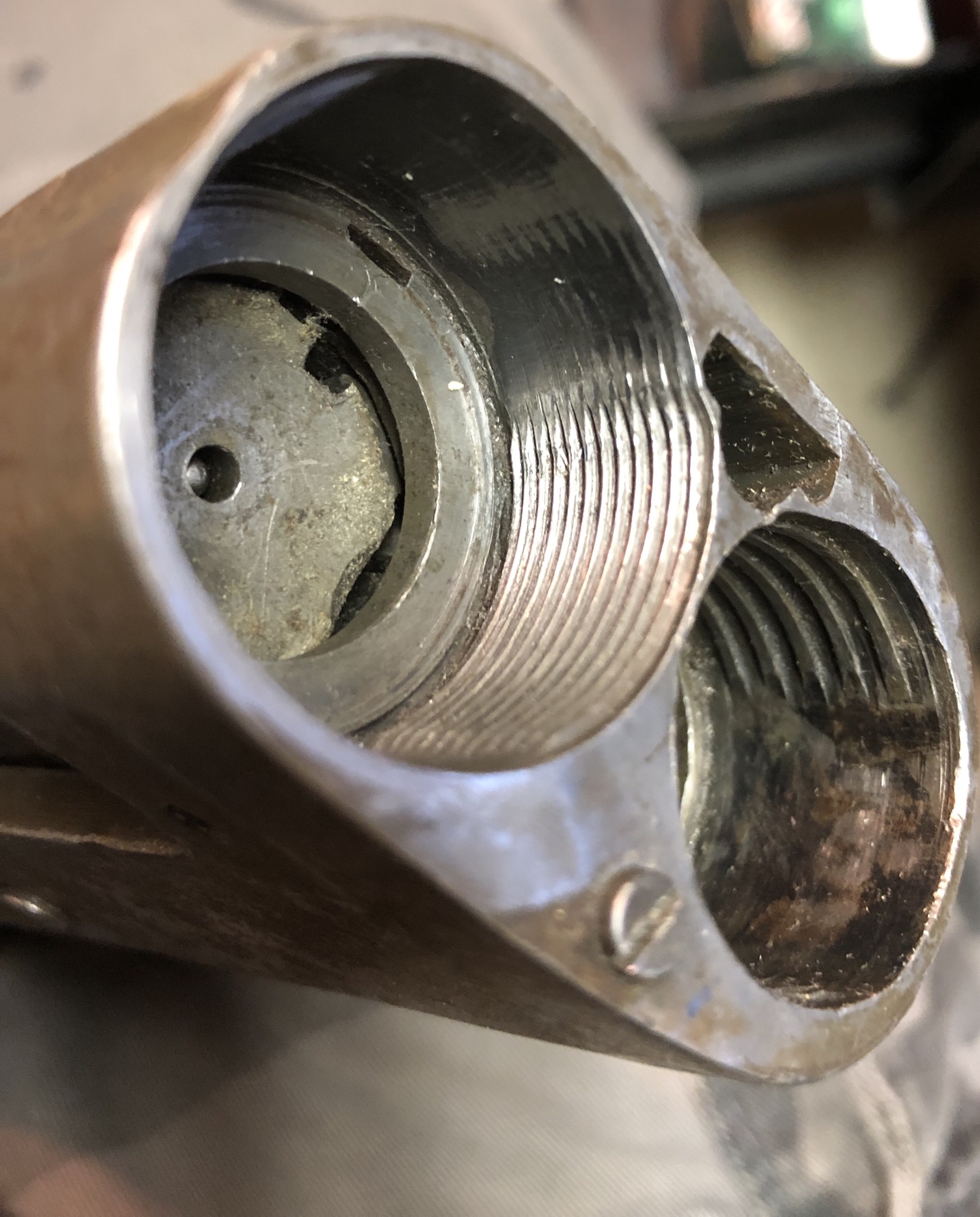
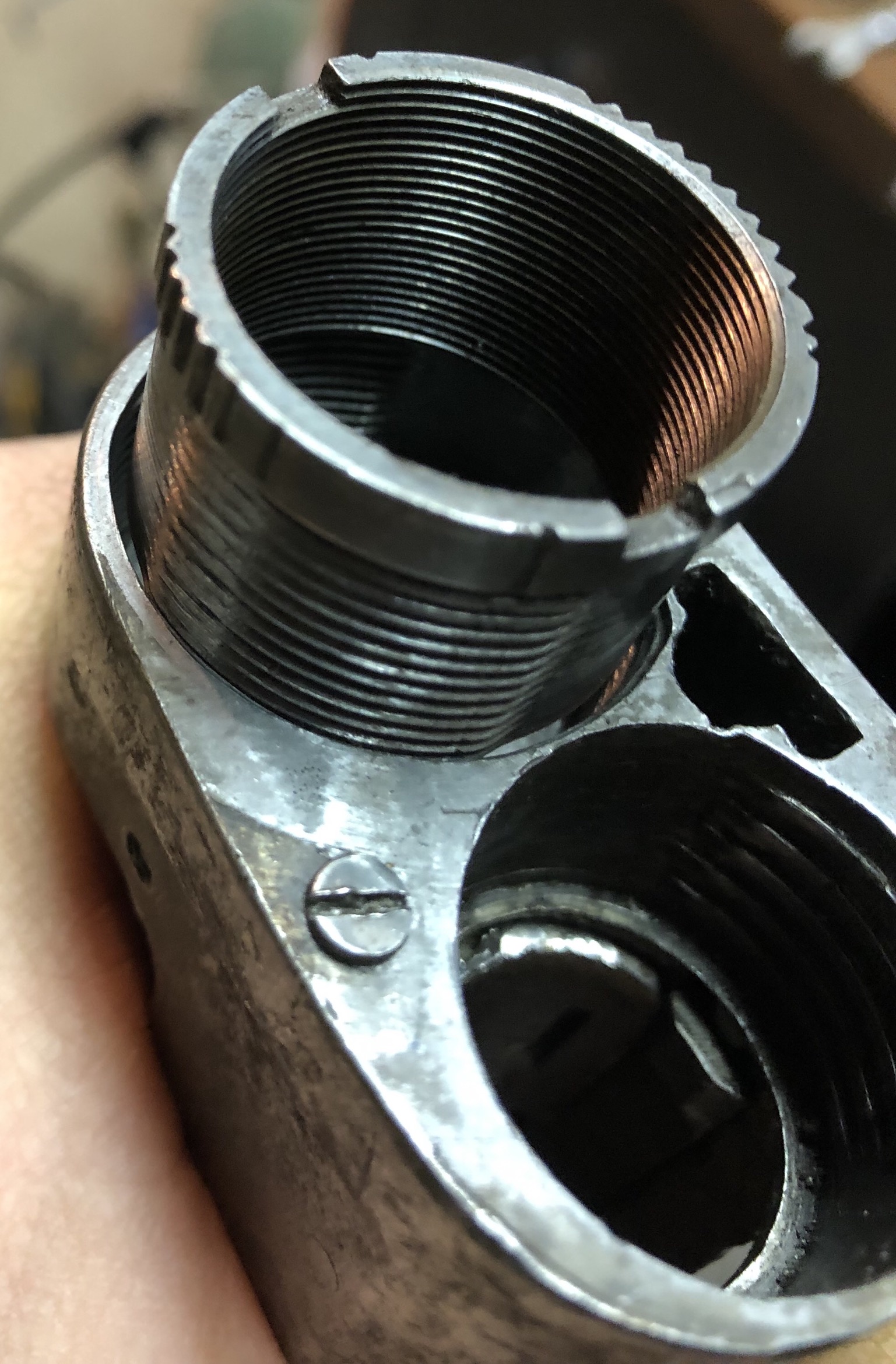
Strangely enough the finely threaded barrel collar is still a smooth and clean thread onto the barrel. The same collar will not thread into the receiver. Check how big the gap is where the threads are pushed out.
iHoF1VM.jpg


The sides of the receiver socket seem to be pulled in, hence the rub marks on the unthreaded portion.

Any ideas what might have happened here?

Also, the needless complexity of this thing is breathtaking. And this guy was a much better designer than I will ever be. Why so many operations, and so many little parts held in by so many little screws?
 
Last edited:
What I can see - action slide channel in receiver is badly worn and deforming into the threads - both for the barrel and magazine tube.
Taking out more metal chasing the threads, even if possible, will merely weaken the receiver.
Replacement receiver needed.
 
was it squeezed at one point in a vise perhaps ??
would it be possible to take a larger tapered punch and put it in the rounded part of the hole beside the outofwhack threads...lightly tapping it back in line with the other threads ??
Just a thought .
 
Last edited:

was it squeezed at one point in a vise perhaps ??
would it be possible to take a larger tapered punch and put it in the rounded part of the hole beside the outofwhack threads...lightly tapping it back in line with the other threads ??
Just a thought .

Hmm. The thought being that the kinked-down thread portion would be from the web buckling as the side walls collapsed inwards, rather than stretching out from the barrel bending.

That would explain the lack of damage to the barrel collar thread, and the fact that the front takedown body is undamaged (which I wouldn't expect it to be in a down-lever-break scenario). And the fact that the bend points are so sharply inverted compared to the profile.

I do know that the front takedown body would have been clamped into something while the previously fitted fake magazine tube was soldered in.

Or someone got the bright idea to "tighten up" the fit on the magazine thread by just squeezing in the sides of the channel a bit.

I should be able to tell that by seeing whether the width of the body changes over its length. Those crimp in marks should be visible, even among the rest of the abuse it suffered.

>use only one part

Are his other designs the same way? I always thought the 1911 was fairly crisp.
 
Looks like either the magazine tube or the barrel was bent downwards, to cause that deformation.

And It also looks like they tried to disassemble it - with the action bar still in - with a vise and pipe wrench.
 
I used a straight-edge to compare the two sides.

The left side flange (in the photo) is noticeably convex, with the flat behind it level.

The right side flange is almost flat, with the flat behind it slightly concave.

There is a bar-shaped indent in the middle of the flange on the right side.

May I ask someone with a known-good unit to check theirs for symmetry?
 
It's difficult to imagine what might have caused that to happen.

As to the "needless complexity" of the design, John Browning's philosophy was why use only one part when you could use two?

Something to do with the manufacturing processes possible or cost effective in his day I would think.
 
Back
Top Bottom