Last year I brought a Blissett, a Holland, a Parker Field & Sons, a Westley Richards, a Boss & Co. (all pinfires), and a 14-bore Lancaster, if memory serves me. I won’t repeat any of the guns this year, and instead of the earliest designs, this year I’m going with best-quality, unusual actions, and rarity. Any guns by the same makers are different guns. This year’s line-up, barring last-minute changes, are 10 pinfires for fun, and two shooters hoping to vie for the Best-of-2019 award:
Double-barrelled 12-bore Needham patent side-lever bar-in-wood pinfire gun by John Blissett of London. 1864
Single-barrelled 12-bore double screw grip underlever pinfire gun by Boss & Co. of London. 1864
Double-barrelled 12-bore double screw grip left-hand underlever pinfire gun by Joseph Braddell & Son of Belfast, Ireland. @1865
Double-barrelled 12-bore push-underlever self-half-cocking pinfire gun by Cogswell & Harrison of London. 1864
Double-barrelled 16-bore “Lockfast” pinfire gun by James Dalziel Dougall of London. 1864
Single-barrel 12-bore double screw grip underlever pinfire gun by John Dickson & Son of Edinburgh, Scotland. 1867
Double-barrelled 12-bore double screw grip underlever pinfire gun by Harris Holland of London. 1863. Cased with loading tools.
Double-barrelled 14-bore pinfire gun, Bastin System, by the Masu Brothers of London. @1866
Double-barrelled 10-bore double screw grip underlever pinfire gun by James Woodward of London, converted from a Charles Moore pellet-lock.
Double-barrelled 16-bore Lefaucheux-lever pinfire gun by Jean-Baptiste Rongé et Fils, Liège, Belgium. Late 1860s.
The shooters:
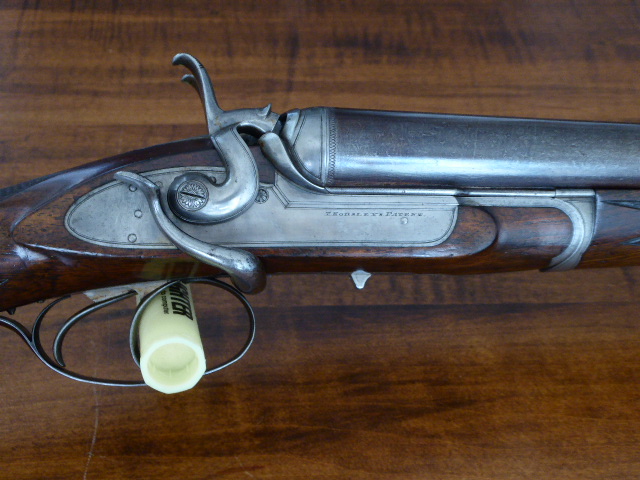
Single-barrel 16-bore double screw grip underlever hammer gun made by Thomas Seymour of London (1841-1844), converted from percussion. Nitro-proof barrel.
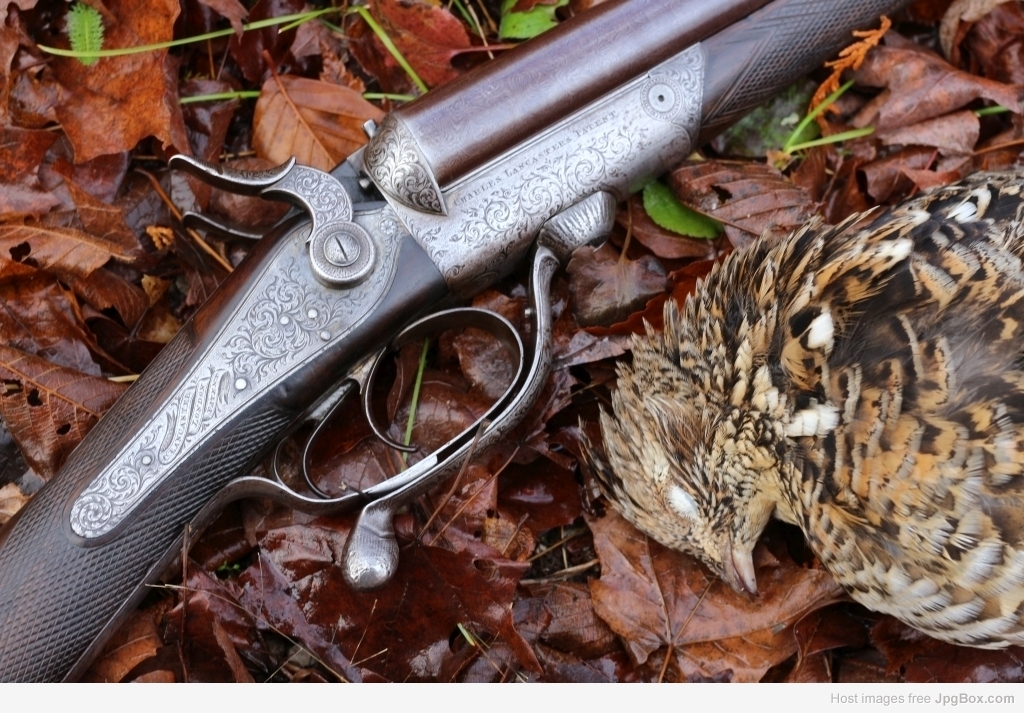
Double-barrelled 12-bore early slide-and-tilt centrefire hammer gun by Charles William Lancaster of London. 1864. Cased, nitro-proof barrels.
Here’s hoping for good weather!