.011 probably not a big deal but drives me ape!

Book length means nothing. It is what suite THEIR rifle. Use the OAL that will fit your magazine and is about 20 thou off the rifling.

So basically, as long as they fit in the mag it's good to go? My 280 loads barely fit but they cycle through fine. My 30-06 don't shoot as good as the 280 but it does best with 56 grains. 280 does best with 56.5 grains. Now it could just be coincidence, or it could be the 7600 long action calibers works good within that node? I don't know, I found it interesting though.
 
trapaholic, i haven't read through all of the replies.

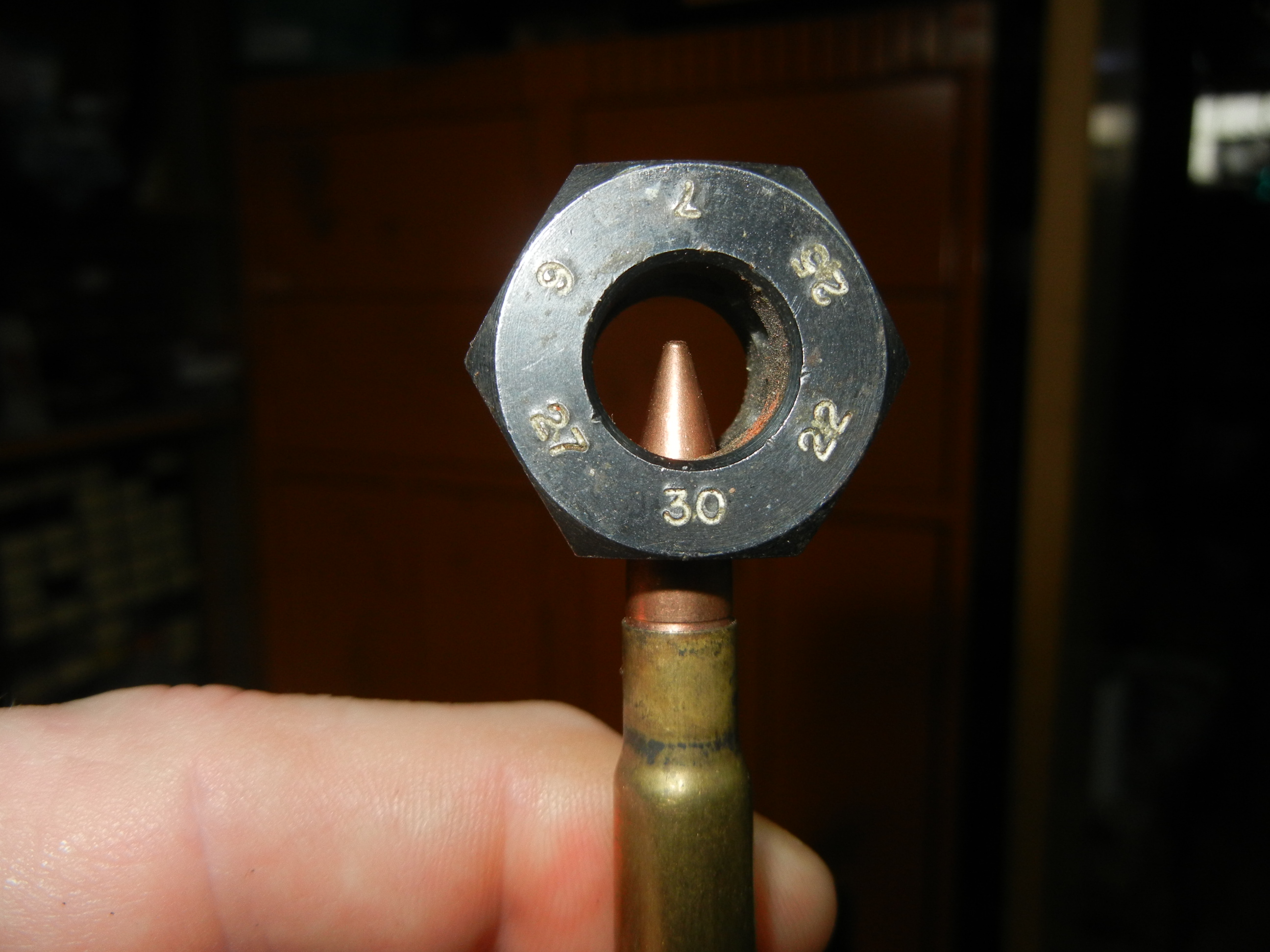
Have you been using a nut gauge to measure your overall length?

The nut gauge will measure the same diameter on the ogive for length, rather than the tip of the cartridge.

If I were shooting competition, .011 wouldn't be acceptable IF it were measured with a NUT GAUGE.
 
trapaholic, i haven't read through all of the replies.

Have you been using a nut gauge to measure your overall length?

The nut gauge will measure the same diameter on the ogive for length, rather than the tip of the cartridge.

If I were shooting competition, .011 wouldn't be acceptable IF it were measured with a NUT GAUGE.

That was the first reply.

But yes that's all that matters is the CBTO. Seat bullets measuring CBTO, and CBTO will be the exact same on every reload. Jump to lands will be exactly the same. Overall length will indeed vary as others have mentioned but that does not matter in the least.

The only reasons to worry about OAL is to make sure it fits in a magazine if that's what you use. And dont go below published minimum OAL as that could spike pressures. But not sure why anyone would go below minimum anyways.

Buy the tools to measure CBTO. It's the only way to seat bullets within .001" or less.
 
Hell, every rifle i own will put 12 shots in one hole.

At 10 yds.

I can put every pellet of #8 birdshot in one hole at 10 yards. I'm not shooting at 10 yards. 25, 75, 100... Might get one that baaarely doesn't make the hole at 100 now and then.

That was the first reply.

But yes that's all that matters is the CBTO. Seat bullets measuring CBTO, and CBTO will be the exact same on every reload. Jump to lands will be exactly the same. Overall length will indeed vary as others have mentioned but that does not matter in the least.

The only reasons to worry about OAL is to make sure it fits in a magazine if that's what you use. And dont go below published minimum OAL as that could spike pressures. But not sure why anyone would go below minimum anyways.

Buy the tools to measure CBTO. It's the only way to seat bullets within .001" or less.

All I'm sayin is when I seat the first one at day 3.330 and I say super, then run the next one through and it's 3.342 or something like that it makes me go ovrecf:P:d:h::confused::mad:
 
as far as the rest of your guys answers, thank you! I was about to send my seater die in for scrap and get a micro adjuster redding hahaha

If you did that and tried adjusting for each bullet you would actually just be moving your CBTO all over the place.

I'm not even going to get into the 12 shots in 1 hole at 100 yards haha. I will leave that alone...
 
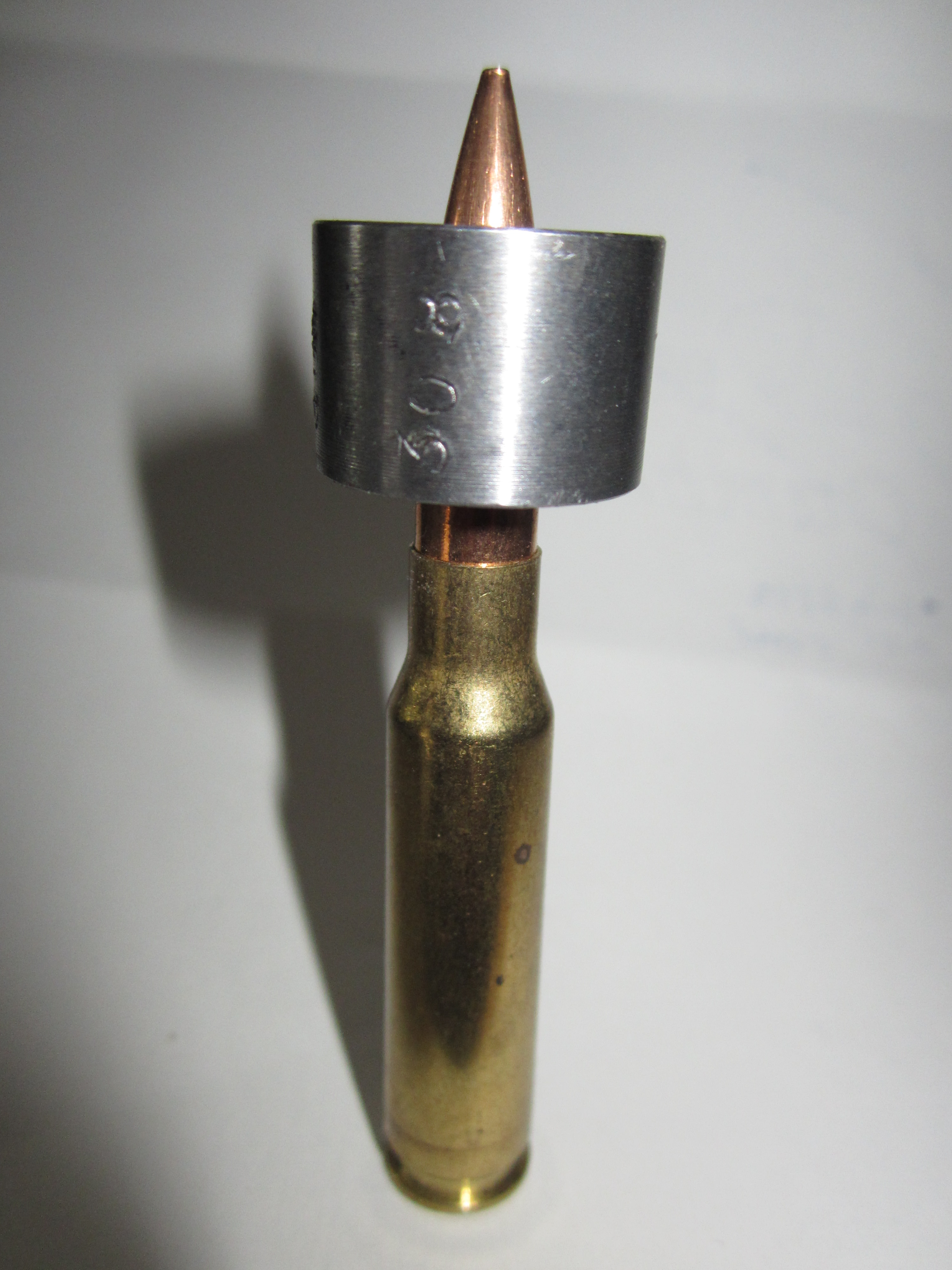
If you want to measure the distance that matters - the position of the ogive - you need something that sits on the ogive. Like this tool:

TcA9F6T.jpg


If you know a gunsmoth, ask him to go into his scrap barrel pile and lice off a 1" piece for you. It can sit on a loaded round and serve to measure the position of the ogive.

yMiA9XZ.jpg
 
Well you will just have to find a way to get over it haha. Or change projectiles.

I will learn to deal with it I guess, you guys have got me through therapy now :D

If you did that and tried adjusting for each bullet you would actually just be moving your CBTO all over the place.

I'm not even going to get into the 12 shots in 1 hole at 100 yards haha. I will leave that alone...

Blows me away too

If you want to measure the distance that matters - the position of the ogive - you need something that sits on the ogive. Like this tool:

TcA9F6T.jpg


If you know a gunsmoth, ask him to go into his scrap barrel pile and lice off a 1" piece for you. It can sit on a loaded round and serve to measure the position of the ogive.

yMiA9XZ.jpg

On my way to talk to Aaron right now!

Extraordinary shooting. I don't see that on many hunting rifles.

Them 140 grain accubonds are frickin lazer beams!
 
Y'all gettin a little advanced with stuff now guys it's scary. But damn you have no idea how much I appreciate y'alls help! But last question... How the he'll am I supposed to seat the first bullet to start with? Just pick what looks good and stick with it? I'm never touching my 280 dies ever! But my 06 dies... I'm not done froggin around with em yet. Gonna start buying ballistic tips instead of accubonds to experiment with though, much cheaper.
 
If it is a Remington, it probably has a deep throat and bullet will not touch rifling.

Say it does. If I drive it in till it touches then back it off between .020-.050 enough to squeak in the mag that'll work yeah? Honestly I'm tired of arguing with it and can't afford other forms of measurement at the moment. Got lucky with the 280 right off the bat, but I've had the 30-06 since I was 17 and it's ate ALLOT of ammo over the years. To the point I'm surprised the barrel isn't burnt out.
 
Heres another way, that avoids using fancy gismos to measure the ogive.
Buy a 3 ft 1/4 inch wood dowel from the hardware store. Close the action on your pump gun. Insert dowel from muzzle end until it butts against the bolt face. Scribe a line on the dowel with a sharp pencil at the muzzle. Remove dowel, open action, drop bullet into chamber, tamp lightly with a piece of bent coat hanger. Insert dowel into muzzle until it touches the end of the bullet. Scribe line on dowel. Push bullet out with dowel, very important!. Measure between the two scribed lines on the dowel with a vernier - this is the overall length needed to touch the rifling. Subtract an appropriate amount - I use 0.030 in for hunting rounds.
To get really fancy - measure the length of the bullet in your trial. This becomes your reference bullet. When you set up your seating die, use the reference bullet to get the desired COAL - then knock it our for further use with a puller. Alternatively, you can use an bullet from the same box or lot that has the same length as the reference bullet.
Warning - if you go down this path, anytime you change bullets, you have to redo your measurement tests. This applies to bullets of the same spec from the same manufacturer, unless they are the same lot.
FWIW - COAL is not that important relative to other parameters, such as bullet weight and charge weight. A given rifle will preferentially tune to a given bullet weight due to barrel harmonics. Fine tuning is done with charge weight. Very fine tuning is done with COAL. When I develop a load for a rifle, I test a few bullet weights with the same powder. A good load will generally show promise "right out of the gate". Further tests are done with charge weight, and possibly another powder if I get ambitious.
So, you got lucky with your 280 - the bullet you chose, and the powder spec worked well. For your 30-06 you need to do some more work in this area...

 
Last edited:
Heres another way, that avoids using fancy gismos to measure the ogive.
Buy a 3 ft 1/4 inch wood dowel from the hardware store. Close the action on your pump gun. Insert dowel from muzzle end until it butts against the bolt face. Scribe a line on the dowel with a sharp pencil at the muzzle. Remove dowel, open action, drop bullet into chamber, tamp lightly with a piece of bent coat hanger. Insert dowel into muzzle until it touches the end of the bullet. Scribe line on dowel. Push bullet out with dowel, very important!. Measure between the two scribed lines on the dowel with a vernier - this is the overall length needed to touch the rifling. Subtract an appropriate amount - I use 0.030 in for hunting rounds.
To get really fancy - measure the length of the bullet in your trial. This becomes your reference bullet. When you set up your seating die, use the reference bullet to get the desired COAL - then knock it our for further use with a puller. Alternatively, you can use an bullet from the same box or lot that has the same length as the reference bullet.
Warning - if you go down this path, anytime you change bullets, you have to redo your measurement tests. This applies to bullets of the same spec from the same manufacturer, unless they are the same lot.
FWIW - COAL is not that important relative to other parameters, such as bullet weight and charge weight. A given rifle will preferentially tune to a given bullet weight due to barrel harmonics. Fine tuning is done with charge weight. Very fine tuning is done with COAL. When I develop a load for a rifle, I test a few bullet weights with the same powder. A good load will generally show promise "right out of the gate". Further tests are done with charge weight, and possibly another powder if I get ambitious.
So, you got lucky with your 280 - the bullet you chose, and the powder spec worked well. For your 30-06 you need to do some more work in this area...
I will try that!
 
Heres another way, that avoids using fancy gismos to measure the ogive.
Buy a 3 ft 1/4 inch wood dowel from the hardware store. Close the action on your pump gun. Insert dowel from muzzle end until it butts against the bolt face. Scribe a line on the dowel with a sharp pencil at the muzzle. Remove dowel, open action, drop bullet into chamber, tamp lightly with a piece of bent coat hanger. Insert dowel into muzzle until it touches the end of the bullet. Scribe line on dowel. Push bullet out with dowel, very important!. Measure between the two scribed lines on the dowel with a vernier - this is the overall length needed to touch the rifling. Subtract an appropriate amount - I use 0.030 in for hunting rounds.
To get really fancy - measure the length of the bullet in your trial. This becomes your reference bullet. When you set up your seating die, use the reference bullet to get the desired COAL - then knock it our for further use with a puller. Alternatively, you can use an bullet from the same box or lot that has the same length as the reference bullet.
Warning - if you go down this path, anytime you change bullets, you have to redo your measurement tests. This applies to bullets of the same spec from the same manufacturer, unless they are the same lot.
FWIW - COAL is not that important relative to other parameters, such as bullet weight and charge weight. A given rifle will preferentially tune to a given bullet weight due to barrel harmonics. Fine tuning is done with charge weight. Very fine tuning is done with COAL. When I develop a load for a rifle, I test a few bullet weights with the same powder. A good load will generally show promise "right out of the gate". Further tests are done with charge weight, and possibly another powder if I get ambitious.
So, you got lucky with your 280 - the bullet you chose, and the powder spec worked well. For your 30-06 you need to do some more work in this area...


Got ta thinkin bout it some. What if I put a bullet in a case, push it up to tha riflin, measure that on the dowel first, then measure to my closed bolt on the dowel? Save havin ta frog around with a coat hanger and all

 
Back
Top Bottom