












































Received my salt bath annealing kit about a week ago. I have annealed about 30 cases and loaded them up, but have not yet been to the range to shoot. So, far think I like the system.
I started my adventure into annealing about 2 years ago with a home made torch annealer and 3 bottles of tempilaq 325f, 700f and 750f. What i found using this the homemade system (it works with a torch held in place and a motor which spins a cake pan which turns the case- the build directions are widely available on the web) was I had a hard time controlling and repeating the temperature from session to session and ended up overcooking several hundred cases- even with using the tempilaq. So, decided to give the salt a try.
After I bought the salt bath, I read the various threads on the interweb started after AMP's report that salt bath annealing doesn't work. So had some time to burn this afternoon and did two non-scientific tests to see if I could learn myself something.
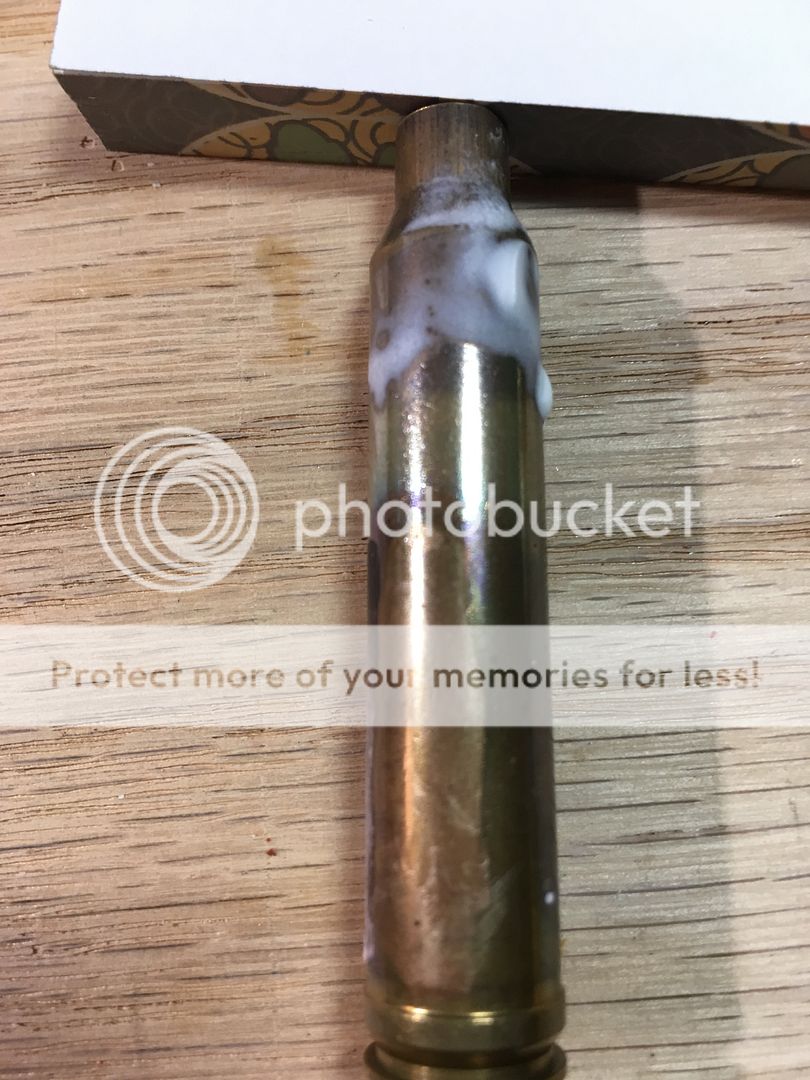
Test one- place a stripe of 325F, 700F and 750F on a 300 Win Mag case, about 30mm up the case form the neck. At this height, the tempilaq starts right around where the Ballistic Recreations shell holder ends, so the tempilaq would be completely visible with the case in the salt. Time how long it took for each of the tempilaq to start reacting and continue to time as the tempilaq change migrated up the case. Did not quench as I wanted to see if the reaction continued after removing from the salt. Temperature of salt was 508c.
picture 1 shows the 325 tempilaq, it started to react at 8 seconds and had reacted to the case head at 37 seconds
Picture 2
Shows 700 (on right) and 750 (on left) tempilaq, 700 degree reacted at 45 seconds and made it as far as you can see at 1 minute-ish. At one minute an orange flame started coming out of the flash whole and I lost my nerve, so I pulled out the case.
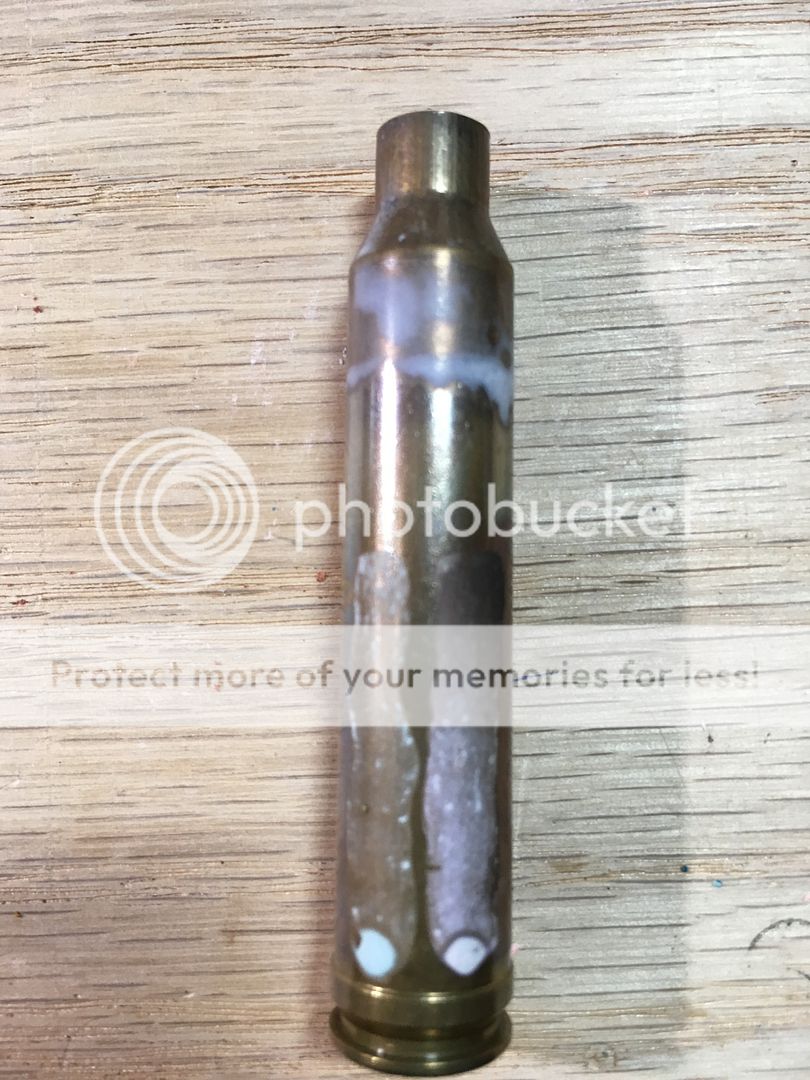
Once the case was out of the salt, the tempilaq reaction did not continue, as far as my eye could tell. Not sure what caused the orange flame, maybe some residue in the case? As well, before started, I did a quick dip to measure the level of the salt on the case. The salt was pretty much bang on where the shoulder starts, maybe 1 mm on to the body of the case. However after the test there is definitely a uniform ring of salt about 1 cm up the body of the case. weird. My guess is this was a result of quick removal from the salts and throwing the brass on the cookie sheet underneath my setup (once the orange flame started), but my guess doesn't really account for the relatively uniform level of the ring of salt. I am not an engineer or a chemist, so if someone is, would appreciate your insights on the orange flame and the salt migration. If some isn't would be interested in hearing your guesses.
On to test 2:
Placed a stripe of all three tempilaqs roughly 5mm from the shoulder- so the tempilaq stripe starts below the case holder, but above the salt. Place 300 win mag case in salt for the recommended max target soak time from Ballistic Recreations of 6 seconds and remove. Do not quench to asses what migration of heat can be seen after removing and avoid washing off tempilaq. Temperature of salt was 514c.
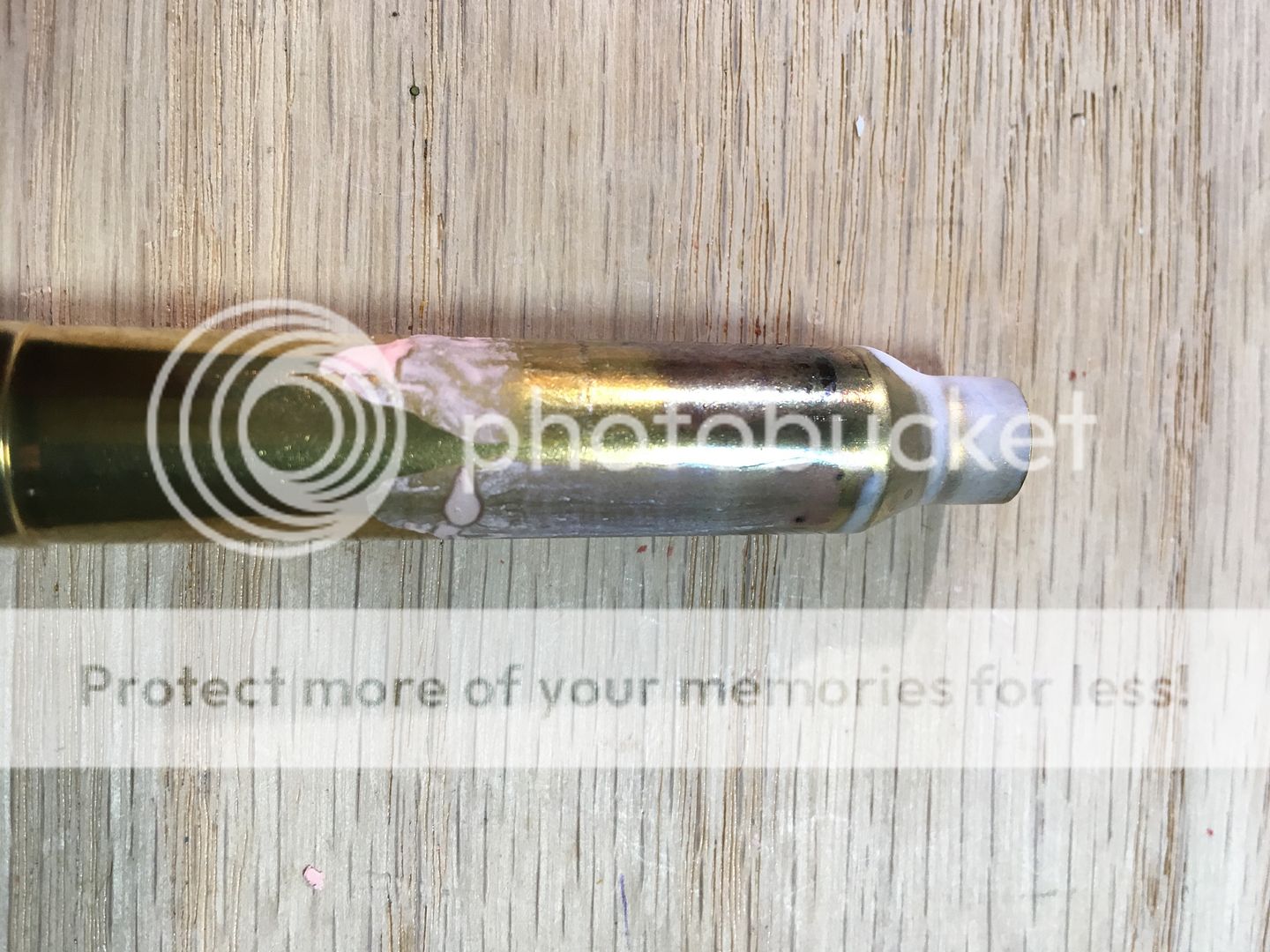
The result was the 325F tempilaq reacted to about half way up the case. The 700F tempilaq looks to me to have reacted to about 3-4mm from where the stripe started, but was just starting. I even question whether it did react, would appreciate opinions (700F is the one on the bottom, bummer about the photo bucket logo) There was no change at all to the 750F tempilaq. I did not see any further tempilaq reaction after removing the case.
So what do I think I learned? Well I think it shows after 6 seconds in the salt, the brass has reached 700F to roughly 1cm down the case body and did not reach above 325F at the mid point of the case. I believe annealing starts at about 500F, so I think this shows that the submersed portion of the neck and shoulder should be well annealed, as the salt will transfer the heat to the brass more efficiently than air and the straight heat conductivity of the brass. Annealing will have continued to some point between where the 700F and 325F tempilaq stopped reacting. Either way, well away from the case head and any danger of softening the brass too far down the case.
Hope you found this interesting.
I started my adventure into annealing about 2 years ago with a home made torch annealer and 3 bottles of tempilaq 325f, 700f and 750f. What i found using this the homemade system (it works with a torch held in place and a motor which spins a cake pan which turns the case- the build directions are widely available on the web) was I had a hard time controlling and repeating the temperature from session to session and ended up overcooking several hundred cases- even with using the tempilaq. So, decided to give the salt a try.
After I bought the salt bath, I read the various threads on the interweb started after AMP's report that salt bath annealing doesn't work. So had some time to burn this afternoon and did two non-scientific tests to see if I could learn myself something.
Test one- place a stripe of 325F, 700F and 750F on a 300 Win Mag case, about 30mm up the case form the neck. At this height, the tempilaq starts right around where the Ballistic Recreations shell holder ends, so the tempilaq would be completely visible with the case in the salt. Time how long it took for each of the tempilaq to start reacting and continue to time as the tempilaq change migrated up the case. Did not quench as I wanted to see if the reaction continued after removing from the salt. Temperature of salt was 508c.
picture 1 shows the 325 tempilaq, it started to react at 8 seconds and had reacted to the case head at 37 seconds

Picture 2
Shows 700 (on right) and 750 (on left) tempilaq, 700 degree reacted at 45 seconds and made it as far as you can see at 1 minute-ish. At one minute an orange flame started coming out of the flash whole and I lost my nerve, so I pulled out the case.

Once the case was out of the salt, the tempilaq reaction did not continue, as far as my eye could tell. Not sure what caused the orange flame, maybe some residue in the case? As well, before started, I did a quick dip to measure the level of the salt on the case. The salt was pretty much bang on where the shoulder starts, maybe 1 mm on to the body of the case. However after the test there is definitely a uniform ring of salt about 1 cm up the body of the case. weird. My guess is this was a result of quick removal from the salts and throwing the brass on the cookie sheet underneath my setup (once the orange flame started), but my guess doesn't really account for the relatively uniform level of the ring of salt. I am not an engineer or a chemist, so if someone is, would appreciate your insights on the orange flame and the salt migration. If some isn't would be interested in hearing your guesses.
On to test 2:
Placed a stripe of all three tempilaqs roughly 5mm from the shoulder- so the tempilaq stripe starts below the case holder, but above the salt. Place 300 win mag case in salt for the recommended max target soak time from Ballistic Recreations of 6 seconds and remove. Do not quench to asses what migration of heat can be seen after removing and avoid washing off tempilaq. Temperature of salt was 514c.

The result was the 325F tempilaq reacted to about half way up the case. The 700F tempilaq looks to me to have reacted to about 3-4mm from where the stripe started, but was just starting. I even question whether it did react, would appreciate opinions (700F is the one on the bottom, bummer about the photo bucket logo) There was no change at all to the 750F tempilaq. I did not see any further tempilaq reaction after removing the case.
So what do I think I learned? Well I think it shows after 6 seconds in the salt, the brass has reached 700F to roughly 1cm down the case body and did not reach above 325F at the mid point of the case. I believe annealing starts at about 500F, so I think this shows that the submersed portion of the neck and shoulder should be well annealed, as the salt will transfer the heat to the brass more efficiently than air and the straight heat conductivity of the brass. Annealing will have continued to some point between where the 700F and 325F tempilaq stopped reacting. Either way, well away from the case head and any danger of softening the brass too far down the case.
Hope you found this interesting.























