Rifle firing upon closing the bolt, without firing pin being actuated

Yeah I was thinking slam fire. Did the primer have a firing pin mark?
Can you cycle the bolt with an empty chamber, slam it closed hard and see if it releases the sear.

Reason #678 why its important to always practice safe muzzle control...
 
Or the rifle. A 'New to Me' rifle might have had the trigger worked on by someone else to the point of being occasionally unsafe and going off. Probably more likely than a primer tilted.

BNGO!
Anytime there has been a an incident with a rifle going off while closing the bolt at my range ( and I have been there when there was more than a few) after speaking with the owner, either they or someone else had adjusted thee trigger improperly.
Closing the bolt slowly did not make a difference, but a hard closing would set the rifles off.

HOWEVER, if there was no firing pin indentation, I got nuthin'!:p
Cat
 
In that case you probably had a primer that MAY not have been seated below flush with the case head, and also happened to be overly sensitive for some reason.

What type of priming tool do you use? I ask that because when I first started reloading, I used the priming arm on an RCBS Rock Chucker press. Seating depth was hap-hazard at best and it took a lot of force to get the primer below flush. I switched to a hand-held priming tool and never looked back. It made a world of difference.

Federal primers are noted for being soft. They're also more sensitive to impact than others if you can believe what you read.
Their packaging is very different from anybody else's, so I'd say there's some truth to it.
 
In that case you probably had a primer that MAY not have been seated below flush with the case head, and also happened to be overly sensitive for some reason.

What type of priming tool do you use? I ask that because when I first started reloading, I used the priming arm on an RCBS Rock Chucker press. Seating depth was hap-hazard at best and it took a lot of force to get the primer below flush. I switched to a hand-held priming tool and never looked back. It made a world of difference.

Federal primers are noted for being soft. They're also more sensitive to impact than others if you can believe what you read.
Their packaging is very different from anybody else's, so I'd say there's some truth to it.

Yes! Federal uses a different priming compound than others. It is more sensitive.

I have had many go off with incidental crushing, including one in a Lee AutoPrime. (Lee litterateur says don't use Federal - which I ignored.)
 
Yes! Federal uses a different priming compound than others. It is more sensitive.

I have had many go off with incidental crushing, including one in a Lee AutoPrime. (Lee litterateur says don't use Federal - which I ignored.)

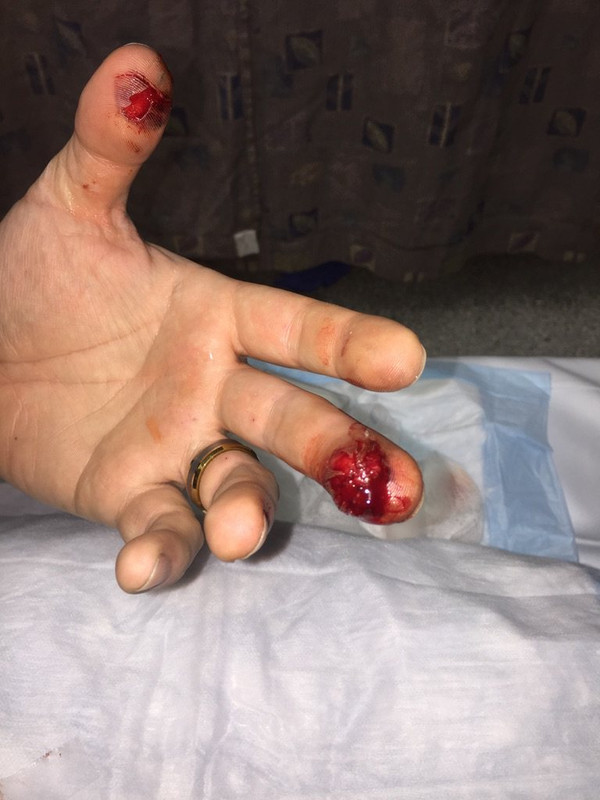
I'll see your autoprime incident and raise you an RCBS hand primer screw up. I thought I'd fix some high primers on some loaded rounds with the unit... Federal SP primers weren't having any of that... Live and learn.

 
I'll see your autoprime incident and raise you an RCBS hand primer screw up. I thought I'd fix some high primers on some loaded rounds with the unit... Federal SP primers weren't having any of that... Live and learn.

Good Gawd, but that looks nasty. You must have been holding the round on the neck, no?
Did the bullet fire far?
 
I'm noticing high primers on some of my high number of fired handloads due to my laziness of not cleaning the primer pockets.
This thread is a great reminder to not ignore things that do not seem right.
 
Just getting into reloading. Thank you for this thread. It appears that these reloading manuals are just the beginning - I have much to learn! Thank you for sharing, so the rest of us can be made aware of potential problems.
 
I'm noticing high primers on some of my high number of fired handloads due to my laziness of not cleaning the primer pockets.
This thread is a great reminder to not ignore things that do not seem right.

I have the Lee case conditioning kit and always use the primer cleaning thing in it, takes two seconds and most of the crud is gone.

But it is tedious, and for this reason I'm building a tumbler so I can do SS tumbling after sizing/depriming.
 
Or the rifle. A 'New to Me' rifle might have had the trigger worked on by someone else to the point of being occasionally unsafe and going off. Probably more likely than a primer tilted.

had a shot go over my head because of this. Friend came to the boat for pick up and as he took the safety off the gun fired. Luckily barrel was pointed up. After investigating his rifle, I found out that if you touch the trigger while the safety is on, the sear released but pin was held by safety. Once safety was released it let go of the firing pin. It got shelved for the rest of the hunt.

But yes, home smithing can also be the issue
 
Sorry if this is any sort of derail, I will add some info. I was home fixing some high primers from a batch of 10,000 9mm I had made. Sometimes while doing large batches the primer seater on my Dillon backs out a bit leaving the primers a bit high.

I had fixed this issue in the past many times by grabbing a case of beer and every few months reseating the rejects. This time around I had used Federal SP primers, they were a good deal and at my volume that really matters. About 20 minutes into the process while watching Netflix with my wife I had a ringing in my ears and an incredible pain in my hand. After realizing what had just happened I told my wife to start the Jeep and put the dogs downstairs.

5 hours later I had all the flesh stuffed back into my finger with 9 stitches to hold it in. The bullet flew across the room and bounced off the wall. My fingers absorbed what energy there was. Needless to say I don't do that sort of thing anymore. Federal primers are certainly more sensitive though... It's prudent to be overly cautious.

 
Back
Top Bottom