Faster powders for shorter barrels - say 1680 for a 16 inch 308

Status
Not open for further replies.

steelgray

Regular
Rating - 100%
37   0   0
People will tell you that Accurate 1680 is too fast for a .308 etc. BUT I say the faster stuff makes total sense for short barrel guns like a 16" 308.

I figure people should match the burn rate to the barrel length. You got a 7" AR? Go with a faster powder or you'll have a huge fireball going on at your muzzle every time you touch-off a round. Got a 9mm carbine? Think of using a slower powder than you would use for your handgun.

IMO, one of the reasons to reload is so you can make these kind of adjustments to suit your situation. Reloading manuals won't help. Use Quickl*ad.
 
Last edited:
Wrong.

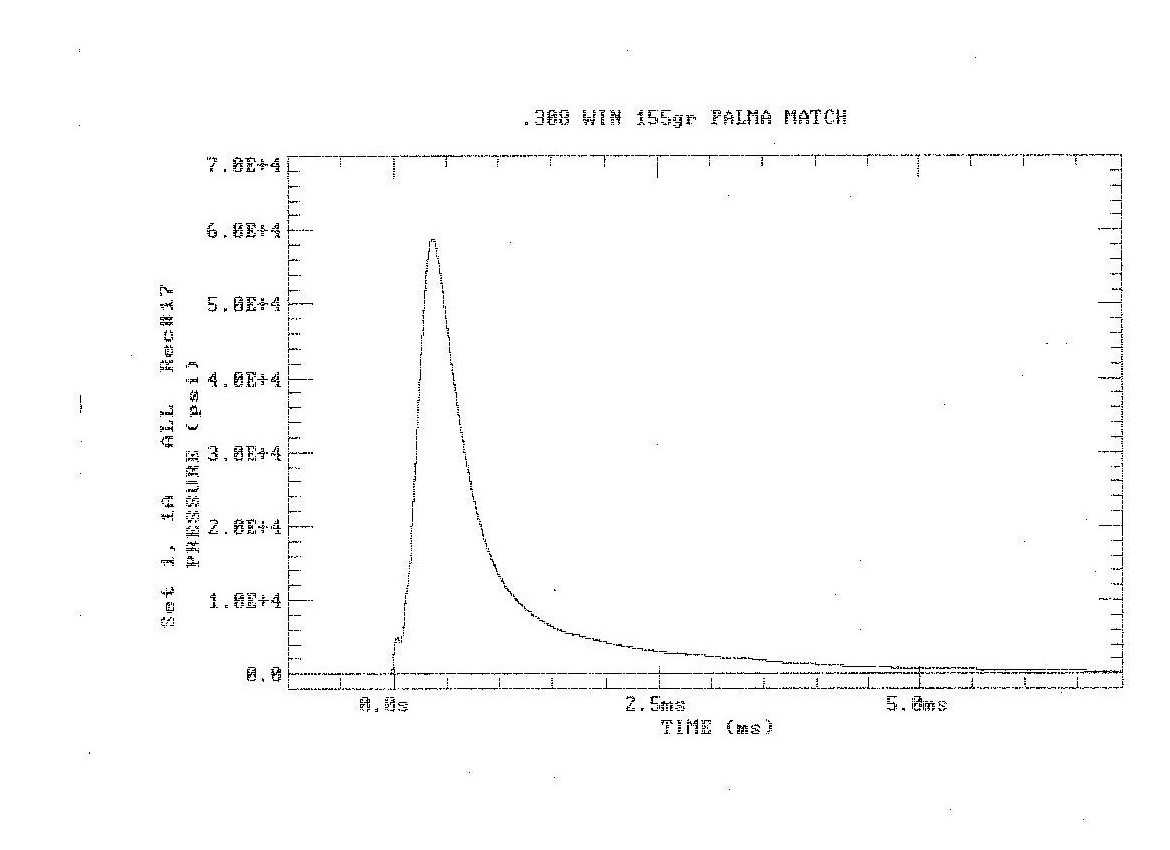
The pressure curve is very steep up and down.

Velocity is a function of max pressure and then the area under the pressure curve until the bullet exits.

Max pressure with 4895 or 1680 is the same. Say 62,000 psi

A faster powder would only mean that the pressure will drop faster, after the peak - less velocity.

The best powder for a 16" 308 is the same powder that is best in a 22" 308.

Here is one of my pressure curves for a 308 round I tested.

hoLCpt9.jpg
 
The time in the barrel with a 16" barrel would be just over 1 Ms. That means that the part of your pressure curve after that is useless - just a big bang and fireball. Here in your graph that adds up to most of the pressure curve.

Wrong.

The pressure curve is very steep up and down.

Velocity is a function of max pressure and then the area under the pressure curve until the bullet exits.

Max pressure with 4895 or 1680 is the same. Say 62,000 psi

A faster powder would only mean that the pressure will drop faster, after the peak - less velocity.

The best powder for a 16" 308 is the same powder that is best in a 22" 308.

Here is one of my pressure curves for a 308 round I tested.

hoLCpt9.jpg
 
The time in the barrel with a 16" barrel would be just over 1 Ms. That means that the part of your pressure curve after that is useless - just a big bang and fireball. Here in your graph that adds up to most of the pressure curve.

I'm going with ganderite on that one. Forgotten more about powder, than most here will ever know.
 
Ganderite is correct. The powder that achieves the best velocity in a 22" barrel, will also develop the best velocity in the 16".
There is no advantage in using a faster burning powder in a short barrel. Dave.
 
The bullet will be in the barrel longer than 1ms. Remember, it has to accelerate
from a dead stop to full velocity by the end of the barrel. Using MV to calculate
the time in the barrel is deceiving. Dave.
 
You might want to watch this.


Lots of talk here but the bottom line is that testing proves that if you shorten and 7.62x39 barrel from let's say 20 inches to 16 inches the ballistic performance is pretty well the same.

If you do the same with a 308 then the drop-off in ballistic performance is huge and, in fact, the 16 inch 308 gun performs about the same as the 16 inch 7.62X39 gun.

The video comes up short because they don't properly explain why.

The specific reason why is that the AK cartridge uses a fast enough powder that most of the pressure has been delivered to the bullet before it leaves even a 16 inch barrel. In the case of the 308 round, the slower powder which is traditionally used in this cartridge means that most of the pressure delivered to the bullet is only achieved in a longer barrel.

When you shorten the barrel in 308 gun the drop off in performance is huge because the slow burning powder is mostly wasted.

HOWEVER if you were to use a faster powder in at 308, then that 16 inch 308 gun would dramatically outperform 16 inch 7.62 by 39 gun. It's simple. All of the unburnt powder in the World does you no good at all once the bullet has left the bore. It's just good for creating a great big fireball and a huge boom and concussion that blows the shooter guy next to you on his but*.

Ever wonder why 4350 isn’t the World's greatest pistol powder. Nuff said?

Somebody does not know how to read a graph:) Ganderite has it pegged

 
Let's try this another way.

I have tested with 1680.
It was very good for a 30 Carbine and 7.62x39 and 17gr made a good reduced load for a 5.56
Much too fast for 308. Max pressure at 60,000 psi and then a very narrow curve, almost vertical on both sides. Dangerous. So if I was using a fast powder, I would not be loading to max.

Look at the graph.

hoLCpt9.jpg


You can get max pressure with any powder up to about RL-15. With heavier bullets, you can max out with a powder as slow as 4350. For maximizing velocity, you need a powder that will give you very consistent pressures at max pressure - say 62,000 psi. RL15 and Varget would be about right.

The only variable left is the slope of the curve, after max. The more area under the curve (the more gentle the curve) the higher the velocity, regardless of barrel length.

The way to develop a powder that would flatten the curve a bit is to make the powder more progressive. That is, make the powder burn slow as it builds to max, then make it burn faster after max.

Pressure builds very quickly because the cartridge is a pipe bomb until the bullet stats to move. Once it moves, the volume increases. If the bullet moves 2 inches, the volume is near double, cutting pressure dramatically. Once the volume is increasing, it would be desirable to make the powder burn faster.

Look at the shape of a kernel of powder. It is shaped like a little log. It starts burning on the outside. Max area is burning, generating max gas.

As the log burns, the surface area gets smaller, generating less gas. Less gas plus an increasing volume means a rapid drop in pressure. As you see in the graph.

So powders are coated or infused (there are various techniques) with a surface retardant, so the powder burns slowly when at max area. As the burn eats through the retardant (such as dinitrotolulene - (DNT), a cousin of TNT) the powder burns faster, so the curve does not drop as fast.

It is as if the powder starts off like 4350 and then becomes 3031.
 
Last edited:
... The only variable left is the slope of the curve, after max. The more area under the curve (the more gentle the curve) the higher the velocity, regardless of barrel length.

That is crazy. The only area under the curve that matters is the part before the time that the bullet leaves the bore!

After that we aren't talking about internal ballistics we are talking external ballistics.

Your curve goes out to 5 Ms. If you have a bullet still in the bore after 5 Ms either you have a barrel as long as a football field or you have a squib.

Do you have Quickload? Look at the data for a .224 Valkyrie load with a muzzle velocity of a bit over 2800 fps (2828 fps). The bullet leaves a 24 in barrel after about 1.232 Ms of barrel time (NOT 5 Ms) - and there is still unburned powder - even with a 24 inch barrel.

The ellipses drawn are to focus your attention on the important parts of the table.

quickload example.jpg


ql2.jpg


The powder in this example is Reloader-17. If this round was to be shot in a gun with a short barrel it would be ridiculous to use a slow powder like that.
 
Last edited:
What our friend is missing is that it is the volume, or to be more correct in the two dimensions shown in the graph, the area under the curve, where the work of producing the velocity is taking place. The steeper the graph, the lesser the area. The lesser the area under the curve, the lower the velocity.

The softer curve of a slower burning powder will obviously have more area beneath it, regardless of whether the bullet is in the barrel for one millisecond or five. The result of more work being accomplished in driving the bullet down the bore is higher velocity.

I understand his dilemma, because for years I believed the same as he does. After getting an Oehler Model 33, and using it a lot, I quickly came to understand my error. That began a journey of very basic research into understanding what was actually happening in the barrel. Correspondence with Homer Powley helped me a lot in this regard. He was actually quite eager to share his time and expertise and knowledge with a neophyte.

Ted
 
Last edited:
Once again the part of the curve after the bullet leaves the barrel is meaningless. It does, indeed, matter whether the bullet is in the bore for 1 Ms. or 5.

After the bullet leaves the bore the remaining part is curve is theoretical. That is, the "nonsense part" of the curve, representing what would have been if the bullet had still been in the bore and still subject to those pressures.... which it is not.

The theoretical part of the curve, instead, adds-up to useless muzzle blast/ report and lost energy. Besides that, you are also assuming the goal is max power. You don't actually get that per the testing in the video above - where a faster burning powder, in the 308 would, have coped better with the shortened barrel time, in the 16" gun.

In any case the objective is to have a balanced shooter - where the load is properly matched to the gun. No huge, useless fireballs please.

Do any of you guys actually have Quickload or are just not into that ballistic sciences thing?

What our friend is missing is that it is the volume, or to be more correct in the two dimensions shown in the graph, the area under the curve, where the work of producing the velocity is taking place. The steeper the graph, the lesser the area. The lesser the area under the curve, the lower the velocity.

The softer curve of a slower burning powder will obviously have more area beneath it, regardless of whether the bullet is in the barrel for one millisecond or five. The result of more work being accomplished in driving the bullet down the bore is higher velocity.

I understand his dilemma, because for years I believed the same as he does. After getting an Oehler Model 33, and using it a lot, I quickly came to understand my error. That began a journey of very basic research into understanding what was actually happening in the barrel. Correspondence with Homer Powley helped me a lot in this regard. He was actually quite eager to share his time and expertise and knowledge with a neophyte.

Ted
 
It doesn't work like that as already noted by the experts here. But if you are getting big ass fireballs out of a 16" barrel in 308, choose a different powder. I don't know what you are using, but the majority of powders have a flash retardant component to them. I've run full house loads in both my 223 and 308 with Varget/4064/IMR4895 and no fireballs. Nork 223 seems to be the ticket if you like them through, also have some Greek 30'06 that is ridiculous...6 foot flame out of a Grand and 1917.
 
Once again the part of the curve after the bullet leaves the barrel is meaningless. It does, indeed, matter whether the bullet is in the bore for 1 Ms. or 5.

After the bullet leaves the bore the remaining part is curve is theoretical. That is, the "nonsense part" of the curve, representing what would have been if the bullet had still been in the bore and still subject to those pressures.... which it is not.

The theoretical part of the curve, instead, adds-up to useless muzzle blast/ report and lost energy. Besides that, you are also assuming the goal is max power. You don't actually get that per the testing in the video above - where a faster burning powder, in the 308 would, have coped better with the shortened barrel time, in the 16" gun.

In any case the objective is to have a balanced shooter - where the load is properly matched to the gun. No huge, useless fireballs please.

Do any of you guys actually have Quickload or are just not into that ballistic sciences thing?

All of the powder is burnt, and peak pressure achieved within the first couple inches of the barrel... regardless of the powder used.
 
Not so. This example shows that even using 1680, in .300 Blkout, in a 16.5" barrel with a 220 grain bullet leaves 16.2% unburned powder (ie., amount of burnt propellant = 84.8%).

Follow this link to load data results (click here)

The suggestion made here stunning.

You self proclaimed "experts here" are asserting, universally, that "The softer curve of a slower burning powder will obviously have more area beneath it, regardless of whether the bullet is in the barrel for one millisecond or five".

If so, why isn't 4350 the World's best pistol powder?

The World of reloading revolves around matching burn rates and powder volumes to cartridges sizes, bullets diameters weights and BARREL lengths.

All of the powder is burnt, and peak pressure achieved within the first couple inches of the barrel... regardless of the powder used.
 
Last edited:
Status
Not open for further replies.
Back
Top Bottom