I want a military crimp. Help Please

Moe

CGN Ultra frequent flyer
Rating - 100%
48   0   0
Location
Fredericton
I have a revolver that pops primers out enough (regardless of load) to jam the action from turning easy. This happens regardless of brass used and only happens with soft primers like Federal.

When I use hard primers like CCI this does not happens but then I get a lot of misfires in double action, even with the main spring cranked up.

I was thinking if I could find a way to crimp the primer pockets after priming like military ammo, then that might work. I haven't been able to find anything yet. I have not tried primer sealer or nail polish but I doubt those will work.

So is there a die or other tool that can do this for a 38/357?

Thanks
Moe
 
You have a problem with headspace , cylinder play or if it is a single action - pacemaker style - it can be fixed by gently stoning the breachface were the hangup mostly happen because of rough edges. condition should be fixed. Get a gunsmith to look at it. Not normal at all.
There is no military style primer crimp tool that I am aware off and I have been at it for 45 years..
 
Last edited:
What make and caliber revolver? Are you shooting hot loads? How many times has the brass been fired? Have you replaced or adjusted your hammer spring? If you have a Smith & Wesson is the strain screw in the grip tight? Is the revolver new or did you buy it used? Did anyone do any "action work" to lighten the trigger pull. The only time I had your problem was when I changed springs to lighter ones. Meaning it was my fault and screw up that the handgun misfired. :bangHead:

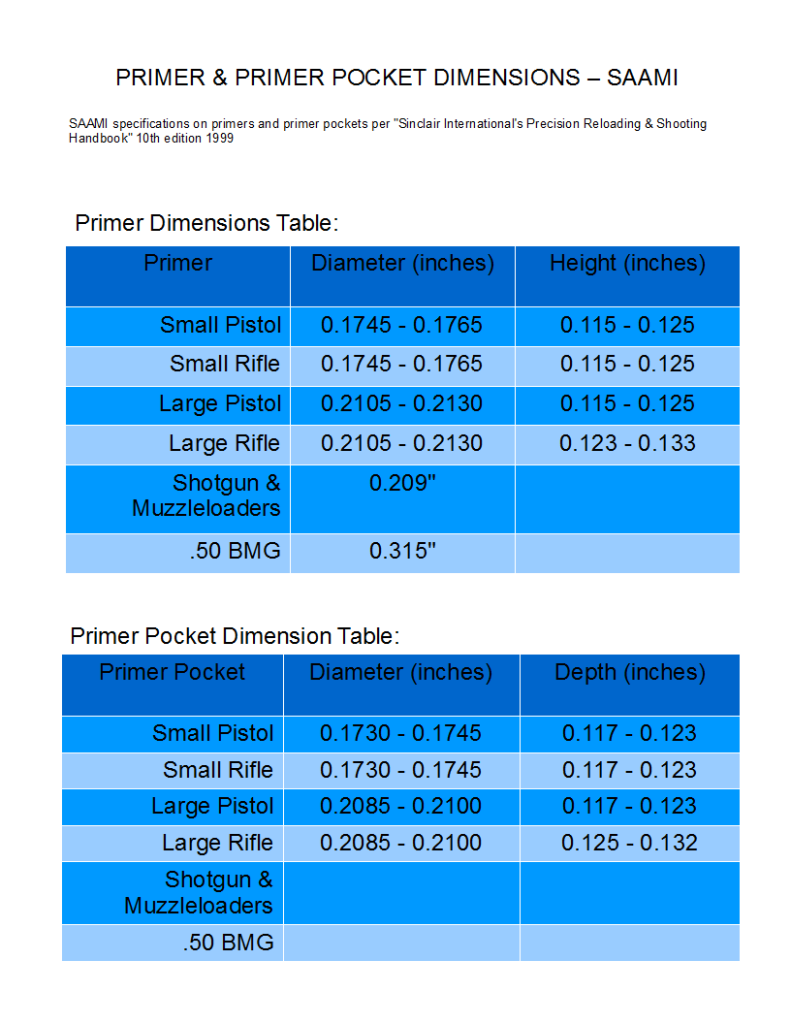
At the link below small pistol primers have a cup thickness of .017 and large pistol primers have a cup thickness of .020.

CHOOSING THE RIGHT PRIMER - A PRIMER ON PRIMERS
http://www.sksboards.com/smf/index.php?topic=56422.0

BlerqTB.png
 
What make of revolver?

What make and caliber revolver? Are you shooting hot loads? How many times has the brass been fired? Have you replaced or adjusted your hammer spring? If you have a Smith & Wesson is the strain screw in the grip tight? Is the revolver new or did you buy it used? Did anyone do any "action work" to lighten the trigger pull. The only time I had your problem was when I changed springs to lighter ones. Meaning it was my fault and screw up that the handgun misfired. :bangHead:

Thanks Guys. S&W K Frame 357, Light 38's to medium 357's. All makes of brass with 1 to 5 reloading for mileage. I have been on the original spring but it is noticeably heavy. Strain crew is maxed and I even tried a spent primer cup under the screw for more strength. It's my uncles gun made in the 60's and he is giving it to me soon. No action work other than the trigger/hammer was stoned at some point professionally.

The hammer clearly is a light strike in DA with hard primers and the soft primers work in DA but back out enough to drag on the gun impeding rotation. This is annoying. At the moment I am just reloading for it with hard CCI primers and shooting SA only. He never noticed this in the 40+ years he had the gun because he never fired it in DA! I appreciate the help.

Cheers
Moe
 
Last edited:
since it's not pressure related in ammo, the springs are all good and adjusted to a heavier trigger pull/lbs - right?

Since its been shot alot, pop out the hammer firing pin and replace the firing pin on the hammer. Or, if that's not worn, I would say theres a headspacing issue, and its finite- small. That's what comes to mind. With no other info - and/or based on the info, That's the 2 cents.

Had the worn firing pin issue on a PPC gun based on a Model 14, regularly replaced springs and ongoing timing/tuned - thruout over 55k rounds. Was kinda hard to believe, Drove me nuts figuring this one out. That's the only issue really I ever had with high mileage..... and then usual high mileage cylinder play after 50k. Parted it out after over 70K, it was my main PPC gun 80s and 90s.
 
Last edited:
I will assume the firing pin is in the hammer and you have no transfer bar. Does the firing pin extend far enough through the frame, measure the protrusion using feeler gauges.
Place resized cases in the cylinder then close, place feeler gauges under the case heads and find out how much air space or headspace you have in thousandths.
If this is excessive the cylinder can be shimmed that moves it to the rear decreasing headspace.

When was the last time the revolver was cleaned extremely well and blasting out the action with Gun Scrubber or any pressurized cleaner?

You would be amazed if you know the proper way to remove the side plate how much dirt can get into the action. You never pry the side plate off, you lightly hit-tap the opposite side with a plastic hammer. Protect this side with a thick rag or a piece of leather and tap until the side plate come loose. Again do not pry on the side plate this will ding the upper corner of the side plate.
 
I will assume the firing pin is in the hammer and you have no transfer bar. Does the firing pin extend far enough through the frame, measure the protrusion using feeler gauges.
Place resized cases in the cylinder then close, place feeler gauges under the case heads and find out how much air space or headspace you have in thousandths.
If this is excessive the cylinder can be shimmed that moves it to the rear decreasing headspace.

When was the last time the revolver was cleaned extremely well and blasting out the action with Gun Scrubber or any pressurized cleaner?

You would be amazed if you know the proper way to remove the side plate how much dirt can get into the action. You never pry the side plate off, you lightly hit-tap the opposite side with a plastic hammer. Protect this side with a thick rag or a piece of leather and tap until the side plate come loose. Again do not pry on the side plate this will ding the upper corner of the side plate.

Had the gun apart and replaced the rebound spring with a lighter one. Didn't help.
Measured the firing pin (hammer nose) protrusion and it was in spec but just. Replaced and no change resulted.
Gave it a thorough cleaning and re-lubed. No change.
Had a gunsmith look at it. He sees nothing wrong. Suggested new hammer nose, thorough cleaning, and crank up main spring. :(

Cheers
Moe
 
Does it happen with factory ammo too?

Only factory ammo I had available was S&B 158 38 SPC. This stuff is hot for not being marked +P. It would not pop primers but only would fire in DA 4 out of 6 times on average. I have some hot defensive 357 Mag factory stuff but I don't want to try it until I get this issue sorted out.

Cheers
Moe
 
I got a dumb idea. Think I might try it just to see. Coat the primer outside wall or the wall of the primer pocket with red Locktite. I know I know. The brass would be one time use, but I wonder.

Cheers
Moe
 
I got a dumb idea. Think I might try it just to see. Coat the primer outside wall or the wall of the primer pocket with red Locktite. I know I know. The brass would be one time use, but I wonder.

Cheers
Moe

Try the green Retaining compound locktite. the primers should still be able to be removed in the press no problem. Same with the red stuff the press would still be able to punch out the spent primers
 
Are the primers actually backing out or is the primer material around the firing pin strike flowing
Back into the firing pin bushing hole ?

I know the L FRAME model 686 had this problem in the 80’s that would bind up the cylinder easily, that was under recall

I know you stated that you have a K frame, but something similar is happening ?
 
Take off the grips & back off the strain screw enough to take out the hammer spring.
Examine the long hammer spring & note the bend.
Put the hammer spring into a vise, bottom first & secure. Use a small hammer & hit the spring until the bend is gone & the spring is straight.
Re-install & screw the strain screw all the way in. Test fire.
 
Try the green Retaining compound locktite. the primers should still be able to be removed in the press no problem. Same with the red stuff the press would still be able to punch out the spent primers

OK. I might pick up both to see.

Thanks.

Are the primers actually backing out or is the primer material around the firing pin strike flowing
Back into the firing pin bushing hole ?

Bit of both I think.

I know the L FRAME model 686 had this problem in the 80’s that would bind up the cylinder easily, that was under recall

I know you stated that you have a K frame, but something similar is happening ?

Good to know. I had a 586 and didn't see it with that gun.

Take off the grips & back off the strain screw enough to take out the hammer spring.
Examine the long hammer spring & note the bend.
Put the hammer spring into a vise, bottom first & secure. Use a small hammer & hit the spring until the bend is gone & the spring is straight.
Re-install & screw the strain screw all the way in. Test fire.

I will consider that. Before I try it I will just borrow one form one of my other K frames to try first.

Thanks.

@Moe. Does the mainspring have a crease through the center? That would be a competition, lighter spring. If so, replace it with a factory or Wolffe unit.

Yea it has the crease. Hmmm maybe I need to consider a new spring.

Thanks
Moe

 
@Moe, before you go for a replacement spring, place a piece of 0.010" brass shim between the mainspring and the strain screw, tighten the screw down until it seats and shoot it.

Let us know.
 
Most of us shooting light 38 specials in CAS have learned to use a firm roll crimp with our cast lead bullets. When the primer ignites the powder it pushes the primer back and the case moving backwards reseats the primer when it hits the recoil shield. The firm crimp helps increase the pressure and you will get a more consistent burn. The other thing you might try is to increase your powder but i'm using 2.8grof tight group with a 105 gr cast lead bullet and as long as I make sure that I have a firm Roll crimp they work fine. crimp lightly and I get misfires and locked up guns.
 
Back
Top Bottom