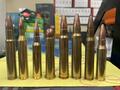
I could never help but notice that ugly bulge on my 45-70 cases when shooting cast bullets, and also couldn't help but notice that some cases had more bulge on one side of the case then the others, obviously the bullet was not seating straight, but heck I was still getting 2.5 MOA with a 4 power scope......
So I stepped up the game and bought a single shot rolling block, went down the rabbit hole and started doing a LOT of reading, I read about black powder, short sizing dies, no sizing dies and then I stumbled onto a post about partial neck sizing, but wait, there really isn't a neck on a 45-70, or any straight walled case for that matter, so I read it, not once but twice, made some adjustments to my dies and loaded some 350 grain cast for the 1895 SBL, 8 shots landed under an inch and a half at 100 yards.......4 power scope.....it's never shot like this, no weird fliers, no split groups, just a nice round tight group........so now your wondering how??? tell us how dammit......
First thing I did was took a fired piece of brass and had a good look at it, hmmm part of my crimp is still there, the case isn't perfectly ironed out, and I need a good measurement of the inside of the case to work from, so I ran it into my belling die and slightly flared the mouth. Next I lifted my full length sizing die way up, ran the case all the way up with the ram and then screwed the die down until I just felt it touch the case, then a bit more. I removed the case and measured the inside of the case with the calipers, 0.466, from there I slowly lowered the die down until the case mouth measured 0.456, 2 thou less then my 0.458 cast bullet, I locked the die in the press and lowered the decapping assembly with the hopes I could still deprime while sizing, as luck would have it I had 2 threads to spare on the RCBS full length die.
The sizing was effortless, I used way less lube then I had needed in the past while running down to the shell holder, not knowing if this was going to work I swapped dies and but the expander die in and slowly ran a case into the die, I could still feel the expander make contact with the case, could feel that contact right to the top of the stroke, hmmm......better seat a bullet and check, always need dummy rounds with no primers, so I seat a bullet, I could feel the bullet slide into the case from the bell to the taper crimp....okay......inspected the loaded dummy round, no bulge.....just a very ###y looking loaded round, held it firm in my hand and hit down bullet first into the loading bench......crimp is holding, no bullet setback......I better load some more and actually shoot them......and so I did.......and they shot better then anything I had loaded and shot before......there is far less sizing of the case, no work hardening....my brass is going to love me and last much much longer......my cast bullet targets are worthy of hanging on the wall to admire for days to come.....for the first time in almost 30 years of pulling the handle on a rock chucker press I learnt something.......I was again the student and not the teacher.........that was cool, and only means one thing......it's my turn to teach again.....so here I am passing on this wonderful bit of information to the masses, please join in with me and lift those sizing dies on the straight walled cases, there is no need to over work that expensive brass.........
So I stepped up the game and bought a single shot rolling block, went down the rabbit hole and started doing a LOT of reading, I read about black powder, short sizing dies, no sizing dies and then I stumbled onto a post about partial neck sizing, but wait, there really isn't a neck on a 45-70, or any straight walled case for that matter, so I read it, not once but twice, made some adjustments to my dies and loaded some 350 grain cast for the 1895 SBL, 8 shots landed under an inch and a half at 100 yards.......4 power scope.....it's never shot like this, no weird fliers, no split groups, just a nice round tight group........so now your wondering how??? tell us how dammit......
First thing I did was took a fired piece of brass and had a good look at it, hmmm part of my crimp is still there, the case isn't perfectly ironed out, and I need a good measurement of the inside of the case to work from, so I ran it into my belling die and slightly flared the mouth. Next I lifted my full length sizing die way up, ran the case all the way up with the ram and then screwed the die down until I just felt it touch the case, then a bit more. I removed the case and measured the inside of the case with the calipers, 0.466, from there I slowly lowered the die down until the case mouth measured 0.456, 2 thou less then my 0.458 cast bullet, I locked the die in the press and lowered the decapping assembly with the hopes I could still deprime while sizing, as luck would have it I had 2 threads to spare on the RCBS full length die.
The sizing was effortless, I used way less lube then I had needed in the past while running down to the shell holder, not knowing if this was going to work I swapped dies and but the expander die in and slowly ran a case into the die, I could still feel the expander make contact with the case, could feel that contact right to the top of the stroke, hmmm......better seat a bullet and check, always need dummy rounds with no primers, so I seat a bullet, I could feel the bullet slide into the case from the bell to the taper crimp....okay......inspected the loaded dummy round, no bulge.....just a very ###y looking loaded round, held it firm in my hand and hit down bullet first into the loading bench......crimp is holding, no bullet setback......I better load some more and actually shoot them......and so I did.......and they shot better then anything I had loaded and shot before......there is far less sizing of the case, no work hardening....my brass is going to love me and last much much longer......my cast bullet targets are worthy of hanging on the wall to admire for days to come.....for the first time in almost 30 years of pulling the handle on a rock chucker press I learnt something.......I was again the student and not the teacher.........that was cool, and only means one thing......it's my turn to teach again.....so here I am passing on this wonderful bit of information to the masses, please join in with me and lift those sizing dies on the straight walled cases, there is no need to over work that expensive brass.........