












































You are using an out of date browser. It may not display this or other websites correctly.
You should upgrade or use an alternative browser.
You should upgrade or use an alternative browser.
Why is an Upland stock shaped angular ?
- Thread starter crossroads45
- Start date
If you mean straight english style grip? Speed and handling for shooting flying game. Its lighter keeping more weight between the hands and allows the hand to operate triggers much more easliy
Since most shotguns are used for ducks and geese, why are there so few of these stocks around ? and they always seem paired with shorter barrels like 22 or 24 inch
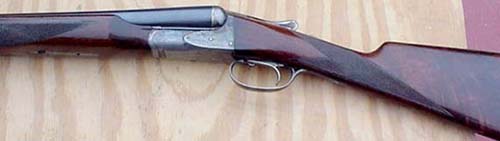

Since most shotguns are used for ducks and geese, why are there so few of these stocks around ? and they always seem paired with shorter barrels like 22 or 24 inch
You have pictured a AH Fox A grade from the classic era of SxS shotguns, with unusually, a single trigger. It has an English (straight) stock and a beavertail forend, almost an oxymoron. Straight stocks typically are used on light, fast handling guns with double triggers, although traditionally they were never used on guns with barrels lengths as short as 22" or 24" inches. And they are just about always matched with a slim splinter forend. Aside from the theoretical fast handling characteristics of a English stock, it is said the straight stock makes sliding the hand back to use the second trigger easier and more natural. And finally, and this is not to be discounted, in the English world where they originated, design aesthetics were and are important. And many feel the straight stock and splinter forend creates a more elegant overall appearance. Beavertail forends (sometimes referred to as "Plug Ugly" or "Boat Paddle-like.
 ) are more typically used on heavier guns where more control is desired, along with a full pistol grip.
Ducks and geese typically require heavier loads be used, creating more recoil. A gun designed for heavier loads typically is a more robust gun. Recoil is managed through overall weight and by giving the shooter something to hang on to.....the pistol grip. A duck and goose gun is more often used on bigger tougher birds (than most upland) at greater distances. Long shots where the longer barrels will help with swing follow through. Upland, is typically a smaller, more easily killed bird (think ruffed grouse) that can be shot with much lighter loads and is typically shot at closer distances. More of a fast, instinctive point and shoot kind of shot. While not everyone agrees, many like the shorter barrels for that kind of quick shooting.
Last edited:
Since most shotguns are used for ducks and geese, why are there so few of these stocks around ? and they always seem paired with shorter barrels like 22 or 24 inch
The real reason for the Straight, English or Upland stock is double triggers. For the better part of the time humans have been using gunpowder to sling shot at game the most effective and reliable way to get a repeat shot was a second barrel with a load in it. Even better if the second barrel had a seperate firing mechanism not dependent on the other barrel firing first. So what we ended up with was a double gun with two triggers and for a long time two manually cocked hammers. Trust me when I say having 2 fingers inside the trigger guard on both triggers dramatically increases the odds of the gun doubling and you hurting yourself. It is faster and more comfortable to slide the hand back to the second trigger then with a Prince of Wales or Pistol grip. It persists on primarily out of fashion and tradition, not to say it doesn't have merit contrary to our benevolent overlords I don't feel the need to critique what works for someone else.
Most shotguns are probably used to ground swat the occasional tasty or bothersome critter that needs sorting out or for breaking clays. Straight stocks fell from general favor here in NA about 1910 that is why you see so few. Upland hunters particularly the purists chasing quail, woodcock and ruffed grouse can be a fickle and odd bunch in general but enough of them have money and were buying enough guns for a period that manufactures gave in to their desires. Barrels shorter than 26" are for ease of moving through a thickly overgrown old apple orchard on a crisp, clear New England fall morning hoping your pointing dog will lock up in that classic stylish point and you'll be able to get a quick accurate snap shot off at a rapidly departing blur of feathers as you step a head of him(or her, they can be very fussy about this too) ideally the shot connects and the timberdoodle(woodcock) or ruffed grouse(pa'tridge) tumbles to the ground and your four legged company makes a perfect retrieve to you.
Last edited:
Why the BPS, and citori are offered in short barrels and straight grips is a head scratcher to me those 2 guns particularly the 12 gauge versions are heavy and ill suited to upland work.
You and me both. Fashion reasons I suspect. Demand by people who don't really understand why.
I will note that your apparent disdain for upland hunters shooting birds on the wing with classic vintage English stocked SxS over setters (please see my avatar) seems needlessly hostile. LOL
In all seriousness (because the above isn't serious) I grew up hunting waterfowl in Manitoba. Spent 25 years doing mostly that. I've spent the last 20 years mostly chasing upland across NA, Canada and the US. While I have seen some ground swatting, the vast majority of animals I have seen taken with shotguns and pellets were birds on the wing. I suspect you're exaggerating the proportion of ground swatting that takes place. As far as birds goes, it's mostly done on ruffed and spruce grouse.
Last edited:

One other reason I read somewhere and believe has some merit is, the strait grip is easier to hold when the gun is at “port arms” or straight up with one hand as you push the limbs out of your way. Anyone who has hunted woodcock over a good pointer knows you have to do the flushing most times.
I don’t own “good” pointers. They almost always crowd the bird to a flush...so I get by with a pistol grip LOL
I don’t own “good” pointers. They almost always crowd the bird to a flush...so I get by with a pistol grip LOL
You have pictured a AH Fox A grade from the classic era of SxS shotguns, with unusually, a single trigger. It has an English (straight) stock and a beavertail forend, almost an oxymoron. Straight stocks typically are used on light, fast handling guns with double triggers, although traditionally they were never used on guns with barrels lengths as short as 22" or 24" inches. And they are just about always matched with a slim splinter forend. Aside from the theoretical fast handling characteristics of a English stock, it is said the straight stock makes sliding the hand back to use the second trigger easier and more natural. And finally, and this is not to be discounted, in the English world where they originated, design aesthetics were and are important. And many feel the straight stock and splinter forend creates a more elegant overall appearance. Beavertail forends (sometimes referred to as "Plug Ugly" or "Boat Paddle-like.
Ducks and geese typically require heavier loads be used, creating more recoil. A gun designed for heavier loads typically is a more robust gun. Recoil is managed through overall weight and by giving the shooter something to hang on to.....the pistol grip. A duck and goose gun is more often used on bigger tougher birds (than most upland) at greater distances. Long shots where the longer barrels will help with swing follow through. Upland, is typically a smaller, more easily killed bird (think ruffed grouse) that can be shot with much lighter loads and is typically shot at closer distances. More of a fast, instinctive point and shoot kind of shot. While not everyone agrees, many like the shorter barrels for that kind of quick shooting.
Do you really move your hand while changing triggers ?


As do I...my hand slides back a bit
Mine, too.
Full disclosure: In my mind, a hand-detachable sidelock double with double triggers, straight stock, and a splinter fore arm is the epitome of shotgun design. I only use single trigger pistol grips for clays competitions.
I wanted to add that I have discovered the importance of keeping your elbow up on the trigger arm. In other words, keeping the right elbow up if you're right handed. You hear and read volumes about technique, especially as applied to competition shooting, but it almost never includes this point. For straightaway shots where no turning of the body is needed, it's not important. But, for any shot where twisting to the right (for right-handed shooters), if your elbow is low - closer to your waist than your shoulder - you will pull the gun down as you swing to the right. Keeping the elbow up prevents this issue and straight stocks promote keeping the elbow up because of the wrist position. This wrist position may be the reason some folks don't like straight stocks.
When I first encountered this concept, I had to consciously remember to keep my elbow up. After years of this, it's now instinctive. No question my shooting success has improved because of it and it's one more reason I will probably never buy another pistol grip or Prince of Wales gripped gun again. Those gd-awful beavertail fore ends will never find their way into my safe, either.

You and me both. Fashion reasons I suspect. Demand by people who don't really understand why.
I will note that your apparent disdain for upland hunters shooting birds on the wing with classic vintage English stocked SxS over setters (please see my avatar) seems needlessly hostile. LOL
In all seriousness (because the above isn't serious) I grew up hunting waterfowl in Manitoba. Spent 25 years doing mostly that. I've spent the last 20 years mostly chasing upland across NA, Canada and the US. While I have seen some ground swatting, the vast majority of animals I have seen taken with shotguns and pellets were birds on the wing. I suspect you're exaggerating the proportion of ground swatting that takes place. As far as birds goes, it's mostly done on ruffed and spruce grouse.
I think your edit hit the nail on the head. Ground swatting is common for truck hunters while big game hunting. The purists wouldn't consider that sporting, on the wing or not at all.
Mine, too.
Full disclosure: In my mind, a hand-detachable sidelock double with double triggers, straight stock, and a splinter fore arm is the epitome of shotgun design. I only use single trigger pistol grips for clays competitions.
I wanted to add that I have discovered the importance of keeping your elbow up on the trigger arm. In other words, keeping the right elbow up if you're right handed. You hear and read volumes about technique, especially as applied to competition shooting, but it almost never includes this point. For straightaway shots where no turning of the body is needed, it's not important. But, for any shot where twisting to the right (for right-handed shooters), if your elbow is low - closer to your waist than your shoulder - you will pull the gun down as you swing to the right. Keeping the elbow up prevents this issue and straight stocks promote keeping the elbow up because of the wrist position. This wrist position may be the reason some folks don't like straight stocks.
When I first encountered this concept, I had to consciously remember to keep my elbow up. After years of this, it's now instinctive. No question my shooting success has improved because of it and it's one more reason I will probably never buy another pistol grip or Prince of Wales gripped gun again. Those gd-awful beavertail fore ends will never find their way into my safe, either.
I agree with the hand, wrist and arm position promoted by a straight stock. I have shot pistol grip double triggers (one was my main duck gun for several years) and had no problem sliding my hand back for the second trigger. I found no advantage to trigger control with a straight stock. I find an enormous difference firing from awkward stances at fast targets with a straight stock. Darn things seem to wait until I am half way over a fallen tree and flush partially behind me.
My English stocked SXSs are now single trigger. In all my years of upland hunting I have never fired the left barrel first in a hunting situation. There might have been a handful of times that I maybe should have out of 1000s of flushes. I have double pulled on the front trigger a few times when using a two trigger set up because of shooting a lot of waterfowl with the autoloader in the days leading up.
I greatly prefer striaght grip and 2 triggers on a sxs but ill admit i just got a 410 for my daughter to grow up to amd its a pow grip with a single trigger and well. Im actually really likely it
Next will be a 28ga or 16ga english stock with dual triggers though
Next will be a 28ga or 16ga english stock with dual triggers though
Attachments

This has been a very informative thread!
There is just something very classy about the straight grip sxs shotgun that appeals to me. Had been pondering the difference between the single/double trigger idea. Being a lefty though, I am wondering if the double triggers are going to be an issue at all?
I am looking at something in a 28 ga as I am growing very fond of that gauge for the upland birds that I mostly hunt, but do hope to hunt pheasant someday. It seems like good loads with #5 should be sufficient.
The other shotgun I have seen with the straight grip that really appealed to me is the Ithaca Model 37 with straight grip and AA wood, in 28 gauge. That is a beautiful gun too, although not quite as classic as the sxs.
There is just something very classy about the straight grip sxs shotgun that appeals to me. Had been pondering the difference between the single/double trigger idea. Being a lefty though, I am wondering if the double triggers are going to be an issue at all?
I am looking at something in a 28 ga as I am growing very fond of that gauge for the upland birds that I mostly hunt, but do hope to hunt pheasant someday. It seems like good loads with #5 should be sufficient.
The other shotgun I have seen with the straight grip that really appealed to me is the Ithaca Model 37 with straight grip and AA wood, in 28 gauge. That is a beautiful gun too, although not quite as classic as the sxs.
Those 28ga ithacas are expensive. I would like one as well.
Before my shoulder injury i coukd shoot my sxs guns with dual triggers left handed. The triggers didnt screw me up its being right eye dominate and closing my right eye that i had trouble with. The dual triggers are often offset but still close enough to center. Instead of simply sliding your finger from one to the next you may have curl it back and tuck it behind the front trigger. A neutral cast would likely be of benifit as well. As with al shotguns fit is most important. Im truly hoping my daughter will end up right eye dominate. It will make my life easier for sure
Before my shoulder injury i coukd shoot my sxs guns with dual triggers left handed. The triggers didnt screw me up its being right eye dominate and closing my right eye that i had trouble with. The dual triggers are often offset but still close enough to center. Instead of simply sliding your finger from one to the next you may have curl it back and tuck it behind the front trigger. A neutral cast would likely be of benifit as well. As with al shotguns fit is most important. Im truly hoping my daughter will end up right eye dominate. It will make my life easier for sure
I hunt upland birds exclusively with English stocked, splinter fore end, two trigger shotguns. I find them ideal, as they are light, balance well, and I have the instant choice of two chokes, just by choosing which trigger to pull. I probably use the front trigger, and IC choke 90% of the time for single birds, but I do choose the IM choke when I don't have a safe shot at first, and have to wait until the bird is farther out by the time the shot presents itself. Some people switch the barrel selector to change chokes, but I have seen multiple instances where the selector went into safe, or hung up, and the result was a lost shot opportunity. And with a two trigger sidelock shotgun, you have two independent firing mechanisms, in case there is ever a trigger issue. When shooting quick doubles, I don't really notice if my hand moves, but it does move slightly when I consciously decide to use the other trigger.

You and me both. Fashion reasons I suspect. Demand by people who don't really understand why.
That probably describes me. I kind of prefer the feel of a smaller english stock when I'm hiking around all day and don't much mind if it is on a O&U. No doubt I don't handle the gun better or faster than if it was a pistol grip. Would love a little SxS but have yet to find an affordable one with chokes that fits me.





















